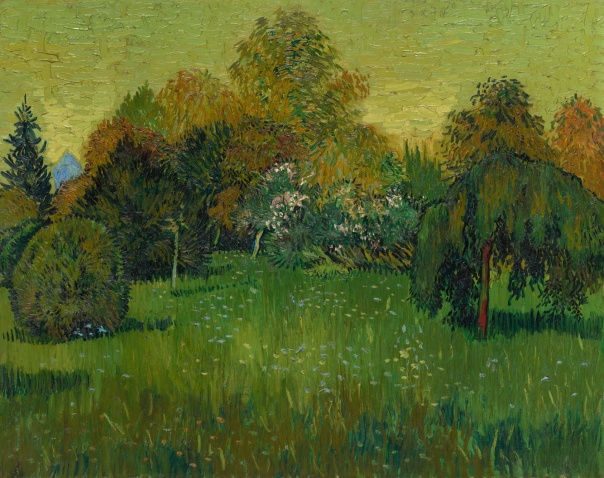
One night as Dick lay half asleep, Into his drowsy eyes A great still light began to creep From out the silent skies. It was the lovely moon’s, for when He raised his dreamy head, Her surge of silver filled the pane And streamed across his bed. So, for a while, each gazed at each — Dick and the solemn moon — Till, climbing slowly on her way, She vanished, and was gone.
-Walter de la Mare
Ivan Marchuk, The Houses Are Illuminated by the Moonlight
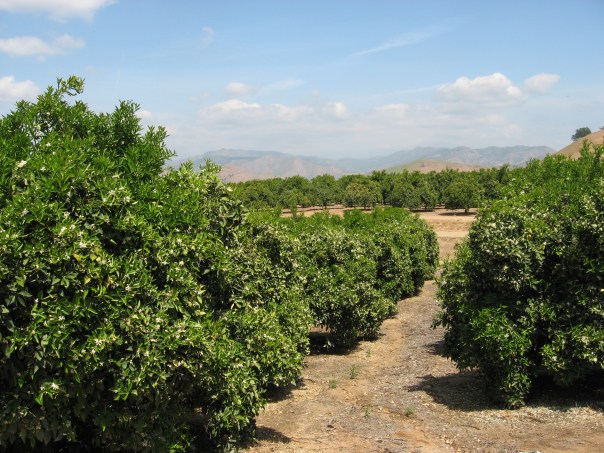
Back in the day when I lived with my family in farm country, in the midst of miles and miles of citrus orchards, my siblings and I would ramble through the groves, ours and our neighbors’, and along the private dirt roads dividing the properties from each another. All the kids did this, and no one ever suggested we were trespassing.
Once we came upon a small and shabby house with its doors and windows open, and obviously abandoned. We dared to go in, and walked through the rooms, which still contained furniture such as a kitchen table with dried up food on plates, other unwashed dishes in the sink, and personal belongings lying about. We didn’t stay long, it was too creepy, but my imagination was stirred from then until now, wondering what story lay behind the disorder. What would prompt the residents to leave without finishing dinner, and never come back? Why had no one bothered to come and clean up the mess, and make the place livable again?
That house didn’t show signs of having been beautiful at any time, but under different circumstances, it might have been. It remains for me a disturbing memory, for all the sad stories it might have been hinting at, but also because of the physical ugliness that stood as a witness to chaos. In all likelihood it has been leveled to the ground long since, and orange trees planted in its spot. I wonder if anyone else remembers it.
The poem below tells of a much richer and more nuanced experience and story. The poet Frederick Goddard Tuckerman was stricken when his wife died after the birth of their third child, and felt that as the father of the child he was somewhat guilty. Most of his poems after her death express these feelings of loss, loss of home and of the woman as the center of family life. One commentator suggests that the description of the mother, twice using the word “sat,” indicates her being frozen in time as a memory.
SONNET XVI (“Under the mountain”)
Under the mountain, as when first I knew Its low black roof, and chimney creeper-twined, The red house stands; and yet my footsteps find Vague in the walks, waste balm and feverfew. But they are gone; no soft-eyed sisters trip Across the porch or lintels; where, behind, The mother sat, — sat knitting with pursed lip. The house stands vacant in its green recess, Absent of beauty as a broken heart; The wild rain enters; and the sunset wind Sighs in the chambers of their loveliness, Or shakes the pane; and in the silent noons, The glass falls from the window, part by part, And ringeth in the grassy stones.
-Frederick Goddard Tuckerman
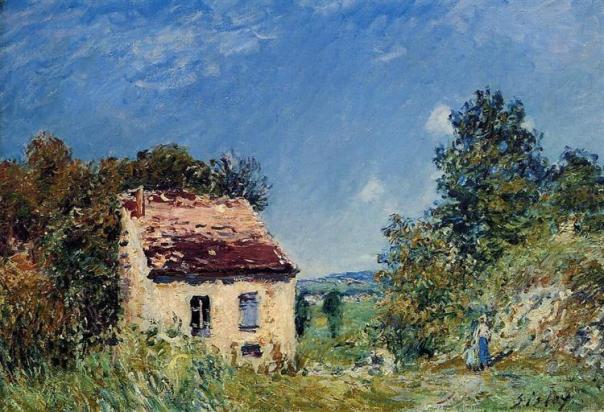
Alfred Sisley, Abandoned House
Thanks to Sally Thomas for sharing this poem on her Substack page last month.
’Tis said our monarch’s liberal mind Is like the ocean unconfined. Happy are they who prove it so; ’Tis not for me that fact to know: I’ve plunged within its waves, ’tis true, But not a single pearl could view.
-Ferdowsi (Abu ʾl-Qasim Ferdowsi Tusi) (935 – 1020) Iran
This poem made me curious about the particular sultan Ferdowsi was referring to, so I poked around. The poet lived in Medieval Iran, and from this detailed Wikipedia list of the Monarchs of Iran, it must have been Mahmoud of Ghazni he was writing about. I learned from another site more about the backstory of this cleverly insulting verse, how it is an example of the relationship challenges between artists and their patrons going back centuries:
“In addition to his military prowess, Mahmud was also a patron of learning and the arts, and Ghazni became a cultural center second only to Baghdad. The great Persian poet Ferdowsi presented his epic poem the Shanameh (Book of Kings) to Mahmud in 1010 CE. Although the Shahnameh is recognized as the greatest and most influential work of Persian literature, Mahmud was not so impressed, and instead of paying Ferdowsi the promised one gold dinar per couplet, instead only gave him a silver dirham per couplet. Despite this unfortunate incident, Mahmud is nonetheless considered a great patron of the arts.”
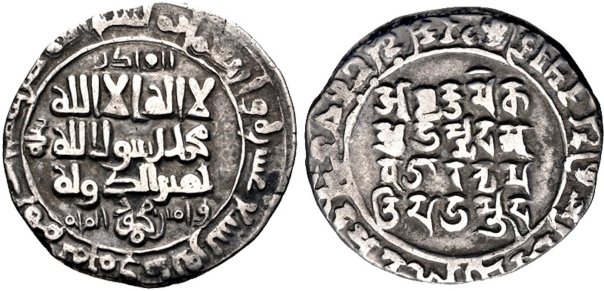
Below are examples of the bilingual coins used during Mahmud’s reign, with Arabic on one side and Sanskrit on the other: