Tag Archives: G.K. Chesterton

Carpets fresh and clean.

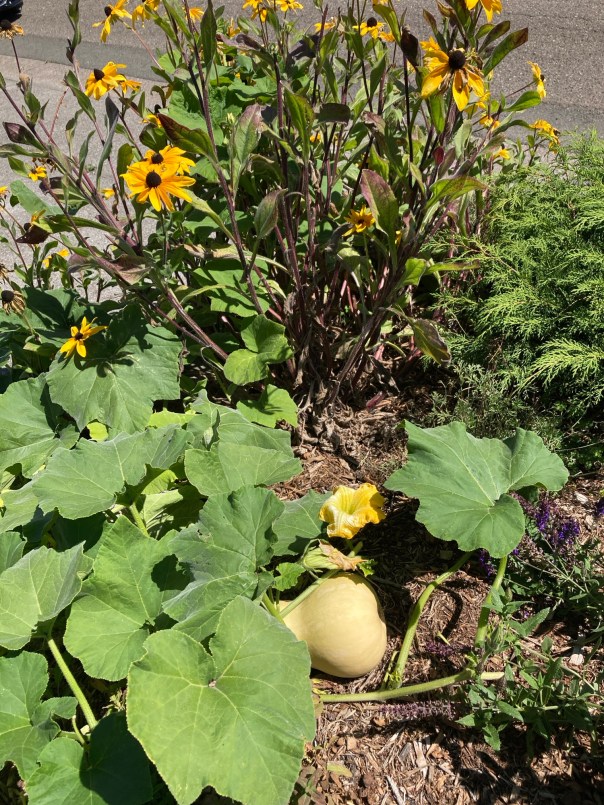
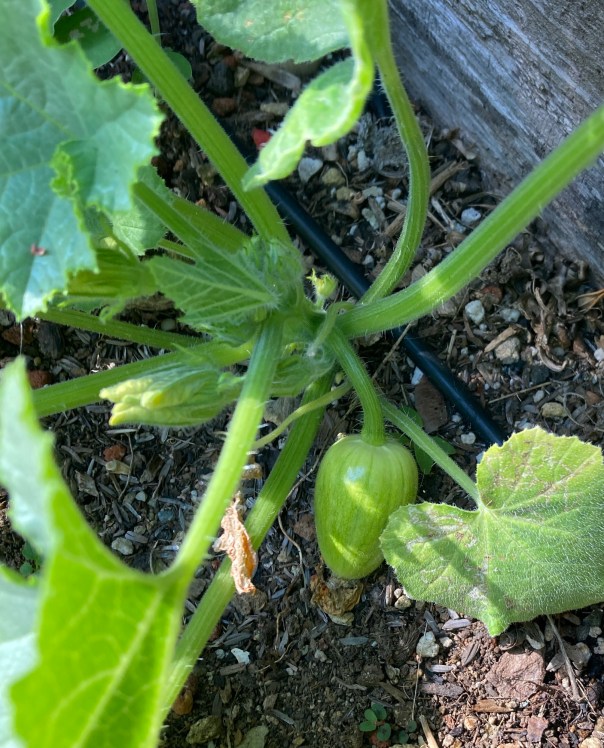
The most encouraging news of the day is, the sun is shining, and the garden is growing. There is already a little Delicata squash on one of the two plants I started from seed in March.

I hired a man to clean about half of my wall-to-wall carpets. Last night and this morning I pushed and hauled furniture around so that I could thoroughly vacuum all the places beforehand. “Kyle” came this morning and was a very conscientious worker with a good deal of experience, and also lots of information for me about the various fibers he’d be cleaning, and how carpets wear, and how stains are removed. He told me that he usually vacuums himself, and was reluctant to skip that step. He asked if I had a good vacuum…? I do, but I let him do that part everywhere again with his machine, for his peace of mind.

Hall carpet just after installation.

I am so happy to have this job done. I don’t have pets, and all the grandchildren have been trained by their parents to remove their shoes in the house, so my rugs get along without frequent shampooing (this is an understatement which I won’t elaborate on); but I had reasons for deciding that this was the time.

While this thorough maintenance was happening over the course of several hours, I cooked up a pot of split pea soup; I roasted eggplant, toasted walnuts and made a batch of quinoa. The flannel bedsheets went into the washer and were replaced with the summer type, and I checked off several other tasks around the house, some of which have been delayed a couple of weeks, and some for months. It’s uncanny how every time I whittle down my to-do list, a few more things break or come due for maintenance.

Checking off the carpet cleaning, which should have been done years ago, felt really good. But — there was a little problem, which immediately added another task to my list. A solution that Kyle used, on a spot barely visible before, reacted with something I evidently used sometime in the past, and left a bleach mark in the middle of my hall. I usually only use water on spots, because they are most often just garden dirt, and I have no memory what it was I put there. Anyway, I will be contacting someone who can patch it, and I’ll have to take a piece from the back of a closet in order to match it. It will probably look fine, and anyway, people are not taking time to notice the carpet when they are walking down the hall. It will give me the pleasure of checking one more thing off the list — yay!

This Sunday we Orthodox will celebrate Pentecost, and I am getting excited thinking about the day. We decorate with greenery of all kinds; in our temple it’s often whole trees that are brought in for the feast, and in some parishes around the world they cover the floor with grass and wildflowers.

Pentecost in Poland

The thought of decorating the church floor takes me back to my new problem of an ugly spot on my floor. It makes me think about how many times I covered a stain on some garment or bath mat, etc, with embroidered flowers. My mind did immediately go in that direction when I saw the small bleached area in the carpet, wondering (very briefly) if there were a comparable fix that I could accomplish in a homey DIY way. It’s not easy to give up doing those creative things, especially when Chesterton’s words linger in my mind: “Thrift is the really romantic thing; economy is more romantic than extravagance… But the thing is true; economy, properly understood, is the more poetic. Thrift is poetic because it is creative….”

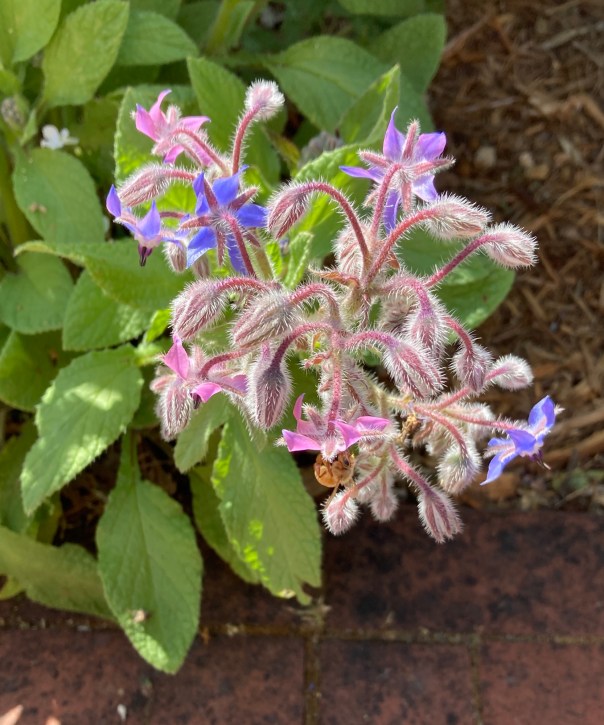
See the golden bee curled up in a ball?

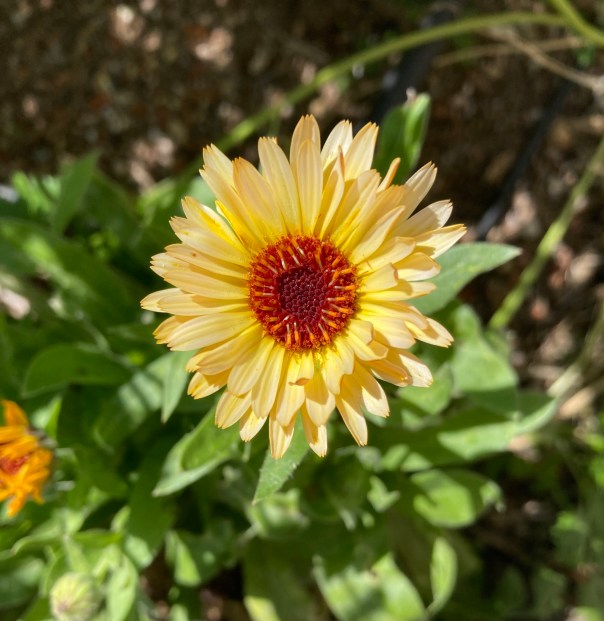
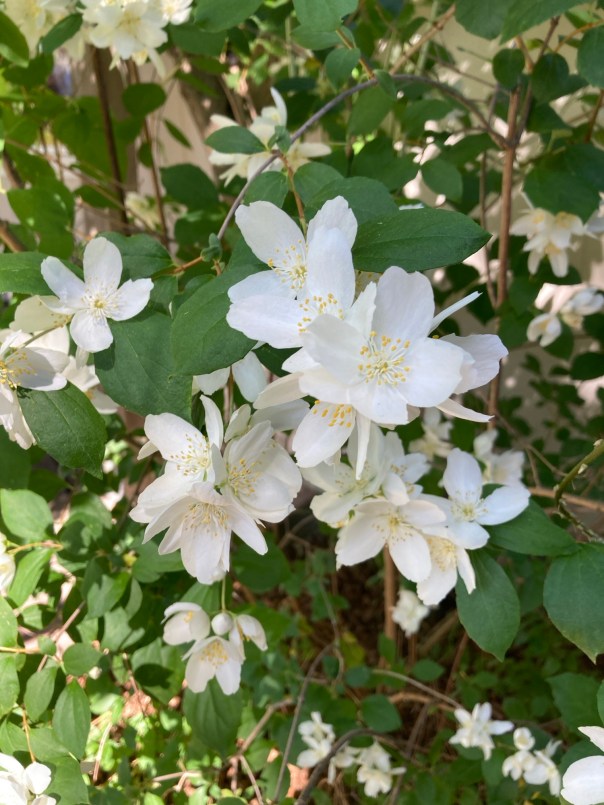
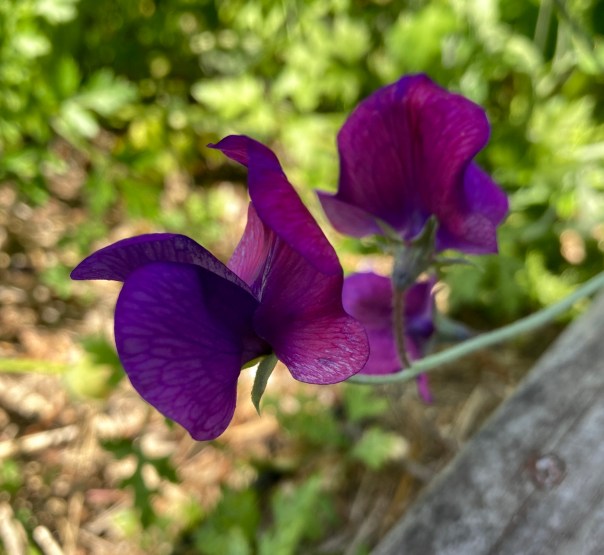
I’m so happy that I can still be creative in the kitchen and garden. That is about all the creativity I have time for anymore! The borage (pictured just above) is blooming and the bees are loving it; they don’t mind having to hang upside down to drink. So many things are blooming, but I will just show you one more, the mock orange. Two bushes were planted on either side of my patio so that their scent would drift across the space where one might sit of a spring evening. Alas, spring evenings aren’t conducive to being outdoors in this neighborhood, neither does this particular mock orange have a strong scent; I have to put my nose right in the flower to detect it. So nothing is lost! And the loveliness of these flowers to the eye is great wealth. Thank you, Lord.

White is a Cloud Dancer.

I ran across the news that Pantone’s choice for Color of the Year 2026 is WHITE! No, not just white, of course, but “Cloud Dancer” white. This is the first time they have chosen a shade of white as the color of the year. I’ve never heard about this practice before, in the 25 years that the company has done it, but that’s because the colors I am interested in are in my garden or my clothes closet, not in a lab.

I personally wouldn’t want to take too much time thinking about one shade of one color, because God has generously given us so many, all day every day, unless we are living in the Arctic. White is a color many of you are seeing a lot of already right now, and not on your walls. Have you thought about giving names to the different shades of snow you are shoveling, or watching fall outside your window?

It’s not because of my lack of snow that I take the trouble to post about this, but because of G.K. Chesterton. He probably wouldn’t think much of someone choosing a Color of the Year, but he did himself write about one color in particular, without regard to style or global trends. For him, it was not merely about things seen, but things unseen, the Cosmos and the Kingdom of God:

“White is a colour. It is not a mere absence of colour; it is a shining and affirmative thing, as fierce as red, as definite as black. When, so to speak, your pencil grows red-hot, it draws roses; when it grows white-hot, it draws stars.

“And one of the two or three defiant verities of the best religious morality, of real Christianity, for example, is exactly this same thing; the chief assertion of religious morality is that white is a colour. Virtue is not the absence of vices or the avoidance of moral dangers; virtue is a vivid and separate thing, like pain or a particular smell. Mercy does not mean not being cruel or sparing people revenge or punishment; it means a plain and positive thing like the sun, which one has either seen or not seen. Chastity does not mean abstention from sexual wrong; it means something flaming, like Joan of Arc.

“In a word, God paints in many colours; but He never paints so gorgeously, I had almost said so gaudily, as when He paints in white.”

-G.K. Chesterton, “A Piece of Chalk,” in Tremendous Trifles


The good giant lifts the world.

Malcolm Guite included this passage from “The Ballad of the White Horse” in his anthology of Advent and Christmas poems, Waiting on the Word. King Alfred the Great narrates:

And well may God with the serving-folk
Cast in His dreadful lot;
Is not He too a servant,
And is not He forgot?
For was not God my gardener
And silent like a slave;
That opened oaks on the uplands
Or thicket in graveyard gave?
And was not God my armourer,
All patient and unpaid,
That sealed my skull as a helmet,
And ribs for hauberk made?
Did not a great grey servant
Of all my sires and me,
Build this pavilion of the pines,
And herd the fowls and fill the vines,
And labour and pass and leave no signs
Save mercy and mystery?
For God is a great servant,
And rose before the day,
From some primordial slumber torn;
But all we living later born
Sleep on, and rise after the morn,
And the Lord has gone away.
On things half sprung from sleeping,
All sleeping suns have shone,
They stretch stiff arms, the yawning trees,
The beasts blink upon hands and knees,
Man is awake and does and sees-
But Heaven has done and gone.
For who shall guess the good riddle
Or speak of the Holiest,
Save in faint figures and failing words,
Who loves, yet laughs among the swords,
Labours, and is at rest?
But some see God like Guthrum,
Crowned, with a great beard curled,
But I see God like a good giant,
That, laboring, lifts the world.

-G.K. Chesterton, excerpt from “The Ballad of the White Horse.”

I like to listen to Fr. Guite read poems on his site. You can read and listen here, too: “The Good Riddle.”

Caspar David Friedrich, Cross in the Forest

Books for the waiting.

O Key of David and sceptre of the House of Israel;
you open and no one can shut;
you shut and no one can open:
Come and lead the prisoners from the prison house,
those who dwell in darkness and the shadow of death.
     -Antiphon “O Clavis”

Orthodox Christians keep a 40-day fast before the Feast of the Nativity of Christ, so we get a head start on those whose Advent starts around the first of December. This year one of the books our parish women’s reading group has chosen for this time is Behold a Great Light: A Daily Devotional for the Nativity Fast through Theophany, edited by Lynnette Horner. It contains short meditations from Fr. Basil Ross Aden, Elissa Bjeletich Davis, Fr. Stephen De Young, Fr. Stephen Freeman, Fr. Michael Gillis, Laura S. Jansson, Nicole Roccas, and Brandi Willis Schreiber. These are interspersed with hymns and Scripture readings of the season.

I noticed that in the Audible format, most of the contributors read their own writings, and I know I would like to hear their voices, but I didn’t get the audio version, because in general I need to read in print anything that I want to meditate on, so that I can pause and think as needed.

Also this year I am trying to read a little of Winter Fire every day. It is a collection of Christmas themed writings from G.K. Chesterton, compiled by and commented on by Ryan Whitaker Smith. Last year I read only a tiny bit from it. Day One of the book begins like this:

It was in the season of Christmas that I came out of my little garden in that “field of the beeches” between the Chilterns and the Thames, and began to walk backwards through history to the place from which Christmas came. —The New Jerusalem (1920)

So begins The New Jerusalem, G. K. Chesterton’s travelogue chronicling his journey to the Holy Land. But before the destination, there is the journey. For Chesterton, it begins in a backyard in Beaconsfield, England, as the large, mustached man unlatches the garden gate and sets off on his adventure. Perhaps yours begins in a kitchen, with a strong cup of black coffee, or in a comfortable corner of the living room, the windows limned with frost. For me, it begins in a home office I affectionately call “the library,” as the fields around my house are blanketed with early morning fog. Regardless of our various points of departure, this book is an invitation to link arms and set off together, as we “walk backwards through history to the place from which Christmas came.”

Note that “I am trying” to read every day. Over the years, and I remember as far back as junior high, I have never had the kind of discipline — or the mind? — that it takes to engage with these daily-reading books as they are meant to be used. I can’t imagine Chesterton reading such a book. Typically the meditations that are included by the editors don’t provide the kind of stimulus or reminder that helps me to think or pray better, so it often feels like a waste of time.

You’d think that a book of Chesterton’s writings would solve the problem for me — we shall see! The latter part of the book, after the Advent readings are done, consists of essays, poems, stories, and even recipes. So far my weakened mind is deterred somewhat by the long paragraphs in the essays, which were not a problem for readers a hundred years ago. It would have been helpful if Mr. Smith had taken the liberty to add a few paragraph breaks occasionally. At the same time, I know it will be a good exercise to settle in and force myself to ponder what only amounts to a few pages in one sitting.

One Christmas book that I definitely enjoy is Malcolm Guite’s Waiting on the Word: A poem a day for Advent, Christmas and Epiphany; poems are the easiest form for me, in which to discover the rich meaning of the season that is full of mystery. It was a little miracle that I could find it last month on my mostly unorganized shelves, and now have it handy on my nightstand.

Guite chooses from many poets a selection of poems that give voice to his belief that “…the the advent of Christ has for us a triple focus.” There is the first coming, in the Incarnation of the Word and His birth in Bethlehem, and the Second Coming of Christ in majesty, at the end of time. In between, “there are many other advents.”

“In our encounters with the poor and the stranger, in the mystery of the sacraments, in those unexpected moments of transfiguration surely there is also an advent and Christ comes to us.”  

It might well happen that some of His comings to us will be through the pages of our books. In any case, Come, Lord Jesus!