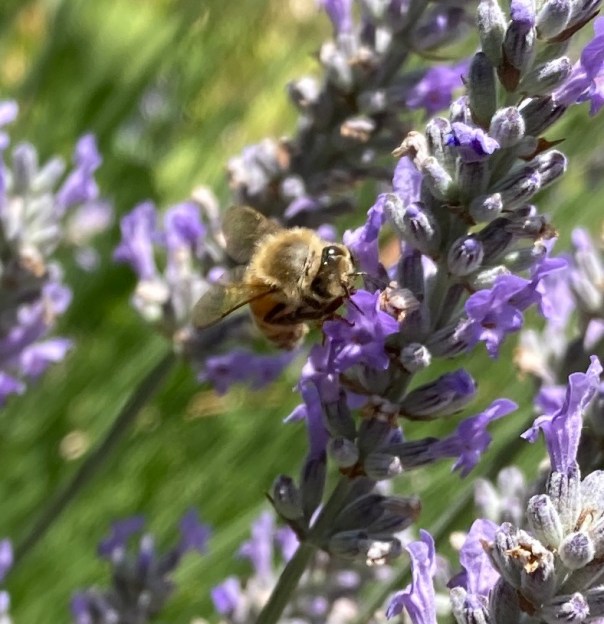
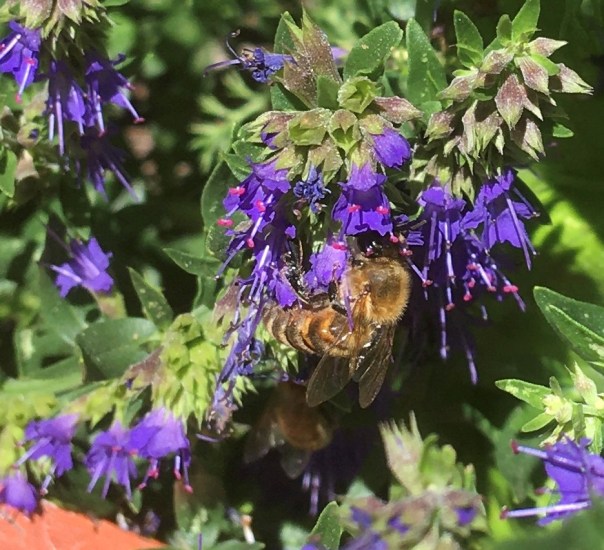
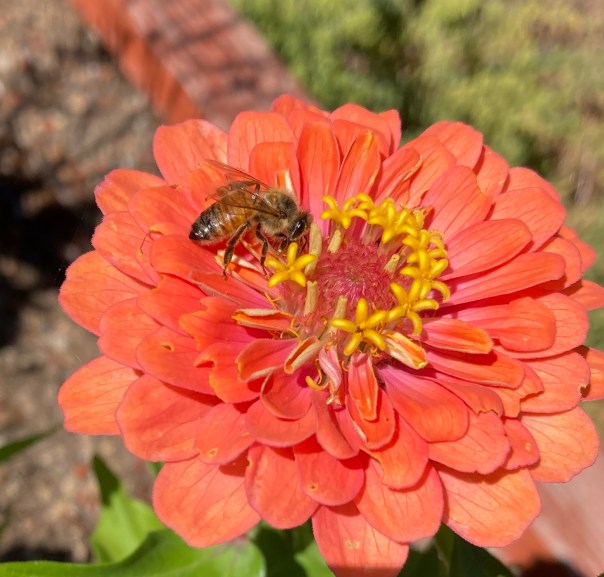
This afternoon the sun came out, but my house was cold, so I took my lunch into the garden and sat in the sunshine, on the edge of the planter box. A few inches away several plants were draping their heavy, flowery stems over the brick area between my seat and the fig tree: Milkweed, salvia, borage, oregano, and lavender were all tucked in close together. The bees were loving it. Carpenter bees, honeybees, some little bees I didn’t recognize. It’s very sweet to be able to take a few steps out my back door and find myself in a world where a thousand tiny creatures are flying about and feasting.
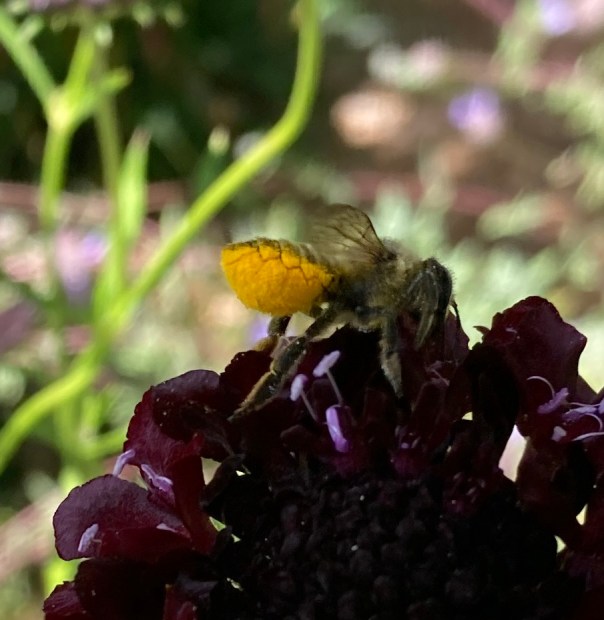
My hands were occupied, I couldn’t take pictures of them, and that was nice for a change. I did take pictures on other days so I am sharing those here. The two just above are from the front garden, where the pincushion flowers are a bit hit. Leafcutter is new to me. While she was buzzing around and I first caught glimpses of all that yellow, I thought maybe it was pollen. But no, it’s not on her legs, it’s her own body that’s so bright. [But YES, shoreacres explains in a comment below, while it’s not on her legs, it is indeed pollen!]
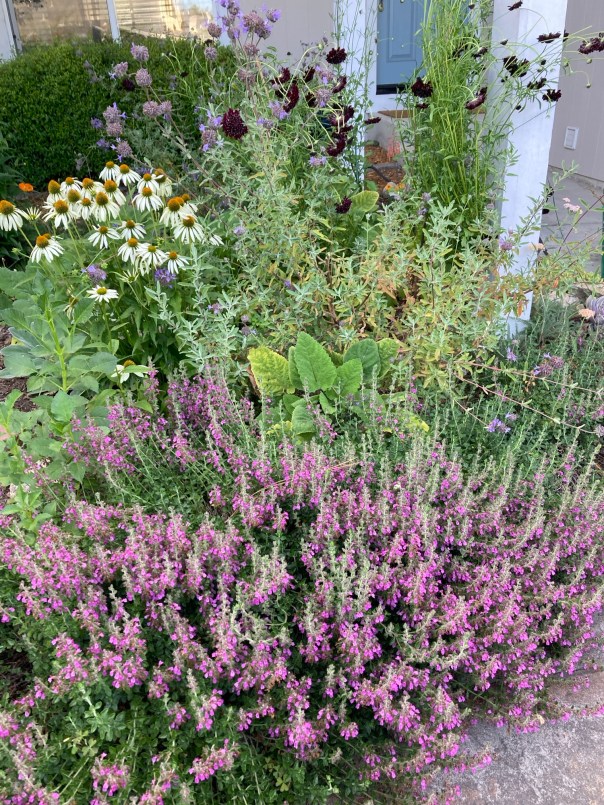
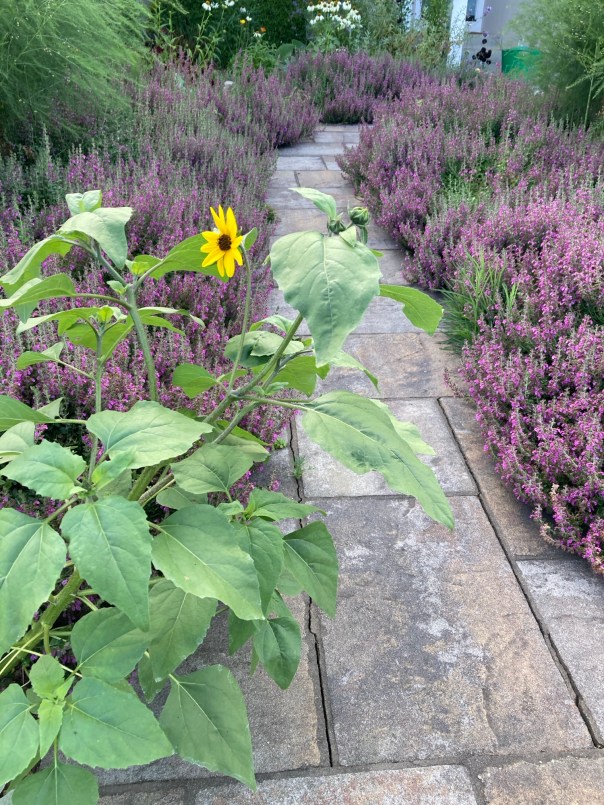
Yes, the pollinators love all these flowers, too: the white echinacea, germander, and salvia clevelandii. I took the picture above just after I propped up the pincushion flowers that grew to 6 feet, looking for the sun. I hadn’t realized that that area is now Part Shade, because of the crape myrtle. I’ll have to move the pincushions in the fall; it’s quite a jumble in there with the flowers in back shorter than the ones in front. I’m in no hurry to do it as long as the bees are so happy.
My first draft of this post was just the poem and painting below,
but then my own bees got added to Emily’s.
It’s all we have.
IT’S ALL I HAVE TO BRING TODAY
It’s all I have to bring today — This, and my heart beside — This, and my heart, and all the fields — And all the meadows wide — Be sure you count — should I forget Some one the sum could tell — This, and my heart, and all the Bees Which in the Clover dwell.
A thousand bees are drinking nectar and collecting pollen in my garden this week, so it’s time I posted this poem I’ve been tasting for a while. Twice this week I went out to photograph the buzzers, but most of the time with little luck. They are too busy to pose for me!
THE HISTORY OF HONEY
“The History of Honey” — by an aged mandarin, And I bought it for the pictures of the burnished bees therein.
For the dainty revelations, masquerading up and down, For the odor of the sandalwood that talked of China-town.
According to the mandarin, the Oriental bees Were the first to hoard their honey in the mountain cavities.
In the ages of antiquity, each summer afternoon, They flew in golden convoys to the mountains of the moon.
And there, in caves by cataracts, where nothing could annoy, Poured gallons in the caverns when Confucius was a boy.
Many mountains bulged with honey stored before the days of Ming, From each crevice dripped the essence of a very precious thing.
Imprisoned in this honey, aging as the aeons wane, Are the souls of all the flowers, waiting to be born again:
Every lotus, every poppy, every tulip, every rose. And those who sip the honey slip beyond all human woes,
Dream again of youth’s digressions, index misty ways of joy, Turn unto the pagan pastimes of Confucius — as a boy.
Doubtless there are yet secreted some divine distilleries Overflowing with the wonder worth a dozen dynasties.
But the mandarin, he made no map, contented in old age To draw the clinging love scenes of the bees on every page.
There he found an inspiration antedating all the Mings, And he got the ancient essence of the very sweetest things.
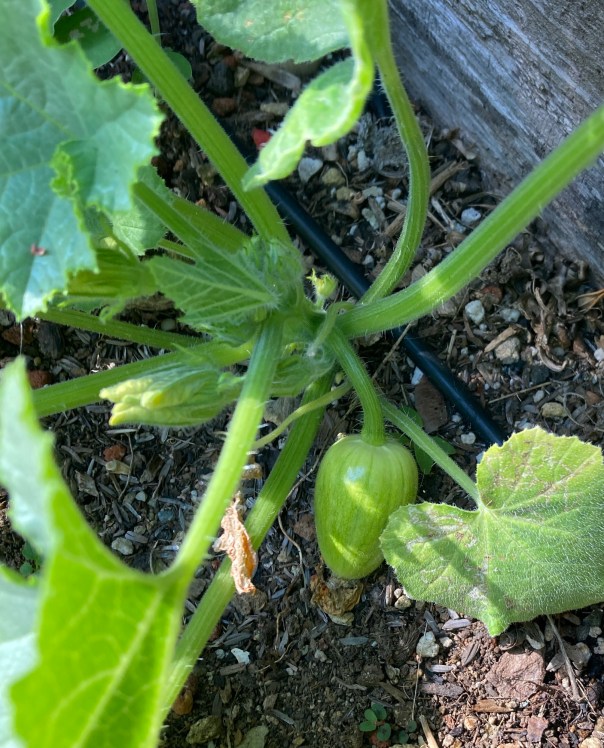
The most encouraging news of the day is, the sun is shining, and the garden is growing. There is already a little Delicata squash on one of the two plants I started from seed in March.
I hired a man to clean about half of my wall-to-wall carpets. Last night and this morning I pushed and hauled furniture around so that I could thoroughly vacuum all the places beforehand. “Kyle” came this morning and was a very conscientious worker with a good deal of experience, and also lots of information for me about the various fibers he’d be cleaning, and how carpets wear, and how stains are removed. He told me that he usually vacuums himself, and was reluctant to skip that step. He asked if I had a good vacuum…? I do, but I let him do that part everywhere again with his machine, for his peace of mind.
Hall carpet just after installation.
I am so happy to have this job done. I don’t have pets, and all the grandchildren have been trained by their parents to remove their shoes in the house, so my rugs get along without frequent shampooing (this is an understatement which I won’t elaborate on); but I had reasons for deciding that this was the time.
While this thorough maintenance was happening over the course of several hours, I cooked up a pot of split pea soup; I roasted eggplant, toasted walnuts and made a batch of quinoa. The flannel bedsheets went into the washer and were replaced with the summer type, and I checked off several other tasks around the house, some of which have been delayed a couple of weeks, and some for months. It’s uncanny how every time I whittle down my to-do list, a few more things break or come due for maintenance.
Checking off the carpet cleaning, which should have been done years ago, felt really good. But — there was a little problem, which immediately added another task to my list. A solution that Kyle used, on a spot barely visible before, reacted with something I evidently used sometime in the past, and left a bleach mark in the middle of my hall. I usually only use water on spots, because they are most often just garden dirt, and I have no memory what it was I put there. Anyway, I will be contacting someone who can patch it, and I’ll have to take a piece from the back of a closet in order to match it. It will probably look fine, and anyway, people are not taking time to notice the carpet when they are walking down the hall. It will give me the pleasure of checking one more thing off the list — yay!
This Sunday we Orthodox will celebrate Pentecost, and I am getting excited thinking about the day. We decorate with greenery of all kinds; in our temple it’s often whole trees that are brought in for the feast, and in some parishes around the world they cover the floor with grass and wildflowers.
Pentecost in Poland
The thought of decorating the church floor takes me back to my new problem of an ugly spot on my floor. It makes me think about how many times I covered a stain on some garment or bath mat, etc, with embroidered flowers. My mind did immediately go in that direction when I saw the small bleached area in the carpet, wondering (very briefly) if there were a comparable fix that I could accomplish in a homey DIY way. It’s not easy to give up doing those creative things, especially when Chesterton’s words linger in my mind: “Thrift is the really romantic thing; economy is more romantic than extravagance… But the thing is true; economy, properly understood, is the more poetic. Thrift is poetic because it is creative….”
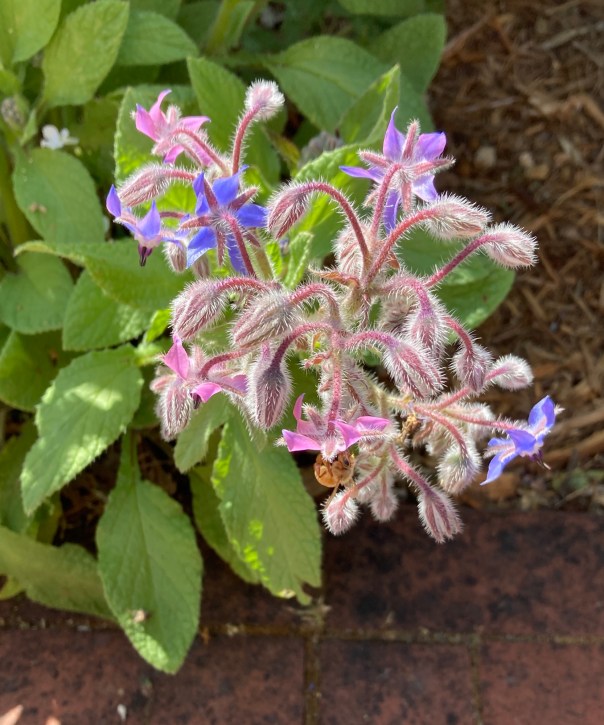
See the golden bee curled up in a ball?
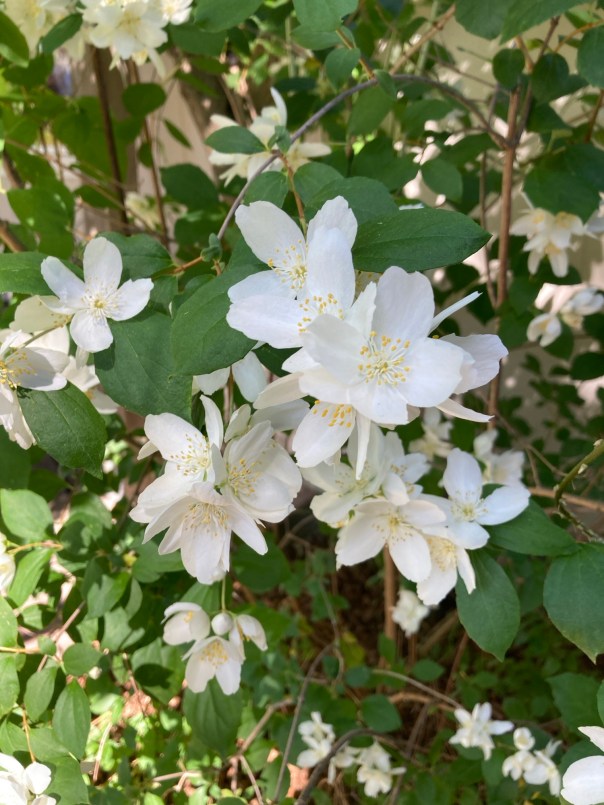
I’m so happy that I can still be creative in the kitchen and garden. That is about all the creativity I have time for anymore! The borage (pictured just above) is blooming and the bees are loving it; they don’t mind having to hang upside down to drink. So many things are blooming, but I will just show you one more, the mock orange. Two bushes were planted on either side of my patio so that their scent would drift across the space where one might sit of a spring evening. Alas, spring evenings aren’t conducive to being outdoors in this neighborhood, neither does this particular mock orange have a strong scent; I have to put my nose right in the flower to detect it. So nothing is lost! And the loveliness of these flowers to the eye is great wealth. Thank you, Lord.
These verses are fun when read aloud, especially if shared with a child.
THE BEES’ SONG
Thousandz of thornz there be On the Rozez where gozez The Zebra of Zee: Sleek, striped, and hairy, The steed of the Fairy Princess of Zee.
Heavy with blossomz be The Rozez that growzez In the thickets of Zee. Where grazez the Zebra, Marked Abracadeeebra, Of the Princess of Zee.
And he nozez that poziez Of the Rozez that grozez So luvez’m and free, With an eye, dark and wary, In search of a Fairy, Whose Rozez he knowzez Were not honeyed for he, But to breathe a sweet incense To solace the Princess Of far-away Zee.
-Walter De La Mare, from the collection for children, Peacock Pie