
In the Orthodox Church we commemorate the Feast of the Conception of the Theotokos on December 9th. Following from the fact that Christ received His human nature from his mother, she is of supreme importance in our salvation history.
Father Thomas Hopko writes in The Winter Pascha: In the Orthodox Church the Virgin Mary is the image of those who are being saved. If Jesus Christ is the Savior, Mary is, par excellence, the image of the saved. She is, in every aspect of her life, as Father Alexander Schmemann so often said, not the great exception, but rather the great example. From her conception to her dormition, that is, her true and real death, she shows how all people must be when they are sanctified by the Holy Spirit as servants of God and imitators of Christ.
I had to keep pushing that last sentence to the front of my mind as I tried to think and write a little more about the mystery of our salvation…

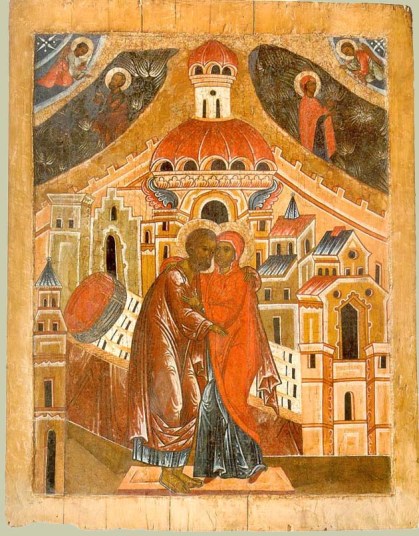
The icons of this feast tell the story of Mary’s parents Joachim and Anna, who had been unable to have children until late in life when Anna became pregnant with the child who would become the mother of our Lord. “Iconreader” has an article on the festal icon with links to related articles and discussion about its theology, and why the icon has been so popular in Russia.
From that article on A Reader’s Guide to Orthodox Icons: The icon of the Conception of the Theotokos is very simple. Joachim and Anna tenderly embrace, standing before a bed. Without being explicit, it is boldly confessed that, whilst a miracle granted to a barren couple, the conception of St Mary happened through natural means. This can be compared with Icons of the Annunciation, which could be described as the Conception of Jesus Christ: in those icons Mary is not shown with Joseph; Mary remained a virgin.
And from the Orthodox Church in America , an excerpt from an article on the feast that discusses beliefs about original sin: The Holy Virgin was like everyone else in her mortality, and in being subject to temptation, although she committed no personal sins. She was not a deified creature removed from the rest of humanity. If this were the case, she would not have been truly human, and the nature that Christ took from her would not have been truly human either. If Christ does not truly share our human nature, then the possibility of our salvation is in doubt.
There is so much to think about here! I would like to read these articles more carefully and thoughtfully, to stretch my mind toward the theology of “the exceeding riches of his grace in his kindness toward us, through Christ Jesus.” (Ephesians 2:7) Whenever I think about theology as a field of study, it brings to mind these words about theology and prayer from Bishop Kallistos Ware, and they help me refocus on the example of Mary, who said to the angel, “Be it unto me according to your word.”:

Theology, mysticism, spirituality, moral rules, worship, art: these things must not be kept in separate compartments. Doctrine cannot be understood unless it is prayed: a theologian, said Evagrius, is one who knows how to pray, and he who prays in spirit and in truth is by that very act a theologian. And doctrine, if it is to be prayed, must also be lived: theology without action, as St. Maximus puts it, is the theology of demons. The creed belongs only to those who live it. Faith and love, theology and life, are inseparable.
In the Byzantine Liturgy, the Creed is introduced with the words, ‘Let us love one another, that with one mind we may confess Father, Son, and Holy Spirit, Trinity, one in essence and undivided.’ This exactly expresses the Orthodox attitude to Tradition. If we do not love one another, we cannot love God; and if we do not love God, we cannot make a true confession of faith and cannot enter into the inner spirit of Tradition, for there is no other way of knowing God than to love Him.
At Christmas, the Truth that ties everything together is (I John 4:19):
We love him, because he first loved us.

 is cardigan sweater for myself, but it has turned out to be a splendid gift Iris and Pathfinder gave me. Every time I wear it, I feel that some of its extravagant energy radiates into my bones and helps them rejoice. And not Christmas Red, but truly Christmasy. I become my own ornament!
 Gladsome Lights