
I was surprised to become personally involved with the tree thinning work here at the lake. My second morning here, after my sister had arrived to spend a day with me, we got a knock at the door from one of the leaders of the fire safety project here in our cabin community. She wanted to review with us the recommendations from the primary agency toward the goal of “fuel reduction” and of making us a “Firewise Community.”
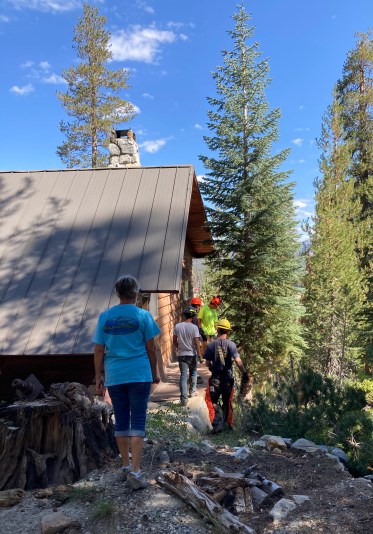
Fifteen workers from outside have joined dozens of property owners in the effort. Weeks ago many of us cabin owners had begun to cut small trees on our own lots and haul them to the roads, to increase the efficiency of the work crews who would join us this week, consisting of two state conservation agencies and a tree service.
If I had known further in advance about this project, I would have timed my visit to avoid it, but now I am really happy it worked out this way. Normally I am the least involved of us siblings in everything regarding our cabin because I live at such a distance compared to them.
But after Nancy was handed a can of orange spray paint, she and I walked around the property to decide on and mark trees that could be easily sawed down by a couple of our fellow residents who were about that business. And we had a consult with the tree service guys about the beautiful tree that features in several of my photos over the years, that unfortunately is one of those that poses a great fire risk by snuggling up to one side of the house.
Until recently, lot owners in our little group of cabins were forbidden to cut trees even on our own property. The expectation was that eventually permission would be given on a case-by-case basis. For many years there has been controversy about how to manage national forests and disagreement among government agencies; increasingly people understand the need to minimize wildfire danger by reducing fuel in the form of crowded forests, dead trees, and thick underbrush.
It was decided that they would take down that tree, and within a few minutes it was lying on the ground and being de-limbed.

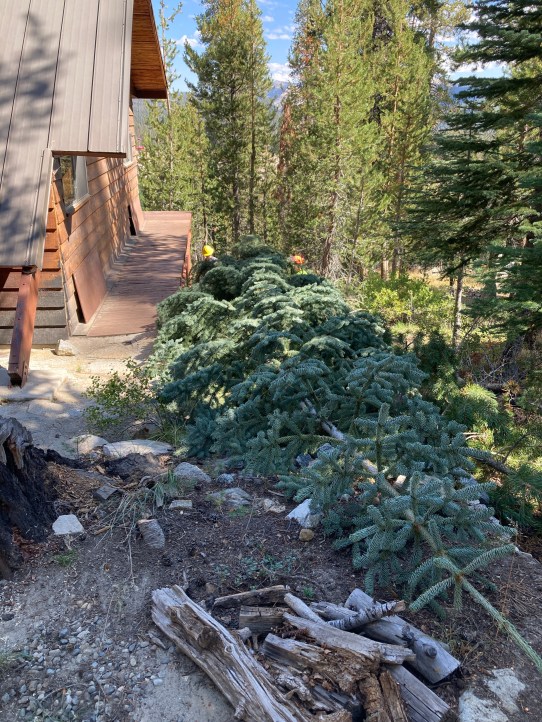
While the chain sawyers were working in front of our cabin, the noise and the exhaust fumes pretty much overwhelmed the senses. The last minutes of our big tree’s life, it was trembling under the repeated shocks of the hammers against wedges that had been squeezed into the initial cut. Nancy and I were standing off to the side taking videos. Then, down it came, and after a while the tree cutters moved on, the fumes dissipated, but the cut trees continued exhaling the last breaths of their essence.

The workers must necessarily be housed and fed by the property owners during this week that they are helping us, and a feeling of camaraderie was palpable. Workers and residents alike, nearly all of us have ties going back generations to small Central Valley communities, and many had been infused with a love for the mountains and the land by our parents and grandparents.
Usually when I am up here, I meet one or two of the other “summer people,” and am frustrated because I never get to know them and often forget their names. Rarely am I around for a work day, and as I most often come in September I miss many of the people who have stopped using their cabin when school starts. This week was different, and I’ve had the chance to talk with people from all the four parts of the group that has formed for this short project.
 One cabin up the road is the sort of work center for the crews, and every night whoever wants can join them to eat and sit around a campfire. While I was there for a few hours last night we were often chatting about the wildfires that even now are blazing in the foothills below here, where several cabin owners have their first homes. Cell phones were often used to check for updates, especially regarding the brother of one of our company, who sent a photo of the dark smoke billowing just behind his house.
When by the light of my little flashlight I walked away from the smell of the campfire and back to my cabin, I immediately entered an atmospheric bath composed of those aromatics I’d enjoyed in smaller doses earlier. It was some kind of therapeutic essential oil experience! My musings since have prompted me to read about just what makes that heady aroma, and I found an article about Forest Bathing, and speculation about how the chemicals in tree sap are good for you: Terpenes and Health.
The piney scent of the forest is intensified when hundreds of trees are cut down and fed to ravenous chipping machines. The molecules of tree begin to be released as soon as the logs and branches are pushed in, and after the chopped up tree is spat out at the other end of the chute, the emanations continue for hours and probably days.
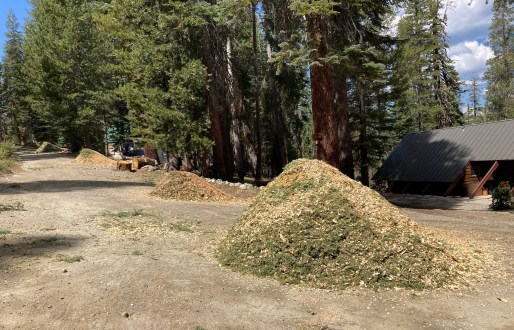
The products of all this chipping are left in piles along the roads, and there were several of these tall mounds along my path home last night. This morning several more had been deposited along the road in front of my cabin. They won’t be there long; one resident has equipment to take the chips away, and we have plans for using them right here in our mountain neighborhood.

This afternoon the weather I’d been wishing for arrived: claps and booms of thunder woke me from a nap, and soon a downpour of rain was clattering on the roof. And through the window wafted another, more humid dose of piney medicine. This highlighted experience of the trees and their yummy healthfulness seems like it might be an added reason to get myself to the mountains more often in the future, and practice forest bathing. But I won’t be disappointed at all if the aromatics in my bath are from trees still alive, with their roots intact and their branches in the sky.

 When I was getting ready to come up here to my high mountain cabin for several days, I didn’t like the idea of leaving my sourdough starter at home with no one to feed it for most of a week. Then I realized, I could bring it with me. That is what is great about road trips — you have lots of flexibility and options. Every experience of air travel makes me love road-tripping more.

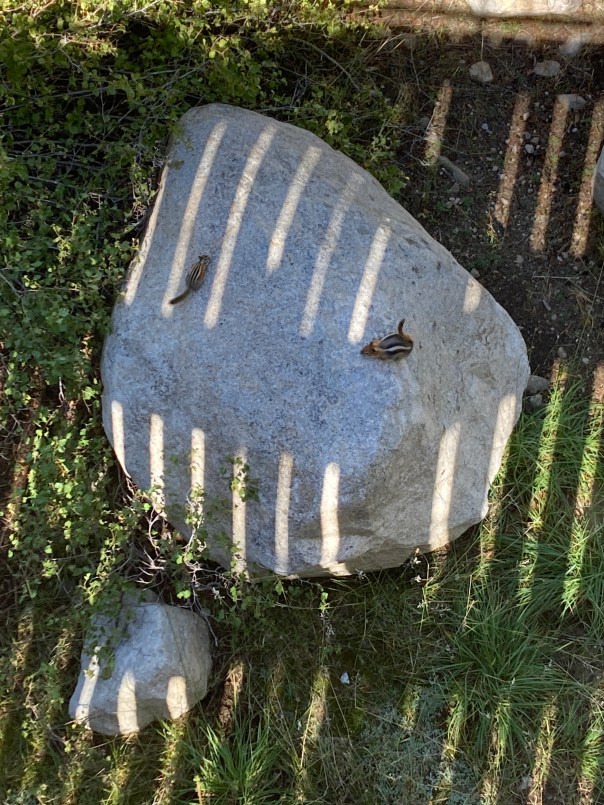
 I stood on the cabin deck watching the critters on the slope below, where they scrambled about, doing their work. After a while I pulled up a chair to the railing and watched some more. Squirrels and chipmunks had found the recent offering I’d made, seeds scattered in the little neighborhood as though from their heaven.
 This week so far I have seen patches of the starry sky through the window from my bed, and through narrow gaps in the tree canopy as I walked along the gravel road coming back from a campfire.
 Gladsome Lights