Category Archives: death

Blackberries, hospice, and being late.

gl IMG_2749 berriesI stopped and snacked on a few blackberries along my walking path this week, and that made me think about my dear late husband. And I wondered, how long does one use the descriptor “late” to refer to the deceased? So I read about that here. And after I read, I wanted to call him my “swete and late amyable husbonde.”

We are used to hearing that adjective attached to its noun, but I found it charming to read in Alexander McCall Smith’s novels of Botswana how people would simply state about someone who had died, “He is late.” You might think that the phrase refers to someone who has only recently died, but I can attest to the relative meaning of recently when we are talking about one’s lifelong partner.

A quote from this month’s New Yorker magazine, in the article about hospice worker Heather Meyerend, “The Threshold”, by Larissa MacFarquhar:

“People react differently to a death. Some cry, some are calm….Wives sometimes throw themselves on the body, weeping and grasping it, especially when the couple have been married forty, fifty, sixty years. ‘The Bible says, And two shall become one,’ Heather says. ‘It’s a wrenching that happens, a tearing, like a garment that’s being pulled apart.'”

Mr. Glad and I married when we were both 21, and soon moved from southern to northern California. Before we had even settled on what county we might live in, we were picking wild blackberries together, up in the redwood forests of Humboldt County. From then on it was a July tradition to search around the country roads or empty lots to gather enough for several pies and a few quarts of syrup as well. That’s how it happened that we formed the habit of his birthday pie.

gl IMG_2747 blackberries

As I’ve thought so much about my husband and our life together over the last year, Sheldon Vanauken’s book A Severe Mercy comes to mind, because it includes a lot about the death of his wife and his dealing with that. I didn’t like the book very much when I read it many years ago, because of the way the two of them seemed unswervingly self-absorbed as a couple; but one thing the grieving husband did tell about always stuck with me and made me ponder, long before I imagined myself in his position.

His wife’s nickname was “Davy,” and within days after her death he experienced the “flooding back to me of all the other Davys I had known. She had been in the year of her dying the Davy she had become — the Christian Davy of Oxford and since,” but he began to remember her at various times of their life together and even before, and to liken this process to what happens when you come to the end of a novel. You have been focused on each page and what the character is doing, who she is at that point in the story. Then you close the book and begin to grasp the meaning of it all from the first chapter on through.

When you are a hospice nurse, or the sole caregiver of a dying person, you have to focus on that day, that page of the life, to give all the love and attention you can. I hope it is possible for you to read the article I linked to above, about this particular nurse – if it becomes unavailable try googling her name – because the description of her work and ministrations is that of a saint. The author of the article follows her on her visits to several different homes and chronicles her interactions with the patients, and her wise assessments of the needs of the dying generally. The story of her own life shows how she was formed and guided by God into this realm that she seems imminently suited for.

When my husband was dying, our family didn’t need the hospice workers to help us with matters of the heart, but I appreciated Heather’s insight about such things as this:

When a patient was tormented and having a difficult time dying, or was hanging on despite no longer eating or drinking, Heather would ask, Is there someone you need to see? If a patient was preoccupied with someone he was resolved never to forgive, Heather might say that this unforgiveness was like bondage, and that if he forgave the person who had injured him that person would no longer be his jailer.

I thought that when I helped my goddaughter in her last days that the experience provided plenty of revisiting of the last months of my husband’s life, but reading about hospice care a year later is actually helpful. I’m less self-absorbed myself and can look back more calmly and see many reasons for thanksgiving in the last weeks and even hours.

One phenomenon that is mentioned in the article is how many people when they are in their last days seem to wait until they are alone before they let themselves “go.” One wife worried a lot about this when her husband was in hospice care, concerned that she might not be with him at that moment, and she was relieved when she was able to be by his side at the end.

I didn’t worry about it, but I would have preferred to be with my husband, and I was. Only from this vantage point does it occur to me that this was a gift from him to me and the daughters who were also there holding his hand, to let us accompany him all the way until the crossing over.

Whenever Heather entered a patient’s home for the first time, she knew that she was walking into a long, long, complicated story that she understood nothing about, a story that was just then reaching its final crisis.

Until today most of my own efforts to look back on my husband’s life have taken me far from last year’s final crisis, and by means of photos I’ve been helped to remember him at earlier stages in his life. But reading things he’s written is perhaps even more satisfying. I’ve just begun to sort through papers to find notes and creations that surprise me, that make me see the depth and complexity of the man whom I was mostly reading page-by-exciting-page all those years. We were living out our own novel, so to speak, and we were, as protagonists usually are, unknowing of what was going to be on the next page. But our Heavenly Father was the author, and He was making the ending very good, in spite of crazy things the characters might do or go through along the way.

gl tract coverI had forgotten about this gospel tract that he created — was it in his 30’s? Unfortunately he didn’t put a date on anything I have dug up so far. In those days he did like to have some “literature” to give people he met, something they could read later on, and I imagine he found most such material too reductionist to be called The Gospel, so he had to make his own. The content of it tells of his foundation in Christ, and also of what he died knowing.

gl tract inside 1

I miss my husband terribly. The grief ebbs and flows and is never the same, except for being always present. I’m glad I’ll be in this process for some time, of rereading my husband’s life and remembering more things to love him for, and be thankful. I’m loath to give up that berry pie tradition, so next week, on his birthday, I’ll be baking  one again — even though I already know he will be late for the party.

gl P1030289

In this case, He truly wasn’t there.

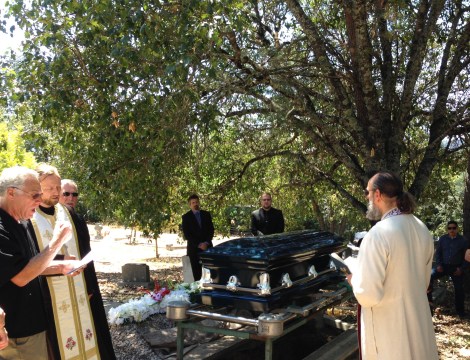
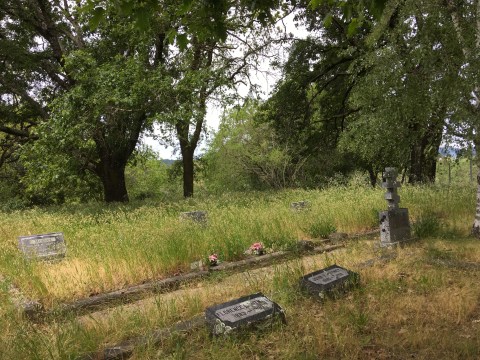
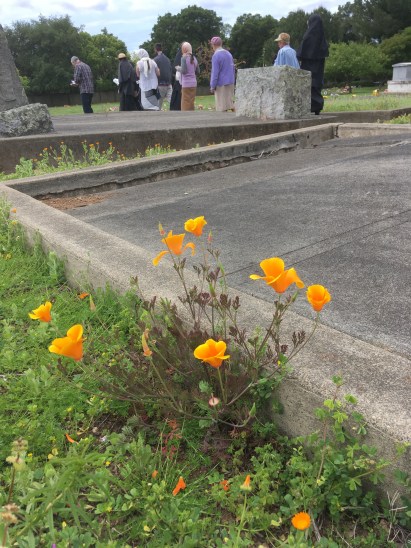
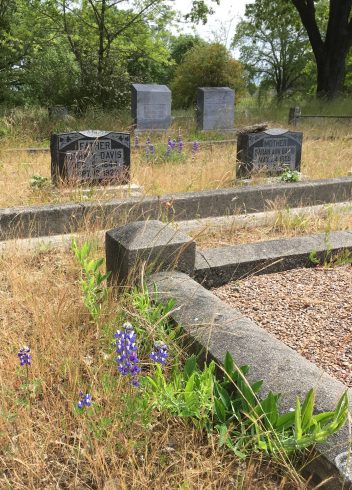
The second Sunday after Pascha we remember the myrrhbearers, the women who came early in the morning to Christ’s tomb to anoint his body. This article from our parish bulletin gave me great joy, as did the excursion I made with some others from church to several cemeteries this week, where we proclaimed Christ’s Resurrection to those in the graves. Our rector told us that we were also myrrhbearers that day, and he reminded us, “This is not a place of rotting and decomposed bodies, but a place of awaiting the Resurrection; what could be more joyful than that?”

IMG_2185

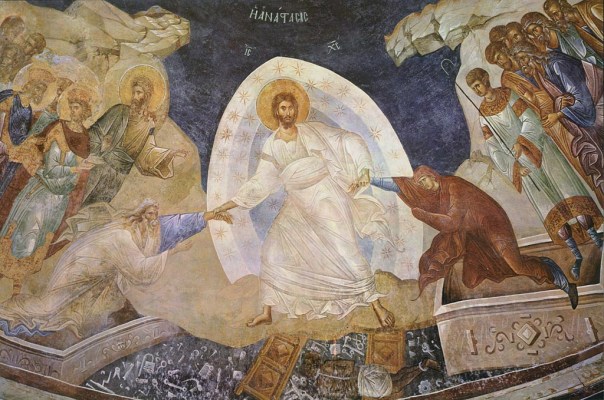
…The women came to anoint a body, a body that had ALREADY been anointed. What a strange thing to do. After all, as virtually every American mother assures her child the first time that he or she attends a funeral, the loved one isn’t THERE! Only his body! If the seven myrrh-bearing women were to have heard our 21st century dismissal of the human body, they would have been astonished. Perhaps they would have assumed that we are pagans, like the philosophers who declared soma sema — “the body is a tomb” — and who cremated their dead to allow the soul to escape that prison. But this was not the philosophy of our beloved myrrh-bearers. Mary Magdalene, when she saw the empty tomb, declared in grief, “They have taken away the LORD” and then asked, “Where have they taken him?” She didn’t ask, “Where have they taken his body?” In her mind, and to the mind of the Jewish faithful (except for the confused Sadducees!), a person was embodied: they looked for not mere spiritual continuation after death, but for the reunion of soul with body, a resurrection! And so do we as Christians! “I look for the resurrection of the dead.” Physical things matter to God….

IMG_2178

Anointing his body, then, was not such a bizarre thing to do. For this holy Tabernacle of God, this Prophet of prophets, this High Priest forever, this King of Kings, is worthy of every anointing honor that we can give him—though He has no NEED of our praise! In fact, it is He who anoints us with the Holy Spirit. But there is something for which He is looking—our faith. This ending of Mark summarizes for us many of the stories that are told in more detail in the other gospels. Briefly we hear about the women’s astonishment, and the  refusal of the apostles to believe, the surprise on the road to Emmaus, the disbelief in the upper room, and how Jesus “upbraided them” because of their disbelief. The One who struggled in the Garden with his chosen path knows what it is to be weak—though He himself was never faithless. And so, He calls to us, as he did to the early disciples, telling us not to be faithless but believing.

IMG_2170
simple barley koliva

The evidences of what He has done and is doing are everywhere around us and among us. Like the early disciples, we have confirmed before our very eyes the truth of His word. Anointed by the Spirit on Pentecost, they went out with the message, and braved many dangers, even death! As the last verse of Mark tells us, “…they went forth and preached everywhere, while the Lord worked with them and confirmed the message by the signs that attended it.” (Mark 16:20)

We too, God’s little anointed ones, are led by the Spirit, as St. Paul puts it; that leading may take us places we would rather not go. “For all who are led by the Spirit of God are sons of God. For you did not receive the spirit of slavery to fall back into fear, but you have received the Spirit of sonship. When we cry, ‘Abba! Father!’ it is the Spirit himself bearing witness with our spirit that we are children of God, and if children, then heirs, heirs of God and fellow heirs with Christ, provided we suffer with him in order that we may also be glorified with him. I consider that the sufferings of this present time are not worth comparing with the glory that is to be revealed in us.” (Romans 8:14-18)

–Excerpt from article by Edith M. Humphrey, Professor of New Testament at Pittsburgh Theological Seminary

Myrrhbearing women at the tomb

Eternal Memory

gl P1030780 koliva 3-24-16With my family and friends I have memorialized my husband in many ways in the last couple of weeks. The evening of the day that we decorated the grave, we had a short memorial service for him at my church. Ivy stood right by me holding her candle straight and steady for the whole fifteen minutes. After we sang and prayed together, we ate koliva together in his honor. “Eternal Memory!”

I’m not going to post a picture here every time I make one of these bowls of ceremonial boiled wheat, but this first anniversary was the Big One for me, so it bears telling about. I wanted to use blue Jordan almonds to decorate, but they were not to be found in the usual candy stores, so I put M&M’s instead, along with white almonds. Maggie helped me with the tricky job of placing candies on a bed of powdered sugar.

On the following weekend the agape meal I had committed to was accomplished. When I mentioned it two weeks ago, in the same post I put a photo of a big pot of soup I’d made, which I think was confusing; that soup had nothing to do with the agape meal that was to come. My menu for the meal that needed to feed about 100 people was: (What I call) Greek Beans, Cottage Fried Potatoes, Cabbage Salad with Tarragon and Toasted Almonds, and vegan Chocolate Carrot Cake.gl P1030804

I used about 15# of cabbage and 50# of potatoes, 20# of Great Northern beans, and about 10# of carrots for the cake. Six dedicated and necessary friends from church helped me both Saturday and Sunday, out of love for me and for my late husband. It was the first time I’d ever organized something like this, and the project filled my mind for many hours over the preceding weeks, as I scribbled my recipes and math problems and gl P1030815 Greek Beansshopping lists on a sheaf of papers I tried to keep all together.

Several things didn’t work exactly as planned – when dealing with large quantities not only the quantities have to be adjusted, but cooking times and methods. Now I know!

Too many finely grated carrots were accidentally put into the cake batter, we couldn’t tell exactly to what degree, so I just gave the four sheet pans longer baking time and we had delectable brownies instead of cake.

In the morning before we started cooking I was jittery, and glad the day was finally here when I could start this last big effort. As I expected, once I got to the church kitchen and my crew began to execute my plans, the whole event was a lot of fun. The food got rave reviews, too!gl P1030833crpAnd now the big One Year milestone has passed. These various commemorative events and tasks have helped me so much to focus my grief and prayers in a community-oriented and practical way. Can you believe that I had joy as well as grief? I didn’t have a minute to spare for brooding, but at the same time I was not distracted from the anniversary, but rather able to keep it in the most satisfying way — I’m very thankful.

Callas and Comfort

gl calla bouquet 3-16 P1030732When we broke up and filled in the swimming pool last summer, the surrounding planting beds were also excavated and new dirt was brought in for the new plants to grow in. In one corner where calla lilies had grown for a decade, we put in native California currant bushes.

Then the callas sprouted again, up through the little blooming ribes. I’ve had to go out every few days and yank out perfectly healthy lilies when they start to encroach too closely around the young plants that I am trying to encourage.

One morning last week when my daughters and I were packing up to visit the cemetery and have a picnic afterward, we discussed going to tP1030837he store to buy some flowers to lay on their father’s grave, because I said I didn’t have any flowers in the yard to take.

I suppose I was thinking about how the snowball bush didn’t yet have any flowers ready to pick. Last year at this time it was loaded with flowers, and one reason I did not take out the old thing was that I anticipated having its beautiful blooms to put on my husband’s grave every March. snowballs crp 15

Well, I had forgotten the calla lilies! Brave and hardy plants that keep coming…. We picked plenty to take to the cemetery, and since then have had more in vases in which they seem to fall naturally into elegant arrangements.

As you can see, we had other home-grown flowers to use — a few surviving ranunculus from the front yard, and even a Bird of Paradise from Pearl’s garden. Several freesia blooms were left after their extravagant display a couple of weeks ago. Scout and Ivy helped by decorating their grandpa’s grave, and their father drew us together by reading these words:

gl grave 3-16 P1030745

For I am sure that neither death nor life, nor angels nor rulers, nor things present nor things to come, nor powers, nor height nor depth, nor anything else in all creation, will be able to separate us from the love of God in Christ Jesus our Lord. (Romans 8:38-39)

Just now I’m reminded of another passage from I Thessalonians, which is also about our togetherness in the Lord (and it ties in nicely with my “C” post):

For the Lord himself shall descend from heaven with a shout, with the voice of the archangel, and with the trump of God: and the dead in Christ shall rise first: Then we which are alive and remain shall be caught up together with them in the clouds, to meet the Lord in the air: and so shall we ever be with the Lord.  Wherefore comfort one another with these words.