Category Archives: food and cooking

Blessings of Showers and — a Baby!

An old Sunday school hymn about “Showers of Blessing” is running through my mind today. There’s little snow in the Sierras, so drought is certainly impending, but rain is falling steadily. It makes me so glad, I don’t even mind that the Dutch iris have been flattened under the water-weight and are lying prostrate as an offering to snails.

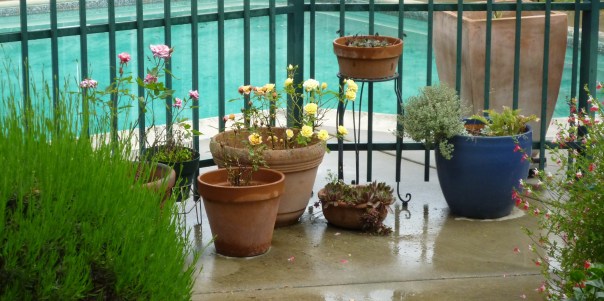
The rains will stop soon enough — and I was lucky to get outpurple fingerling between showers and find a few flowers that hadn’t been chewed, to add to my centerpiece for a company dinner.

We ate some roasted potatoes in different colors. This purple one matches all the Lenten vestments at church, but also makes me think of an Easter egg.b.d. gift box 2014

My latest birthday present also makes me look ahead, to the day in April when I will be planting a spearmint and a pepper plant. While I’m waiting for gardening weather I can eat the jam or salsa! This box came from my friend Sophia.

You are reading the first post I have written in my new blog home at WordPress. I’ve been itching to leave Blogger for a good while, as I’ve been getting the hints that the mother ship has sailed off into distant waters and left me in a leaky lifeboat.

But the last straw was when I was unable to update my Grandmother Status from eleven to twelve. Yes, I have a new grandson, second son of Soldier and his Joy, so new I haven’t come up with a nickname for him. But he needed to be counted; he is the huge blessing I’m counting as my most spectacular birthday present. Coming early as he did, not only a gift from God welcome at any time, but closer to my own birthday than anyone else in the family, I can’t help but receive him as a special present to me.

So I put speed on and hired a techie friend to move me over here where they do nothing but blogs. It’s going to take me a while to fine-tune things, but I’m happier already.

I remember long ago how a school friend of mine was given a kitten, and she named him Cadeau, which is French for gift. But that doesn’t seem an appropriate nickname for my ninth grandson. I’ll have to keep working on that project, while I bask in all the abundance of gifts in my life. Welcome, Baby Boy!

March bouquet 14

RFC drinks in graces.

“It was St. Thomas, I think, who pointed out a long time ago that if God wanted to get rid of the universe, He would not have to do anything; He would have to stop doing something. Wine is — the fruit of the vine stands in act, outside of nothing — because it is His very present pleasure to have it so. The creative act is contemporary, intimate, and immediate to each part, parcel and period of the world.

“…The bloom of yeast lies upon the grapeskins year after year because He likes it; C6H12O6=2C2H5OH+CO2 is a dependable process because, every September, He says, That was nice; do it again.

“Let us pause and drink to that.”

Robert Farrar Capon knows well that there are people who will not drink to anything, because they are teetotalers. He’s writing this chapter on “Water in Excelsis,” in the book The Supper of the Lamb, about a God Who delights in his creation, and he is not sympathetic to what he sees as a mistaken attitude: “Only the ungrateful or the purblind can fail to see that sugar in the grape and yeast on the skins is a divine idea, not a human one.”

And as for what he calls The Woman’s Christian Temperance Union’s version of The Lord’s Supper, only about 100 years old and lacking completely what Holy Scripture and church tradition prescribe as the proper drink, he does not shrink back from engaging its adherents in argument, particularly the ones who think that the Greek word for wine in the Gospels meant something other than wine.

“The commentator cited, as I recall, grape juice for one meaning, and raisin paste for another. He inclined, ultimately, toward the latter.

“I suppose such people are blessed with reverent minds which prevent them from drawing irreverent conclusions. I myself, however, could never resist the temptation to read raisin paste for wine in the story of the Miracle of Cana.

“‘When the ruler of the feast had tasted the water that was made raisin paste…he said unto the bridegroom, “Every man at the beginning doth set forth good raisin paste, and when men have well drunk [eaten? — the text is no doubt corrupt], then that which is worse: but thou hast kept the good raisin paste until now.”‘ Does it not whet your appetite for the critical opera omnia of such an author, where he will freely have at the length and breadth of Scripture? Can you not see his promised land flowing with peanut butter and jelly; his apocalypse, in which the great whore Babylon is given the cup of the ginger ale of the fierceness of the wrath of God?”

Capon has a different argument with secularists, and it is over their classifying wine as an alcoholic beverage, when the author knows it as a class in itself, far removed from the hard liquor that is often used to ill effect, and which he tells us is “for strong souls after great dinners.” Capon:

“With wine at hand, the good man concerns himself, not with getting drunk, but with drinking in all the natural delectabilities of wine: taste, color, bouquet; its manifold graces; the way it complements food and enhances conversation; and its sovereign power to turn evenings into occasions, to lift eating beyond nourishment to conviviality, and to bring the race, for a few hours at least, to that happy state where men are wise and women beautiful, and even one’s children begin to look promising.”

I admit I am inspired by RFC’s eager receptivity to God’s gifts. What little appreciation I’ve had for wine as a beverage has been slow in developing, and I let my husband be in charge of that aspect of our dining. But wine in the chalice of Holy Communion has always seemed to me the obvious choice in obedience to Christ’s teaching.

This chapter contains more and expanded theologizing about the secular and the sacred, using wine and the making of wine as a demonstration of the goodness and delight of God. I am still musing on much of this and hope to ramble on here again, sharing with you the infectious loves of Robert Farrar Capon.

Other posts in this series are:
RFC is the man we need.
RFC begins with the meat.
RFC considers blood and sacrifice.
RFC makes one of nature’s marvels.
RFC drinks in graces.
RFC for Butter Week

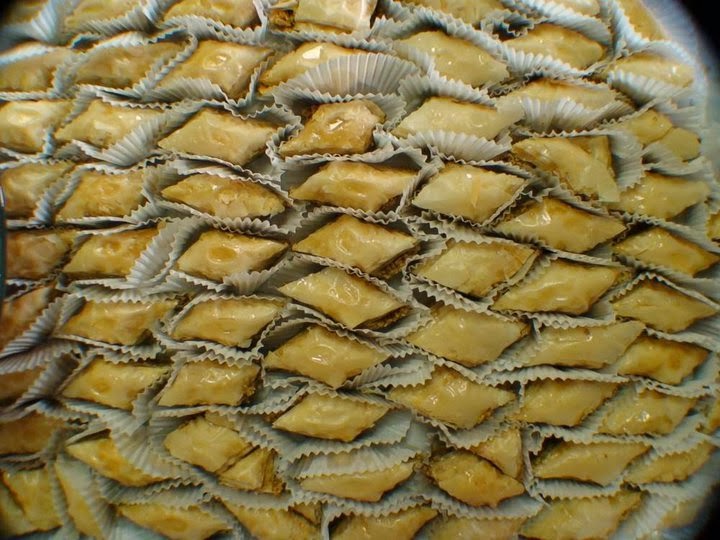
Please don’t try Roger Farrar Capon’s baklava recipe. He describes it as “french-fried,” and yes, it does involved a large quantity of oil ! which I declare a horrid perversion of the spirit of baklava. This is the first thing I have found in The Supper of the Lamb that has so disappointed and surprised me. I guess no one can be perfect.

But the perfect baklava recipe does exist, simplicity itself for method; and for taste, the divine melding of flavors, of which that of Butter is central. It is the one used in my parish to make umpteen sheet pans of baklava every year for festivals and celebratory meals, and I will eventually make it at home and share the recipe here.

As I write, we Orthodox Christians are in the midst of what is sometimes called Butter Week, the week before Lent properly begins, and the last in which we eat dairy products (but start fasting from meat). The perfect time to tell about Capon’s attitude toward butter, which I am very sympathetic to. For example, at the end of a section on sauces he shares:

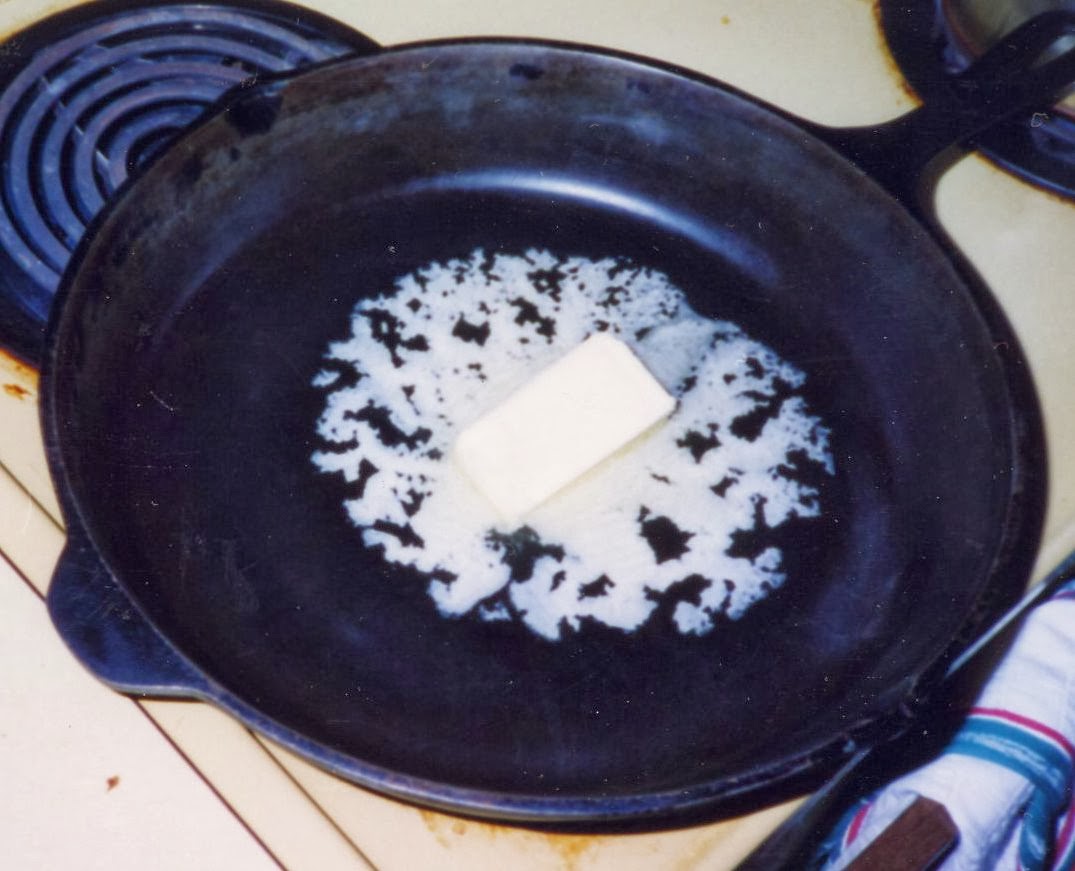
One last secret. There is almost no sauce that will not be improved by having a lump of butter whisked into it the moment before it is served. In addition to what it does for the flavor, it provides the sauce itself with a patina, a sheen which delights the eye even before the palate begins to judge. It is an embellishment not lightly to be forgone. Dishes should come to the table vested, robed. Don Giovanni is marvelous any way you can get to hear it. But given a choice between seeing it performed full dress, or on a bare stage with the cast in T shirts and sneakers, no rational man would hesitate. A great sauce deserves a great finish. Whatever you do, therefore, don’t omit the final grace — the loving pat of butter.

Those last words remind me of my grandmother, who showed this kind of love in her kitchen and to those she fed, including herself, and she lived healthily and on her own past the age of 100. I can still picture her standing by the stove and tucking fat pats of butter into the slits she had made in our baked potatoes just before taking them to the dining table.

Capon considers bread and butter, or cheese, to be basic ferial (everyday) food for those meals that one is keeping simple and light, for the sake of being able to enjoy real feasting less often. I’ll write more on that principle later. In contrast to bread and butter, we have what RFC calls “the epitome of baking”: pastry. He gives a lot of time and great detail to teaching us how to make puff pastry and Danish pastry, which must be made with butter, of course. I personally am not interested in this kind of cooking at my stage of life, and am happy to eat my butter in a hundred places other than pastry. Capon explains further that butter

…is not, in any except the merely technical sense of the word, grease. It melts at the temperature of the tongue, and consequently goes down as easily as cream. (You do not like to drink cream? I am sorry. Let us agree to disagree and get on with it.) Any man who cannot tell the difference between butter and margarine has callouses on the inside of his mouth…Butter is a substance in its own right, justified by its own delectability, not by its contributory services. It is a unique and solid sauce; it is apt to more dishes than anything in the world, and it is, like all the greatest sauces, worthy of being eaten plain.

Besides pastry, there are many recipes at the back of the book that feature this blessed food, including what look to be very nice cakes and cookies. I think all of us have plenty of that kind of recipe already, and if you don’t, just look on my own Recipes and Vague Instructions page on this blog. I wholeheartedly agree with RFC that butter “glorifies almost everything it touches.”

Other posts in this series are:
RFC is the man we need.
RFC begins with the meat.
RFC considers blood and sacrifice.
RFC makes one of nature’s marvels.

RFC makes one of nature’s marvels.

In the chapter titled “Living Water” in The Supper of the Lamb, in which we learn how to make Brown Stock and White Stock, Robert Farrar Capon continues, “…you are now ready for the really astonishing part of the exercise.” It’s the lead-in to another of the recipes that are scattered throughout the first two-thirds of The Supper of the Lamb, with more of them concentrated in the recipe section at the back.

Many of the recipes seem a little outdated now, but I doubt I’d have taken to the foods featured in Supper even in 1969 when it was first published, because I was just learning to live on my own and to eat rice and vegetables. Our ferial eating in those days was sparser of meat and wine than RFC could have imagined, and Diet for a Small Planet was the go-to cookbook. It would be another ten or fifteen years before I bought my first leg of lamb.

Nowadays I am well supplied with recipes for most everything I could possibly want to cook, but Capon’s next suggestion sounds so strange and appealing that I think I will have to try it eventually. If I had to choose between meat and butter, two foods at the top of my list of culinary loves, I guess I’m just sensible enough to choose meat, and when RFC tells me I can capture its “heart and soul” in my kitchen, I can’t resist his encouragement to create something of which he also claims, “…you will find yourself whittling off little pieces to dissolve on your tongue at odd times of the day.”

I’ll just give you the whole recipe here, because though we no doubt can find a version online, I naturally like the style of this one. It will be my last “meaty” post on this book, because in my church we are beginning our Lenten fast from meat very soon, and it’s time for me to turn the page.

HOMEMADE MEAT GLAZE
(Meat Extract)

Take the strainerful of bones and scraps [from which you have made the stock] and put them back into the stockpot. Add any scraps of meat you have around: poultry, pork, veal — even leftover hamburger — just stay away from lamb and ham. Meat extract can, of course, be made from the used bones alone, but anything that brings more natural gelatin to the pot is welcome. Cover everything deeply with cold water, adding no salt at all, and boil for two or three hours more.

That done, strain once again, this time into a large saucepan. Discard the bones. (They have been worked to death. Even the dog will look down his nose at them now.)

Boil the contents of the pan hard, skimming the froth from the top now and then, until the liquid is drastically reduced. When it is down to about a pint, transfer it to a smaller pan and boil on, over slightly reduced heat. Continue boiling until it reaches the consistency of a thick, blackish-brown syrup (half a cup, give or take a little). Pour this into a heatproof jar, cool, and refrigerate.

You now have, perhaps for the first time in your life, real meat extract — one of nature’s marvels. It is, of course, highly concentrated gelatin, but it has been imbued with the heart and soul of meat. Its taste is beautiful. Moreover, in spite of the fact that no speck of salt went into all those quarts of water the second time around, it is salted to perfection. Its consistency is, admittedly, a little forbidding; It is not unlike a young and tender shoe heel. Refrigerated, it will keep in this state for weeks; but, obligingly enough, it melts at the temperature of the mouth. If you are any lover of food at all, you will find yourself whittling off little pieces to dissolve on your tongue at odd times of the day.

Use it ad lib. Its general effect is to give a sauce soul and substance without overpowering the proper flavor of the dish. Experiment. It improves almost anything. A tablespoonful melted in warm Hollandaise imparts a certain roundness and resonance to what is sometimes an excessively light and lemony sauce. A piece dropped on top of a hot fried egg (plus a dash of Tabasco, if you are up to it) is delightful. And in the form of Colbert Butter, it is the perfect accompaniment to steaks, chops, fish, or poultry — not to mention a piece of matzoh at three in the afternoon.