Category Archives: Holy Week

The Bright Monday that was…

According to liturgical time, Bright Monday is already past, and we are entering Bright Tuesday of this blessed week. I’m afraid I’m not readjusted to plain time yet, or to the way much of the world has merely switched from the weekend to weekday, or from Easter to common days. The superabundance of life and joy that descends on us at Pascha is too much for a few hours or even a few days to contain. So when I saw a call coming in on my phone from my doctor, my first thought was, Why would anyone be calling me today?? I didn’t pick up.
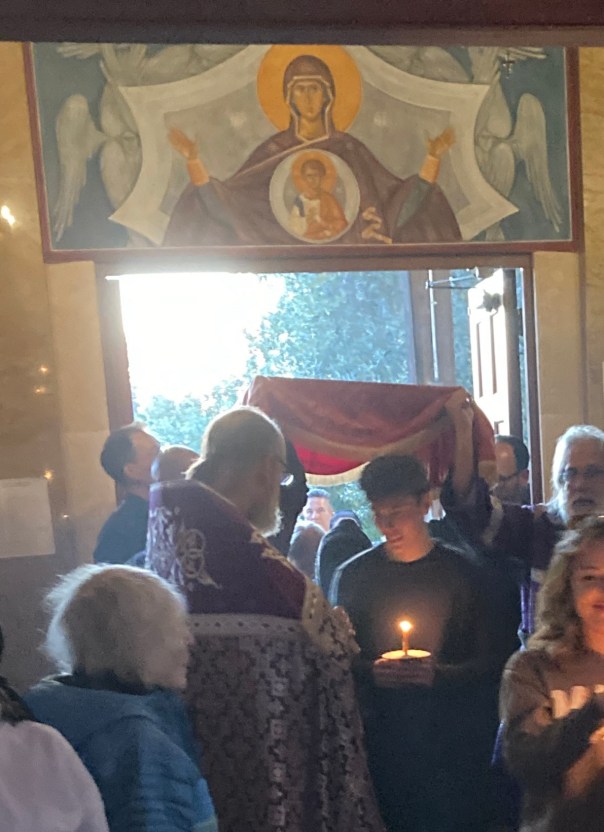
After Palm Sunday this year I was home for the next few days of Holy Week, but from Thursday evening until Sunday evening I went to church every day. Normally I can’t manage that with my limited mental and physical resources, but Holy Week is not Normal, and it didn’t feel right to be home when so much was happening elsewhere. I wish I didn’t have to miss any of the multitude of grace-filled services, each with its unique flavor, and particular gifts that are given only once a year to those present to imbibe and absorb them. Through all the senses and by means of our minds, as we hear the deep theology of our salvation, we are mystically brought into the presence of Christ — as He talks at length to His disciples in the upper room, prays in Gethsemane, is betrayed, mocked, and nailed to the cross.

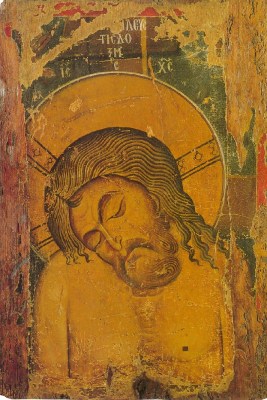
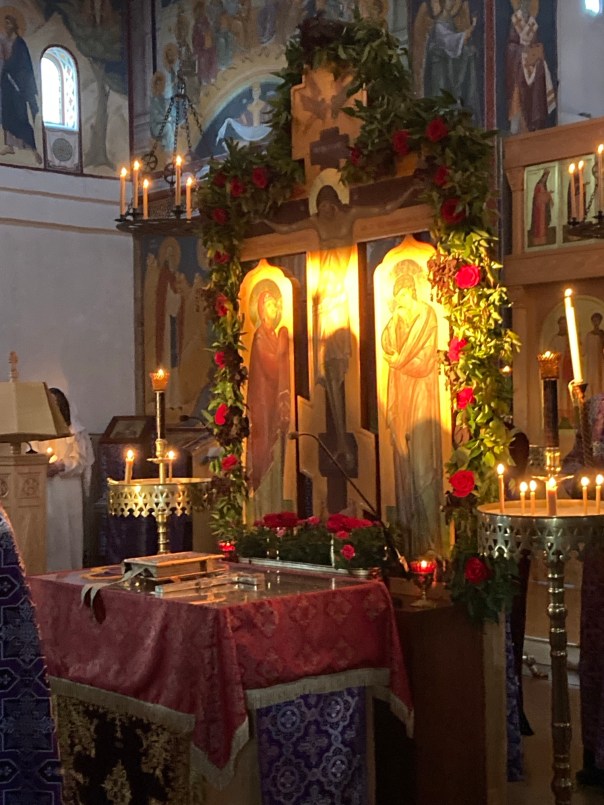
At the Holy Saturday services we sing about the Harrowing of Hell. Both of the pictures above are from Matins of Holy Saturday, which is Friday evening. On Saturday, after the Vesperal Liturgy midday, many people are bustling about the church tidying up and decorating in preparation for the Paschal service.

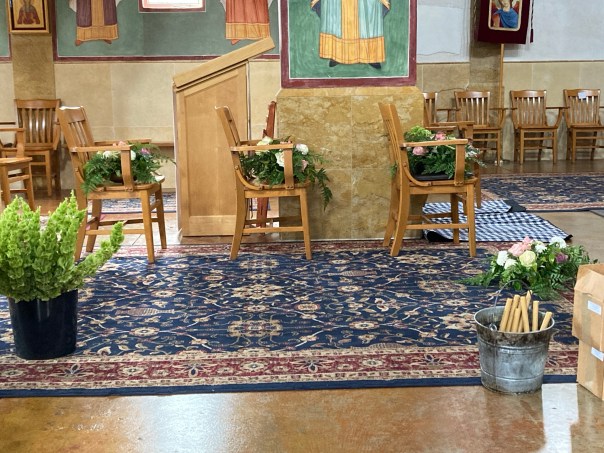
At the same time other parishioners take turns reading the Acts of the Apostles beginning from the end of Saturday’s Liturgy all the way until the beginning of the service at 11:30 p.m.
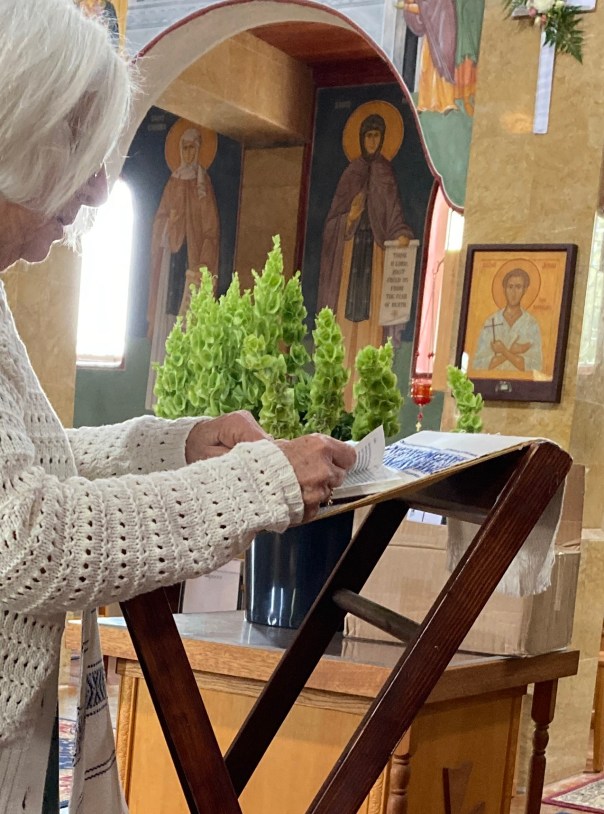
By the time we get to Saturday night we are prepared to exult finally, at midnight, to shout, “Christ is risen!” and, “Indeed He is risen!” and with all our being to sing until we are hoarse the many glorious hymns of Paschal Matins, about Christ’s conquering of death. As the gates of Hell have been broken down, so are the gates and doors of the church open throughout Bright Week.

Many, if not most people in my parish make traditional rich breads and Pascha Cheese (a mildly sweet loaf made of cream cheese and others) to eat at the feast, but I have never done this. One new friend, when she heard that I hadn’t baked anything for my household, was mildly horrified, but also very pleased that she had good reason to give me one of the four braided breads that she’d baked Saturday morning, in the style of her homeland of Moldova. So I went home with this cheese-filled pastry, which I’ve been enjoying very much.

As to the spiritual feast, truly, we need all the time until Pentecost to even partially digest the reality of it. I expect to be in Greece for the feast of Pentecost, which will be different! But for the next few weeks we live in the radiance of “Christ is risen!” May the light of the Resurrection shine on your whole week, and make it Bright.
The End and egg-dyeing.

It’s the end of Holy Wednesday as I write, and Fr. Stephen Freeman tells us that “The first three days of Holy Week are collectively known as the End.” So in a way this is the end of the end, but in another way we are at the beginning of the more intense days of this week leading up to Christ’s glorious Resurrection. In the meantime,

“Christ is moving towards His end, the consummation of the Incarnation. As He is increasingly revealed, everything around Him is revealed as well. Things are shown to be more clearly what they are. Those who hate Him, begin to be revealed as plotters and murderers. What was once only thoughts and feelings of envy become plots and perjury. The power of Rome is unmasked for its injustice, mere people-pleasing. The High Priest is revealed to believe that the destruction of God is good for his nation. The weakness of the disciples and the empty boasting of Peter and the rest are shown for their true emptiness. The sin of the world is revealed in the death of God.”

You can read the whole of it here: “The Bridegroom and Judgment.”

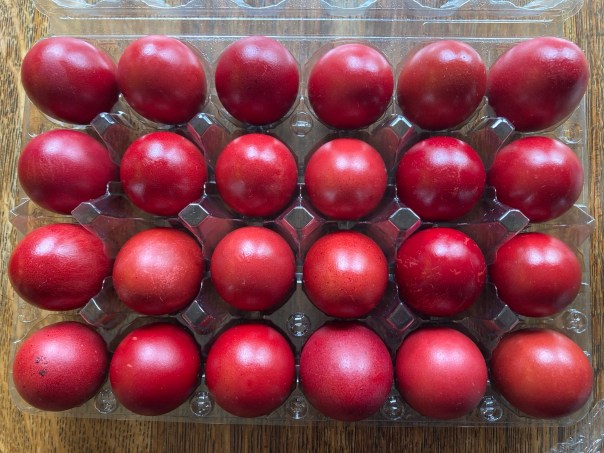
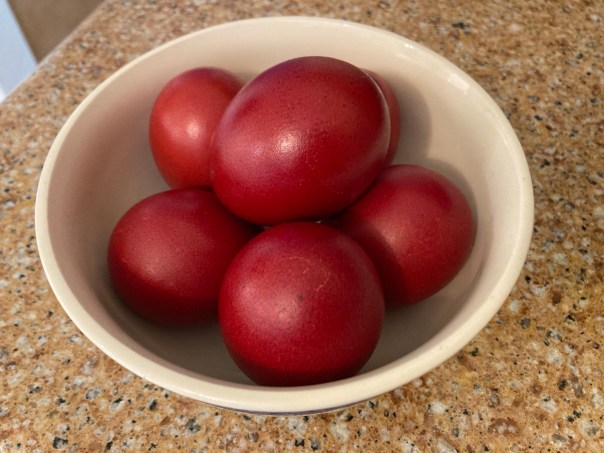
For me, it’s also the day of egg-dyeing. This year another parishioner and I split the work; I dyed only half of the red eggs that will be handed out at the end of our Paschal Liturgy in the wee hours of Sunday morning. I did it at home on my own today, and it was a very restful and quiet time.

Eat this scroll.

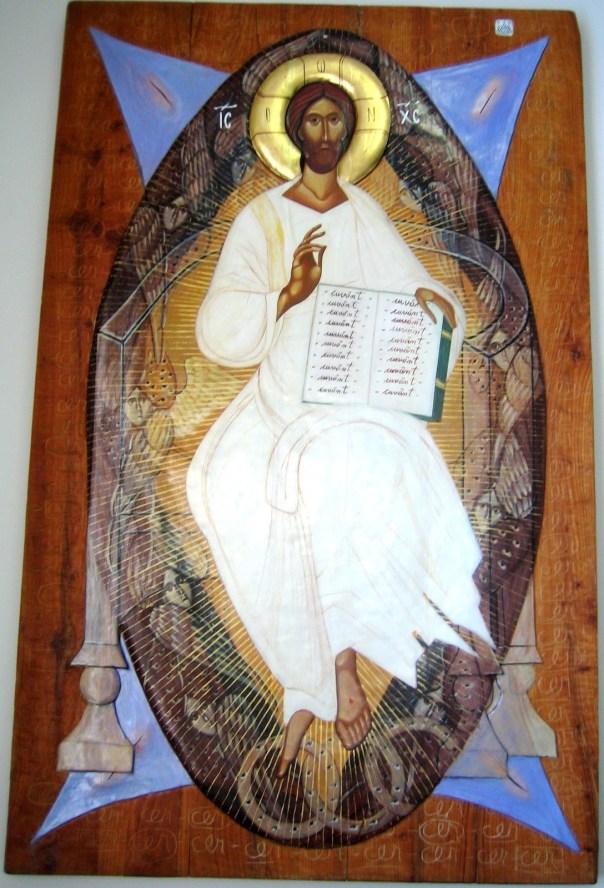
One of the readings for Holy Monday is from Ezekiel, a description of what the prophet saw in his vision of creatures and wheels:
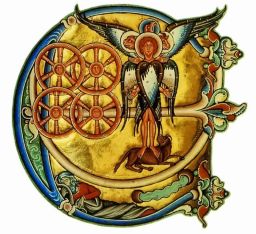
…a whirlwind was coming out of the north, a great cloud with raging fire engulfing itself; and brightness was all around it and radiating out of its midst like the color of amber, out of the midst of the fire. Also from within it came the likeness of four living creatures. And this was their appearance: they had the likeness of a man. Each one had four faces, and each one had four wings. Their legs were straight, and the soles of their feet were like the soles of calves’ feet. They sparkled like the color of burnished bronze. The hands of a man were under their wings on their four sides; and each of the four had faces and wings. Their wings touched one another.

The creatures did not turn when they went, but each one went straight forward. As for the likeness of their faces, each had the face of a man; each of the four had the face of a lion on the right side, each of the four had the face of an ox on the left side, and each of the four had the face of an eagle. Thus were their faces. Their wings stretched upward; two wings of each one touched one another, and two covered their bodies.

And each one went straight forward; they went wherever the spirit wanted to go, and they did not turn when they went. As for the likeness of the living creatures, their appearance was like burning coals of fire, like the appearance of torches going back and forth among the living creatures. The fire was bright, and out of the fire went lightning. And the living creatures ran back and forth, in appearance like a flash of lightning.

Now as I looked at the living creatures, behold, a wheel was on the earth beside each living creature with its four faces. The appearance of the wheels and their workings was like the color of beryl, and all four had the same likeness. The appearance of their workings was, as it were, a wheel in the middle of a wheel. When they moved, they went toward any one of four directions; they did not turn aside when they went.

As for their rims, they were so high they were awesome; and their rims were full of eyes, all around the four of them. When the living creatures went, the wheels went beside them; and when the living creatures were lifted up from the earth, the wheels were lifted up. Wherever the spirit wanted to go, they went, because there the spirit went; and the wheels were lifted together with them, for the spirit of the living creatures was in the wheels.

I was interested to see how artists might have rendered these images. Many of the pictures were quite psychedelic, and just as mind-boggling as the descriptions Ezekiel gave. My favorite was this quiet sculpture, detail of an Amiens Cathedral facade which shows only two wheels, and a prophet who might be seen as receiving his vision, or perhaps meditating on the whole of it — which would be impossible to render in stone. The complexity and drama are only hinted at by the way the wheels are interwoven or interweaving.

The church fathers have written that the four living creatures are the cherubim, the guardians of the throne of God. The burning coals are holy men, the lamps signify the light of the gospel, and the wheels signify Holy Scripture; St. Gregory the Great tells us that “the New Testament lay hidden by allegory in the letter of the Old Testament.”

Ezekiel closes his description (beyond this day’s reading) with the words, “This was the vision of the likeness of the Lord’s glory. I saw it, and I fell down on my face….” and God spoke to him, gave him an assignment, and gave him a scroll, saying:

“Son of man, eat this scroll, and go and speak to the children of Israel.” So I opened my mouth, and he fed me the scroll. Then he said to me, “Son of man, your mouth shall eat and your stomach will be filled with this scroll that is given you.” So I ate it, and it was in my mouth as sweet as honey.

My Bible footnotes remind me that the faithful can also know that sweetness that Ezekiel tasted, as the Psalmist sings:

How sweet to my taste are Your teachings.
More than honey and the honeycomb in my mouth.

This probably works best when we love and obey those teachings… Lord, have mercy!

Heal me, O LORD, and I shall be healed;
save me, and I shall be saved:
for thou art my praise.

Jeremiah 17:14