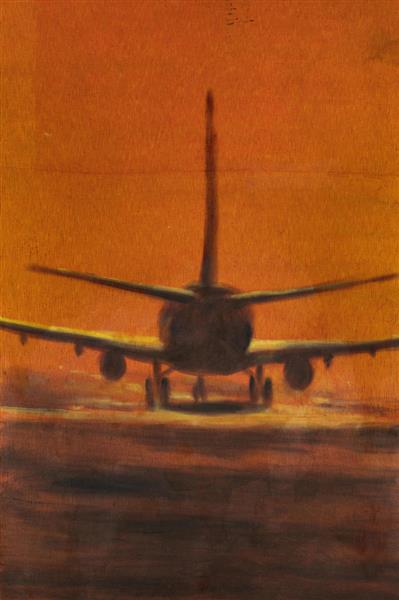
THE RACE
When I got to the airport I rushed up to the desk,
bought a ticket, ten minutes later
they told me the flight was cancelled, the doctors
had said my father would not live through the night
and the flight was cancelled. A young man
with a dark brown moustache told me
another airline had a nonstop
leaving in seven minutes. See that
elevator over there, well go
down to the first floor, make a right, you’ll
see a yellow bus, get off at the
second Pan Am terminal, I
ran, I who have no sense of direction
raced exactly where he’d told me, a fish
slipping upstream deftly against
the flow of the river. I jumped off that bus with those
bags I had thrown everything into
in five minutes, and ran, the bags
wagged me from side to side as if
to prove I was under the claims of the material,
I ran up to a man with a flower on his breast,
I who always go to the end of the line, I said
Help me. He looked at my ticket, he said
Make a left and then a right, go up the moving stairs and then
run. I lumbered up the moving stairs,
at the top I saw the corridor,
and then I took a deep breath, I said
goodbye to my body, goodbye to comfort,
I used my legs and heart as if I would
gladly use them up for this,
to touch him again in this life. I ran, and the
bags banged against me, wheeled and coursed
in skewed orbits, I have seen pictures of
women running, their belongings tied
in scarves grasped in their fists, I blessed my
long legs he gave me, my strong
heart I abandoned to its own purpose,
I ran to Gate 17 and they were
just lifting the thick white
lozenge of the door to fit it into
the socket of the plane. Like the one who is not
too rich, I turned sideways and
slipped through the needle’s eye, and then
I walked down the aisle toward my father. The jet
was full, and people’s hair was shining, they were
smiling, the interior of the plane was filled with a
mist of gold endorphin light,
I wept as people weep when they enter heaven,
in massive relief. We lifted up
gently from one tip of the continent
and did not stop until we set down lightly on the
other edge, I walked into his room
and watched his chest rise slowly
and sink again, all night
I watched him breathe.
-Sharon Olds, from The Father