Category Archives: quotes

Arugula and other flowers

rocket in bloom

When arugula flowers it becomes obvious that it’s a member of the mustard family. We like to call it rocket — that name is easier to say and also hints at how fast it shoots up. This is one of those vegetables that one would do well to plant every three weeks or so, if you want to have some tender young leaves on hand at all times. I made some soup with some tall plants a while back and discovered that the stems get as tough as bamboo when they lengthen out.

It took a lot of oomph to get myself into the garden this afternoon, but when I tested the levels I found that in fact enough oomph had accumulated after two days of rest for me to work for a few hours and fill the yard waste can with weeds and spent blooms.


How could there be so many spent flowers already? Hmm…well, they were blooming when it was raining day after day in March and we didn’t go into the garden much. Then I was gone for ten days, and they bloomed some more!

Cecile Brunner rose

All the thoughts I’d had about how I’m ready to move to an apartment with no yard, because I hate all the yard mess that I can never keep up with — they all vanished as I dug my trowel and shovel into the dirt and cleaned up around the greens and the flowers. I found three little Johnny Jump-ups that had dropped in near the greens and I tucked them in again and gave them a drink. I found two patches of parsley that look like they have been enjoying the weather immensely.

While I was in Maryland the freesias all bloomed, and Dutch iris came up so that I could cut some for the table. I took out most of the rocket, cut some back, and left a few to wave their petals in the breeze.

In the front yard, my amazing single purple verbena plant is blooming again! It bloomed and bloomed and spread over a square yard and more last summer, and didn’t freeze back. Verbena that I buy in 6-packs is so hard to keep alive, but three 4″ pots of some kind of super verbena that I bought at a good nursery are so vigorous and hardy. The two pink ones are in the back yard and the snails had munched them so I didn’t take their picture. They are blooming valiantly in spite of being defaced.

Certain muscles will be complaining tomorrow, but I did enough today to give me hope for the coming months. And I found a good quote from a 1936 book called Garden Rubbish that encourages me to take care of my garden so that I will like it more:

It is utterly forbidden to be half-hearted about gardening.  
You have got to love your garden whether you like it or not. 
Forget-me-nots and columbine leaves

Annunciation

Today is the beginning of our salvation,
And the revelation of
the eternal mystery!
The Son of God becomes
the Son of the Virgin
As Gabriel announces
the coming of Grace.
Together with him let us cry
to the Theotokos:
“Rejoice, O Full of Grace,

the Lord is with you!”

The announcement by the Archangel Gabriel to the Virgin Mary that she would bear the Christ, the Son of God, is one of the twelve Great Feasts of the church year in Orthodoxy, and is celebrated exactly nine months before the celebration of the birth of the Christ Child, on March 25th. The words above are from a hymn that we sing on this feast.

Not long ago I read The Presence of Mary, a booklet by Fr. Alexander Schmemann in the St. Athanasius Study Series, published by Conciliar Press © 1988. In 26 pages the author discusses in depth the role of Christ’s mother in our salvation history, and sets it against “…the fundamental spiritual disease of our time [that] must be termed anthropological heresy.”

That last clause piqued my interest, too! I’ve been wanting to take the time to read the booklet again and write a real review about the truths that Fr. Schmemann helps to clarify, but that time is not now. However, the present moment and celebration does seem to be right for at least posting a quote from the book, as we contemplate her who is “blessed among women”:

“It is clear that an abstract and impersonal study of man posits a self-evident conclusion: man as total dependence. An equally abstract exaltation of man posits its a priori premise: man as total freedom. But both are revealed in the unique personal experience of Mary, an experience given to the Church and made into her experience, as one and the same truth about man.

“In Mary, the very notions of ‘dependence’ and ‘freedom’ cease to be opposed to one another as mutually exclusive. We are inclined to think that where there is dependence there can be no freedom, where there is freedom there can be no dependence. Mary, however, accepts, she obeys, she humbles herself before the living Truth itself, a Presence, a Beauty, a Life, a Call so overwhelmingly evident that it makes the notion of ‘dependence’ an empty one — or rather identical and coextensive with that of freedom. For as long as freedom is nothing but the other side of dependence — a protest, a rebellion against dependence — as long as freedom itself depends on dependence for its meaning, it is also an empty notion. Each time freedom chooses and accepts, it ceases to be freedom. Here, however, in the unique experience of Mary, freedom becomes the very content of dependence, the one eternally fulfilling itself in the other as life, joy, knowledge, communion, and fulness.

“Admittedly these are poor, inadequate, and clumsy human words about an experience, a vision, a reality which transcends all human words. But, having read them, look again at that woman who eternally stands at the very heart of the Church filling our hearts with a mysterious yet ineffable joy, making us repeat eternally that same salutation which she heard in the depth of her heart on the day of Annunciation: Rejoice!”

-Father Alexander Schmemann

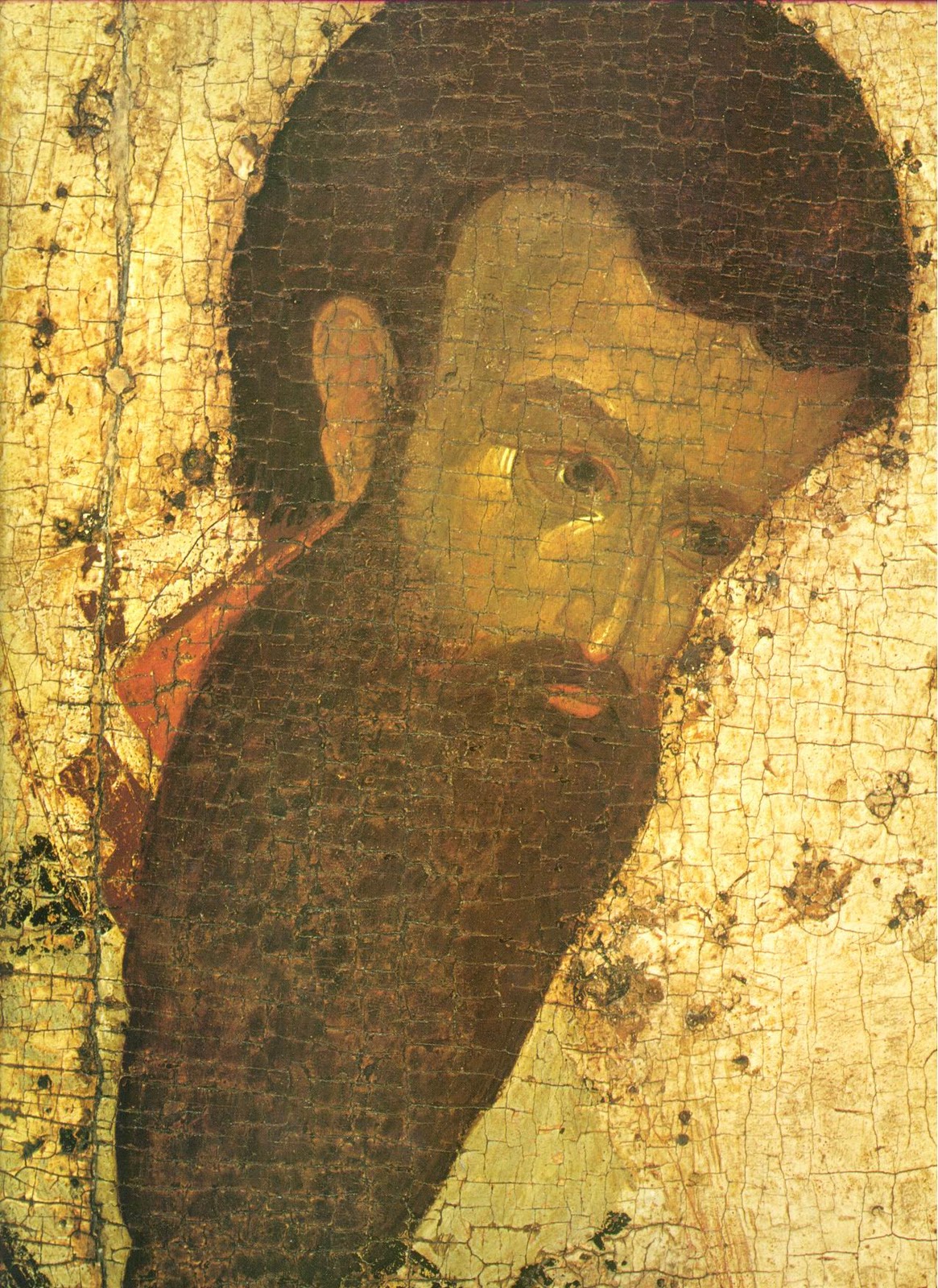
(Icon by Mikhail Nesterov)

Birthday Reflection

St. Nikolai

Yes, it’s my birthday today! Another day to thank God for all His wonderful gifts.

This spring I’ve been enjoying The Prologue of Ohrid by St.Nikolai Velimirovic. I splurged on this two-volume set of readings for every day of the year when our church bookstore offered it at a discount. I was the one who had to write down information about the book for a list of sale items, and that was the first time I’d actually looked inside. Something about the name along with its size had made me disregard it, but in the Preface I learned that the name Ohrid is “solely to distinguish it from the ancient Slavonic Prologue which — regrettably, because of its language — has become inaccessible to the Slavic people of our time.”

I’d heard and read many of St. Nikolai’s Prayers by the Lake, which are heartfelt and inspiring poems, so it is not surprising that his devotionals of three or four pages are also beneficial. They include stories of two or more saints commemorated that day, a Reflection, a Contemplation, a Homily of a few paragraphs, and often a Hymn of Praise. I’m happy to know that the whole thing is also available online, so I won’t need to carry my book across the continent later this month.

Today’s Reflection is a good one for Lent:

Even in His pain on the Cross, the Lord Jesus did not condemn sinners but offered up pardon for their sins to His Father, saying, They know not what they do (Luke 23:34)! Let us not judge anyone so that we will not be judged. For no one is certain that, before his death, he will not commit the same sin by which he condemns his brother. St. Anastasius of Sinai teaches: “Even if you see someone sinning, do not judge him, for you do not know what the end of his life will be like. The thief who was crucified with Christ was a murderer, while Judas was an apostle of Jesus, but the thief entered into the Kingdom, and the apostle went to perdition. Even if you see someone sinning, bear in mind that you do not know his good works. For many have sinned openly and repented in secret; we see their sins, but we do not know their repentance. Therefore, brethren, let us not judge anyone so that we will not be judged.”

St. Anastasius by Rembrandt