Today I’ve been tossing out most of my beloved Touchstone and Gilbert magazines, but not before I glance at notes I’d written to myself on their covers ten or more years ago, suggesting to my mind and pen (and keyboard) topics to muse and write about. I have accumulated several boxes of such periodicals, including cooking and gardening magazines as well, every issue containing provocative information and knowledge that I hoped to incorporate into my daily life, both the active and contemplative aspects.
One of them that drew me in was short enough to reread this morning: “It All Depends: on Randomness and the Providence of God,” by Philip Rempel. Rempel compares the Enlightenment view of the cosmos as orderly clockwork to the postmodern concept of it as random and chaotic. Both end up being “dead and dreary,” especially when contrasted with the reality of the world we see in front of us, and described in the language of Christ and the church.
“For the world we observe if we open our eyes is indeed a universe filled with both structure and freedom, but the structure is never a rigid structure and the freedom is never a lawless freedom. As in a dance, or all art for that matter, where rules and creativity must work in tandem to produce something of meaning, so it is with the universe. In some sense we are part of a cosmic dance, but the dance must be structured if it is to have meaning; a universe of arbitrary motion is just as unsatisfying as a universe without motion.
“The existence of every created thing, and thus its role in the dance, is entirely and continually dependent on God, and so our movement through the cosmos and through time, which is our response to his love, must be continually focused on him and directed towards him. Particles and probabilities, and people and planets, are all twirling through the cosmos in response to God’s loving call.”
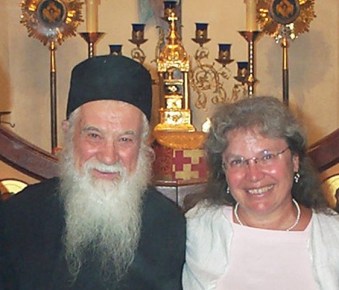
Just before I was to attend a recent baby shower, I found an article by Frederica Mathewes-Green, a sort of meditation on the power of a mother’s influence. It’s primarily about Father George Calciu, who was “one of the great confessors of Christianity in the twentieth century. Having survived the diabolic prison experiments of Communist Romania, Fr. George went on to become an apostle to spiritual seekers in Romania and, eventually, throughout the world.”
Fr. George spent a total of more than 20 years in prison. When later he was a pastor in the United States, he became Frederica’s spiritual father and confessor.
Her thoughts about his relationship to his mother seemed perfect to share at a baby shower, so I read the whole article before gifts were opened. Putting together what she knew personally of Fr. George, and what he told her about his mother, Frederica concluded:
“I think that Fr. George’s mother planted something joyous in him, when he was still a baby in the cradle. Her love and her delight in him took root, and grew as strong as an oak tree.”
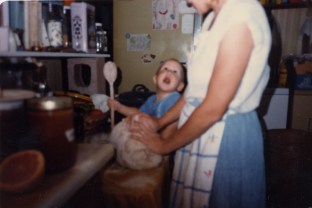
I have read many stories about people who, when as adults they found themselves in deep trouble and disorder from whatever source, for whatever reason, were sustained and preserved — and sometimes brought to repentance — by simple childhood memories of what was normal and good. Sometimes it was the thought of one sweet person, or one beautiful day, long ago embedded in their soul, like an ember still glowing. From this one bit of warmth and light they found the strength to pray and the courage to do whatever was necessary.
“We do not know where our children’s lives will lead them; they may have to undergo suffering that we will be unable to prevent. They may be somewhere far beyond our ability to help them. But in the loving care we give each day, we plant something for a lifetime. Each small thing we do can be preparing them to meet challenges that we cannot yet see.”
“Now, what do we mean by nominalism, and why is it important? There are many aspects of the nominalist position, but the main one is just the denial that this created world is an icon of a heavenly reality. Instead, nominalists hold this world’s form to be arbitrary, a product of sheer divine will.
“As Orthodox, we still comfortably assert that the world is an icon of heaven, or is meant to be. But in the West this union of the symbolic and the real became rather vexed. Now, we have even developed this destructive iconoclasm around gender, the human body, human sexuality, and so forth. Outside the Church, we have come to think that we can simply posit whatever reality we wish about these things.
“The nominalist and the realist positions must be reconciled. We must see that the reality of the world depends upon its being a symbol of heavenly realities. If creation is not a symbol of heaven, then its essence, its substance, would be of little importance. For example, if the world is just the arbitrary product of God’s will, then God could have made some other world, or not have given us gender, and so forth. And if the world’s form is arbitrary, then it is no longer ‘good,’ no longer beautiful and holy.”
This Lord’s Day we were remembering the paralytic, who sat by the pool waiting for a chance to get into the water at those times when an angel stirred it, so that he might be healed. After 38 years, Jesus came by and healed him.
Father John in his homily highlighted one aspect of the Gospel story: how we are like that man in our seeming paralysis when it comes to overcoming our sins. Priests often hear in confession the lament of the Christian who continues to battle the same weaknesses and failings year after year, feeling that he makes little progress.
I think a lot about the truism that habits are like a second nature to us. As we read in Jeremiah 13:23: “Can the Ethiopian change his skin or the leopard its spots? Neither can you do good who are accustomed to doing evil.”
It sounds very little like one chipper exhortation you might have read: “It’s never too late to be what you might have been.” Well, yes, why not just start today? When I read that on Tuesday, I remembered the paralytic, and I thought on my own unchanged bad habits. After his 38 years, wasn’t it in fact too late for many things? (The assumption is that one might have been greater; the reverse is probably more true, that it’s never too late to start a downward spiral.)
George Eliot (Mary Ann Evans)
For myself, let’s see…how many years have I been cultivating certain of my bad habits? More than that, I’m afraid. But it’s a simple thing: “The only thing that stands between me and greatness is me.” (Woody Allen)
George Eliot is credited with having made that bold assertion, “It’s never to late to be what you might have been.” She was the subject of a New Yorker article from February, 2011, “Middlemarch and Me,” by Rebecca Mead, who questions the validity of the quote and whether it even reflects the true outlook of the author Mary Ann Evans.
Mead has been a lifelong lover of Eliot’s books, Middlemarch in particular, and she points out some hints that the author leaves in her novels, as well as forthright confessions from her journals, to show that her general attitude was wiser and more modest.
In Middlemarch, we read of the main character, “Dorothea herself had no dreams of being praised above other women, feeling that there was always something better which she might have done, if she had only been better and known better.”
Mead writes: “Middlemarch is not about blooming late, or unexpectedly coming into one’s own after the unproductive flush of youth. Middlemarch suggests that it is always too late to be what you might have been — but it also shows that, virtually without exception, the unrealized life is worth living. The book that Virginia Woolf characterized as ‘one of the few English novels written for grown-up people’ is also a book about how to be a grownup person — about how to bear one’s share of sorrow, failure, and loss, as well as to enjoy moments of hard-won happiness.”
Let’s look back at the Paralytic by the Sheep’s Gate Pool. He must have had some way to propel himself, perhaps one limb that was functional, so that he could sit there for much of his life hoping to get down to the water first. He certainly had patience — and perseverance, to keep trying.
Father John said that even if we feel we have nothing more than a big toe’s worth of strength against our sins, we must keep struggling. Because we never know when Jesus will come to us. When he came to the cripple by the pool, He Himself was the source of the healing, and the man was delivered from his afflictions and was able to walk and carry his bed. For most of us, we will not receive the equivalent healing until we are resurrected in the coming Kingdom.
In the meantime, we will have failures. Maybe we will even think we are failures. It is very discouraging when one realizes what Samuel Johnson found: “The chains of habit are generally too small to be felt until they are too strong to be broken.” On another aspect of this human experience, Dorothea said in Middlemarch about her husband’s intellectual labors: “Failure after long perseverance is much grander than never to have a striving good enough to be called a failure.”
The most helpful sort of activity to persevere in, if one wants to be on the path to God, is prayer. “A long perseverance” of this sort would never be disappointing. The very moments of prayer have the potential to be Heaven itself, in the presence of the God Who is Love.
“In patience you possess your souls,” we read in Luke 21, and Mark Twain elaborates: “Habit is habit, and not to be flung out of the window by any man, but coaxed downstairs a step at a time.”
Whether we are being too easy on ourselves is the question. If we are being lazy, of course, that is one of the sins we are trying to overcome. And pride in thinking we are equal to any task, we can be anything we put our minds to — that also must be set aside.
Mary Ann Evans put it this way in her journal: “The difficulty is, to decide how far resolution should set in the direction of activity rather than in the acceptance of a more negative state.”
But I like best the way St. Seraphim of Sarov speaks about this, and will close with his gentle words: “One should be lenient towards the weaknesses and imperfections of one’s own soul and endure one’s own shortcomings as we tolerate the shortcomings of our neighbours, and at the same time not become lazy but impel oneself to work on one’s improvement incessantly.”
 Today I’ve been tossing out most of my beloved Touchstone and Gilbert magazines, but not before I glance at notes I’d written to myself on their covers ten or more years ago, suggesting to my mind and pen (and keyboard) topics to muse and write about. I have accumulated several boxes of such periodicals, including cooking and gardening magazines as well, every issue containing provocative information and knowledge that I hoped to incorporate into my daily life, both the active and contemplative aspects.
 I have read many stories about people who, when as adults they found themselves in deep trouble and disorder from whatever source, for whatever reason, were sustained and preserved — and sometimes brought to repentance — by simple childhood memories of what was normal and good. Sometimes it was the thought of one sweet person, or one beautiful day, long ago embedded in their soul, like an ember still glowing. From this one bit of warmth and light they found the strength to pray and the courage to do whatever was necessary.


 Gladsome Lights