Tag Archives: Jan Schmuckal

We were each other looking out.

“Late one winter afternoon as I was walking to a class that I had to teach, I noticed the beginnings of what promised to be one of the great local sunsets. There was just the right kind of clouds and the sky was starting to burn and the bare trees were black as soot against it. When I got to the classroom, the lights were all on, of course, and the students were chattering, and I was just about to start things off when I thought of the sunset going on out there in the winter dusk, and on impulse, without warning, I snapped off the classroom lights.

“I am not sure that I ever had a happier impulse. The room faced west so as soon as it went dark, everything disappeared except what we could see through the windows, and there it was—the entire sky on fire by then, like the end of the world or the beginning of the world.

“You might think that somebody would have said something. Teachers do not usually plunge their students into that kind of darkness, and you might have expected a wisecrack or two or at least the creaking of chairs as people turned around to see if the old bird had finally lost his mind. But the astonishing thing was that the silence was as complete as you can get it in a room full of people, and we all sat there unmoving for as long as it took the extraordinary spectacle to fade slowly away.

“For over twenty minutes nobody spoke a word. Nobody did anything. We just sat there in the near-dark and watched one day of our lives come to an end, and it is no immodesty to say that it was a great class because my only contribution was to snap off the lights and then hold my tongue. And I am not being sentimental about sunsets when I say that it was a great class because in a way the sunset was the least of it.

“What was great was the unbusy-ness of it. It was taking unlabeled, unallotted time just to look with maybe more than our eyes at what was wonderfully there to be looked at without any obligation to think any constructive thoughts about it or turn it to any useful purpose later, without any weapon at hand in the dark to kill the time it took. It was the sense too that we were not just ourselves individually looking our at the winter sky but that we were in some way also each other looking out at it. We were bound together there simply by the fact of our being human, by our splendid insignificance in face of what was going on out there through the window, and by our curious significance in face of what was going on in there in that classroom.

“The way this world works, people are very apt to use the words they speak not so much as a way of revealing but, rather, as a way of concealing who they really are and what they really think, and that is why more than a few moments of silence with people we do not know well are apt to make us so tense and uneasy. Stripped of our verbal camouflage, we feel unarmed against the world and vulnerable, so we start babbling about anything just to keep the silence at bay. But if we can bear to let it be, silence, of course, can be communion at a very deep level indeed, and that half hour of silence was precisely that, and perhaps that was the greatest part of it all.”

— Frederick Buechner
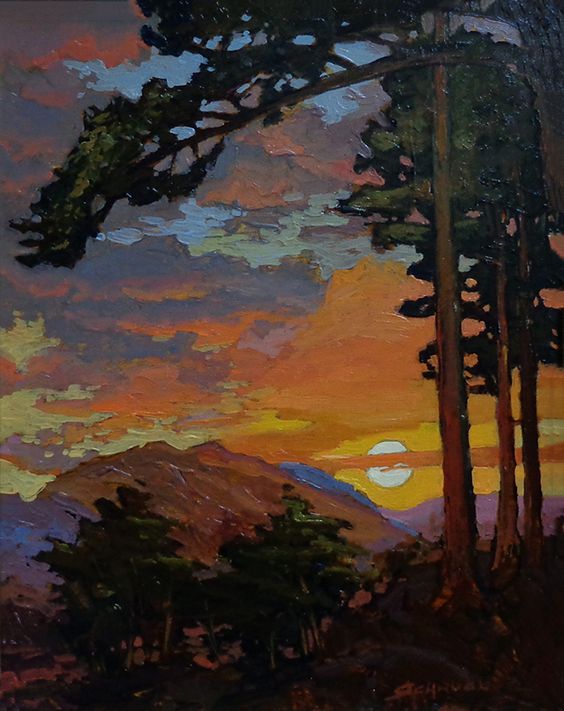
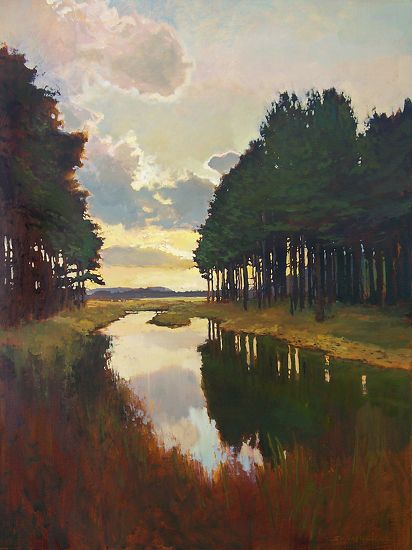
Jan Schmuckal, Sunset on the Pass

First read on Bologna.

For love of earthly life.

AT COMMON DAWN

At common dawn there is a voice of bird
So sweet, ’tis kin to pain,
For love of earthly life it needs be heard,
And lets not sleep again.

This bird I did one time at midnight hear
In wet November wood
Say to himself his lyric faint and clear
As one at daybreak should.

He ceased; the covert breathed no other sound,
Nor moody answer made;
But all the world at beauty’s worship found,
Was waking in the glade.

-Vivian Locke Ellis

by Jan Schmuckal

Anyone can possess a poem.

“Why We No Longer But Still Could Have Beautiful Things” is something Anthony Esolen discusses in an article titled “The Ugly and the Good,”  which was first published in Touchstone in 2020. This month he republished it in his Substack newsletter.

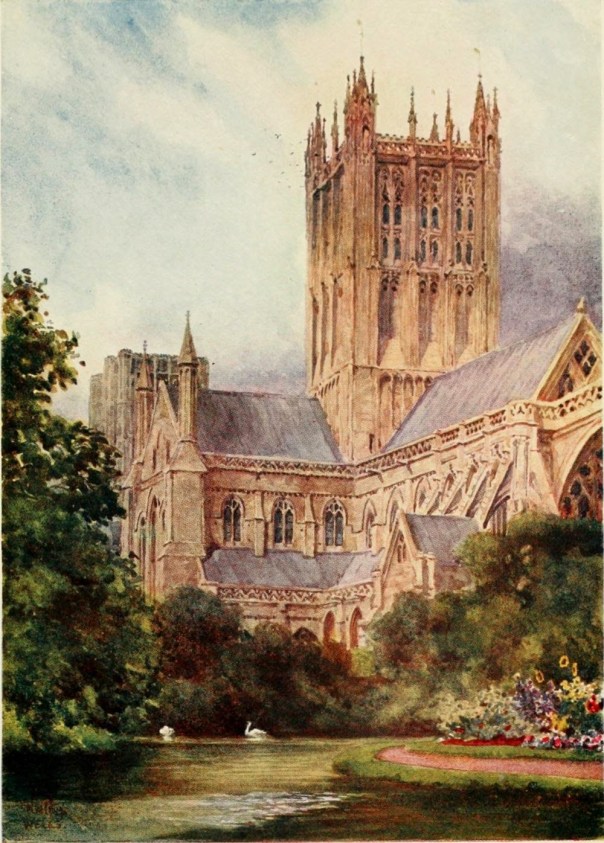
Wells Cathedral, England

Esolen begins by talking about beautiful cathedrals built in the Middle Ages:

“I’ve come to see the medieval cathedrals of Europe as the most glorious works of folk art the world has ever known…. They rose up as a lofty expression of the piety of ordinary people, the work of hundreds of men’s hands, digging the deep cavity for the foundation, hewing and setting delicate half-ton stones without mortar, mixing colors for paint or the glazing of windows, searching the forests for the tallest oaks to fell and to carve into beams to span a roof; far more kinds of work than I know and can name.

“They did it because they loved doing it. They were free.”

He contrasts freedom with license, using the example of Ebenezer Scrooge for the latter:

“To be free is not, O modern man, to be rid of all claims upon your love, your duty, your person, and your substance. If that were true, then Charles Dickens crafted a truly blithe and free spirit in the unregenerate Ebenezer Scrooge, crouching alone in his dismal flat and eating gruel gone sour. If you are talking about freedom and you are not talking about love and devotion, then you are not talking about freedom at all; you are talking about moral license, or a permission guaranteed by statutory law, that you may in some regard do exactly as you like, which may include gazing endlessly at evil pictures on your computer screen, and thus transforming yourself, cell by cell and pulse by pulse, into a thing, an automaton.”

Van Gogh, The Good Samaritan

His college students ask him for a definition of freedom, because, unfortunately, many of them are puzzled by his statements about what it is not. This is his answer:

“Freedom is the unimpeded capacity to attain to the perfection proper to the kind of creature you are. But since man is made in the image of the God who is a three-personed communion of love, his perfection, the enlargement of his soul, can only come by means of a gift, by the gift of grace from God, which enables him to make of himself a gift to others. There is no truly human freedom without grace, and the love that is its proper response.”

As to modern man’s failure to develop a love, or even a desire for beautiful things, Esolen proposes three reasons. If you’re interested enough that you’ve read this far, you can read them in the article: “The Ugly and the Good”

He also exhorts us to work on the restoration of the culture we have lost:

 “We must take back the heart, the chest, the seat of proper passions, which is to take back from Satan those commanding heights of the imagination, which is to reject the errors I have mentioned and to repair the harm they have done. We must not value the useful over the beautiful. We must not reduce beauty to a commodity. We must not forget that our experience of beauty should lead us back to the source of beauty, who is God.”

Esolen suggests that we spend more time cultivating an appreciation for art of every sort; and that we start with the beautiful things that are most accessible:

“Song and poetry are the most immediately available of all the arts, requiring only a human mind and a human voice. If you want a Rembrandt, you have to go see it, or carry a copy with you under your arm while you avert your eyes from the glare of the policeman. Grand pianos, with Van Cliburn sitting at them, are not to be found on every street corner. You cannot from your porch in New Hampshire gaze upon the great arms that Bernini conceived for St. Peter’s piazza, extending in the shape of a key to embrace the thousands who would come to worship there.

“But anyone can possess a song or a poem. If you have a voice, you can sing, and if you have a mind, you can remember what you sing. If you have a voice, you can utter a poem, and remember what you have uttered. In a way, you can best possess a song only by singing it, and a poem only by giving it the performance of your mind and heart and voice and body. Song and poetry should be the most democratic of the arts, more truly by the people, of the people, and for the people than anything else in our experience.”

That brings me to — Poetry Month! I have a little experience of what he’s talking about here, knowing by heart several poems from A Child’s Garden of Verses, which give me joy when I have occasion to recite them, usually to a grandchild, these days. How many songs do I know? Oh my, countless! After reading Esolen, I am extra grateful for all the songs and singing I have loved throughout my life. I am singing these days more than ever.

This short and beloved poem below, which I think I’ve shared here more than once — maybe I should compose a tune for it. Because of its simplicity and rhythm it embedded itself in my mind very easily, long ago, and years later it was right at hand to speak aloud, one night when my late husband and I were peering over a bridge into the dark, where with the help of a street light we could see ripples in the stream down below.

The tide in the river,
The tide in the river runs deep.
I saw a shiver
Pass over the river
As the tide turned in its sleep.

–Eleanor Farejon

May we nurture ever more beauty, music and poetry in our lives,
and offer the joy with thankfulness up to God.

by Jan Schmuckal