Behold the father is his daughter’s son,
The bird that built the nest is hatched therein,
The old of years an hour hath not outrun,
Eternal life to live doth now begin,
The Word is dumb, the mirth of heaven doth weep,
Might feeble is, and force doth faintly creep.
O dying souls, behold your living spring;
O dazzled eyes, behold your sun of grace;
Dull ears, attend what word this Word doth bring;
Up, heavy hearts, with joy your joy embrace.
From death, from dark, from deafness, from despairs
This life, this light, this Word, this joy repairs.
Gift better than himself God doth not know;
Gift better than his God no man can see.
This gift doth here the giver given bestow;
Gift to this gift let each receiver be.
God is my gift, himself he freely gave me;
God’s gift am I, and none but God shall have me.
Man altered was by sin from man to beast;
Beast’s food is hay, hay is all mortal flesh.
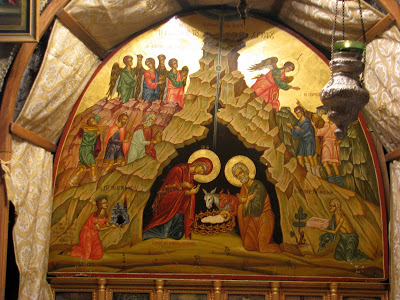
Now God is flesh and lies in manger pressed
As hay, the brutest sinner to refresh.
O happy field wherein that fodder grew,
Whose taste doth us from beasts to men renew.
If all the world a single body shared —
One heart, one breath, one blood, one flesh, one life —
Then sin has not one cell, one atom spared
The poison of shared wickedness and strife.
What wickedness, what strife, you well may ask,
Oblivious that you yourself are sick,
That fallen nature’s health is but a mask
And trust in this world just a devil’s trick.
We are one body, and our body died
The day we sinned, the days we sinned anew,
The walking-dead until the Crucified
By dying killed our sin to make life true.
And so, live well, ye merry gentlemen:
Sin’s antidote was born in Bethlehem.
On this Sunday in the Orthodox Church we remember the Holy Forefathers, the faithful ancestors of Christ, many of whom are named in a long list in the services yesterday and today, men and women like David, Jael, Daniel, Rachel, Moses and Ruth….
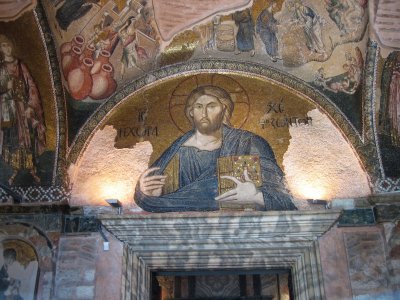
“The Land of the Living” – Chora
And the hymns sing of how they all, long since passed from this earthly existence, are even now “in the Land of the Living.” Thomas Hopko in The Winter Pascha mentions a church near Constantinople where a huge mosaic of Christ is named: “The Land of the Living.” I found a photo of it (above).
I learned in the short account of the life of Athanasius at the beginning of his On the Incarnation that the last and worst persecution of Christians ended in Egypt in 311 A.D., when Athanasius was about fourteen. From the age of five he had lived with the constant threat of death, and with the ever-present reality of persecution of his friends and family. The behavior of the ungodly is irrational and inhuman, and tends to cause great pain and suffering, often unto death, not only of the innocent but also of the most Christ-like. As an adult the scenes and events of his childhood seem to be fresh in his mind when he writes:
“A very strong proof of this destruction of death and its conquest by the cross is supplied by the present fact, namely this. All the disciples of Christ despise death; they take the offensive against it and instead of fearing it, by the sign of the cross and by faith in Christ trample on it as on something dead. Before the divine sojourn of the Saviour, even the holiest of men were afraid of death, and mourned the dead as those who perish. But now that the Saviour has raised his body, death is no longer terrible, but all those who believe in Christ tread it underfoot as nothing, knowing full well that when they die they do not perish, but live indeed, and become incorruptible through the resurrection. But that devil who of old wickedly exulted in death, now that the pains of death are loosed, he alone it is who remains truly dead.”
I started composing this post about death and the saint’s childhood before the horrific murders at a Connecticut school last week. I found the description Athanasius gives, of people bravely and even joyfully facing death daily, foreign to my 21st-century suburban self. But the topic turns out to be pertinent, and the recent stories of gutsy teachers in our own country inspiring — especially when taken with the letter from our Archbishop Tikhon after that event:
“Concerning those who have fallen asleep, Saint Paul exhorts us not to “grieve even as others who have no hope” [1 Thessalonians 4:13]. And yet, herein he does not forbid us from grieving. Now is the time for us to weep, but we must weep with the firm hope that comes from our faith in our Lord Jesus Christ. “Shed tears, but remain calm; weep modestly, and with fear of God,” writes Saint John Chrysostom. And following this example, each of us must strive to transform our sorrow into prayer.
Just this week I was asked to tell one of my favorite Bible verses, one that readily comes to mind without effort. It is always this one, that speaks of our complete dependence on the Lord as our LIFE, whether living or dying. Our leaves will not wither, because Christ Himself is The Land of the Living.
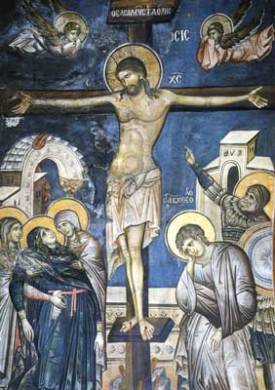
…the air is the sphere of the devil, and the enemy of our race, who, having fallen from heaven, endeavors with the other evil spirits who shared in his disobedience both to keep souls from the truth and to hinder the progress of those who are trying to follow it. The apostle refers to this when he says, “According to the prince of the power of the air, of the spirit that now worketh in the sons of disobedience.” But the Lord came to overthrow the devil and to purify the air and to make “a way” for us up to heaven, as the apostle says, “through the veil, that is to say, His flesh.” This had to be done through death, and by what other kind of death could it be done, save by a death in the air, that is, on the cross? Here, again, you see how right and natural it was that the Lord should suffer thus; for being thus “lifted up,” He cleansed the air from all the evil influences of the enemy. “I beheld Satan as lightning falling,” He says; and thus he re-opened the road to heaven, saying again, “Lift up your gates, O ye princes, and be ye lift up, ye everlasting doors.”

 Gladsome Lights