Monthly Archives: March 2019

Gospel for Forgiveness Sunday

For if you forgive men their trespasses, your heavenly Father will also forgive you. But if you do not forgive men their trespasses, neither will your Father forgive your trespasses.

Moreover, when you fast, do not be like the hypocrites, with a sad countenance. For they disfigure their faces that they may appear to men to be fasting. Assuredly, I say to you, they have their reward. But you, when you fast, anoint your head and wash your face, so that you do not appear to men to be fasting, but to your Father who is in the secret place; and your Father who sees in secret will reward you openly.

Do not lay up for yourselves treasures on earth, where moth and rust destroy and where thieves break in and steal; but lay up for yourselves treasures in heaven, where neither moth nor rust destroys and where thieves do not break in and steal. For where your treasure is, there your heart will be also.

Matthew 6:14-21 – Gospel for Forgiveness Sunday

Expulsion from Paradise – Palatine Chapel, Palermo, 12th century

As the soul, so the education…

Five years ago I posted this quote and comments as part of a blog-along about the author. Today as I read it I am half terrified at the tone of Chesterton’s statement, how he makes education sound like the most natural and effortless, even unstoppable thing. The health of the sub-cultures we nurture is more critical than ever, so that the “soul” of these little societies may continue to nurture us and to educate our grandchildren and great grandchildren.

Education is simply the soul of a society
as it passes from one generation to another.

–G.K. Chesterton

People who aren’t used to thinking in a Chestertonian way may think this statement extravagant, or overly poetic and ephemeral. I forgive them, because they likely are recipients of a societal soul that lacks perspective and understanding. It takes time and tradition to build a healthy society, and the modernists who taught many of us have lost the moorings of our Christian past. Many people don’t have a concept of passing something on to their children; they just want them to have a college degree so they can get a Good Job.

I have done most of my growing up in the little society of the family my husband and I created many decades ago, and the culture and nourishment has been good. The word soul didn’t come to mind as a descriptor of what we were trying to impart to our children, while we were trying to give them the best nurturing, the best culture for healthy growth, but now that I have for so long been focused on cultivating life in my children and my self, Chesterton’s way of describing it seems perfect.

Of course, it’s frighteningly full of possibilities. How would you characterize the soul of American society? Or the society of your extended family? Are you in a church that is unified and close-knit enough to constitute a society, and is it one that you can feel good about the next generation continuing? The process that GKC hints at brings to mind images of some ghost-like being floating over the globe, and I wonder how much control I can have over that?

At any rate, this thought makes me gladder than ever that my husband and I were able to homeschool our children for many years, and pass on to them thousands of small bites of hearty soul food. We can’t even know for sure which were superfoods and which were maybe just as nourishing, but harder to digest, seeing how God redeems and uses even our failures. But we cooked up the recipe ourselves, in our home kitchen, so to speak, and after all this time, it is still tasting very good.


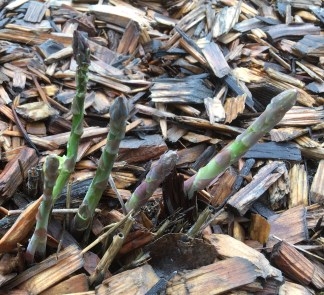
Asparagus shoots up, and I wait.

The rain continues, glory to God! But… it’s hard to get enough endorphins to keep in a good mood, when the rain keeps us indoors. A few times I’ve put on Celtic music and danced in order to get muscles exercised and my whole self warmed and enlivened. Yesterday I went for a walk that had to be shortened when the weather forecast proved wrong, and in spite of my longish raincoat I came home drenched.

But a few minutes previous, I had just got on to the creek path when I came upon a eucalyptus limb that had fallen the night before, when there had been no significant wind. Those of us who stopped to analyze the situation finally saw where the tree (on the left below) had broken, higher up than this picture shows. The log must have bumped lower limbs that forced it to flip over before it hit the ground.  We thought it likely it was so waterlogged that it snapped off from sheer weight.

One day neighbor Kim and I walked her dog between showers and I saw this friendly face on a cactus. My own garden is looking fresh and clean; asparagus are pushing up and the fava beans getting taller.

This morning a couple of ladies were coming for tea, and I found one calla lily with which to decorate the table. Last night when I thought to bake a cake for the occasion, I remembered these Brazilian Cheese Rolls that I love, and made them instead. I knew I had all the ingredients on hand, too, and since I’m still working on Using Up, they worked out perfectly.

 

The only starch in the recipe is tapioca flour, so they are grain-free. The first stage of dough containing hot milk, butter and tapioca is gluey. After it rests a few minutes and egg and cheese are added, lumps of the soft dough are pulled off and baked. This time my rolls were smoother on the outside than I remember. The inside is always moist and chewy with that dense mochi texture.


My remodeling project is not making much progress, because the architect seems to keep my small job at the bottom of his stack. I can’t apply for a permit until I have certain drawings, and who knows when they will ever be done. In the meantime I have plenty of work to do on my end, all falling into the broad category of Housework, but not so much that I can’t enjoy the rather restful pace I have fallen into, in my waiting. Lent begins on Monday, and especially in that first week I’ll be glad the house is not yet filled with sawing and hammering and men in boots tromping up and down the stairs. By the time construction starts the rain will likely have stopped, and in every way we will be feeling the lightening of springtime.

Four sad poems from the Japanese.

I picked four of the One Hundred Poems from the Japanese, collected and translated by Kenneth Rexroth in 1964. Why did I choose these in particular? They have a couple of things in common in that they are not obviously love poems, and they are sad and melancholy. The last one, by the “deified poet” Hitomaro, was his death poem. Next week I will post some verse that is less lonely, but it’s worth considering how some long-ago poets expressed this universal condition.

This is not the moon,
Nor is this the spring,
Of other springs,
And I alone
Am still the same.

-Ariwara No Narihira, 9th century


I may live on until
I long for this time
In which I am so unhappy,
And remember it fondly.

-Fujiwara No Kiyosuke, 12th century


All during a night
Of anxiety I wait.
At last the dawn comes
Through the cracks of the shutters,
Heartless as night.

-The Monk Shun-e, 12th century


My girl is waiting for me
And does not know
That my body will stay here
On the rocks of Mount Kamo.

-Hitomaro, 7th-8th centuries