Monthly Archives: December 2023

Christmas in the Trenches

Maria Horvath (blog now inactive) posted this song, scripture and video together many years ago:

We begin this month’s look at the different forms of love with one of the most thought-provoking statements ever made about love.

In the Sermon on the Mount, Christ tells his followers, “You have heard that it was said, ‘You shall love your neighbor and hate your enemy.’ But I say to you, Love your enemies and pray for those who persecute you, so that you may be sons of your Father who is in heaven; for he makes his sun rise on the evil and on the good, and send rain on the just and on the unjust. For if you love those who love you, what reward have you? Do not even the tax collectors do the same? And if you salute only your brethren, what more are you doing than others? Do not even the Gentiles do the same? You, therefore, must be perfect, as your heavenly Father is perfect.” ~ Matthew 5:43-48

The lyrics below tell the true story of a truce between British and German soldiers on the Western Front in 1914. It is told from the perspective of a fictional British soldier.

CHRISTMAS IN THE TRENCHES

Oh, my name is Francis Tolliver, I come from Liverpool,
Two years ago the war was waiting for me after school.
From Belgium and to Flanders, Germany to here,
I have fought for King and country I love dear.

’Twas Christmas in the trenches and the frost so bitter hung,
The frozen fields of France where still no songs of peace were sung.
Our families back in England were toasting us that day
Their brave and glorious lads so far away.

I was lying with me mess mates on the cold and rocky ground
When across the lines of battle came a most peculiar sound.
Says I, Now listen up me boys, each soldier strained to hear
As one young German voice sang out so clear.

He’s singing bloody well, you know, my partner says to me.
Soon one by one each German voice joined in in harmony.
The cannons rested silent and the gas cloud rolled no more,
As Christmas brought us respite from the war.

As soon as they were finished and a reverent pause was spent,
“God Rest Ye Merry Gentlemen” struck up some lads from Kent.
The next they sang was “Stille Nacht.” ’Tis “Silent Night,” says I,
And in two tongues one song filled up that sky.

There’s someone coming towards us now, the front line sentry cried.
All sights were fixed on one lone figure trudging from their side.
His truce flag like a Christmas Star shone on the plain so bright
As he bravely trudged unarmed into the night.

Then one by one on either side walked in to No Man’s Land
But neither gun nor bayonet, we met there hand to hand.
We shared some secret brandy and we wished each other well,
And in a flare-lit football game we gave ’em hell.

We traded chocolates and cigarettes and photographs from home,
These sons and fathers far away from families of their own.
Tom Sanders played the squeeze box and they had a violin,
This curious and unlikely band of men.

Soon daylight stole upon us and France was France once more.
With sad farewells we each began to settle back to war.
But the question haunted every heart that lived that wondrous night,
Whose family have I fixed within my sights?

’Twas Christmas in the trenches and the frost so bitter hung.
The frozen fields of France were warmed, the songs of peace were sung.
For the walls they’d kept between us to exact the work of war
Had been crumbled and were gone forever more.

Oh, my name is Francis Tolliver, in Liverpool I dwell.
Each Christmas come since World War I, I’ve learned its lessons well,
For the one who calls the shots won’t be among the dead and lame,
And on each end of the rifle we’re the same.

~ John McCutcheon, born 1952, American singer, musician, and composer
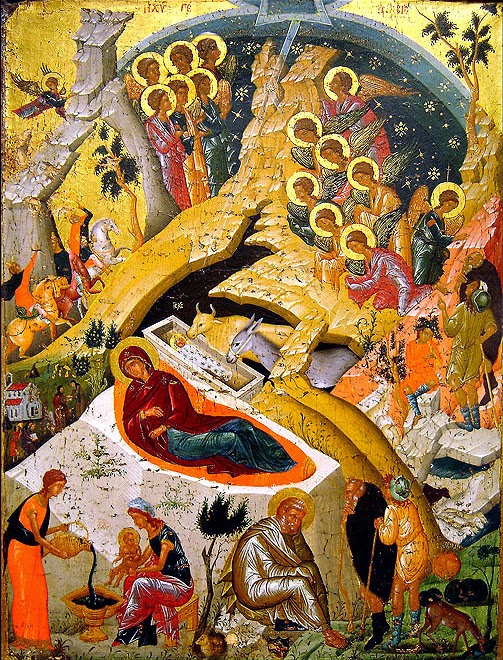
This is how the Word becomes incarnate.

THE NATIVITY OF CHRIST ~ A MEDITATION

…The greatest mystery of the Incarnation is that, having happened once in history, it recurs  in every person that comes to Christ. In the deep silence of the night the Word of God became incarnate on earth: this is how the Word becomes incarnate in the silent depths of our soul, where our mind lapses into silence, where words run out, where our spirit stands before God.

Christ was born on earth unknown and unrecognized, for only the Magi and the shepherds went out to meet him. In the same way, quietly and unrecognizably to others, Christ is born in a human soul, and it comes out to meet him, because a star has been born in it, leading to the light.

We mysteriously recognize Christ in us during prayer, when we discover that our prayer has been accepted and heard, that God ‘came and abode in us’ and filled us with his life-bearing presence. We encounter Christ in the Eucharist, when, having received his body and blood, we feel that our own body is penetrated by his divine energy, and the blood of God runs though our veins.

We encounter Christ in other sacraments of the Church, when through union with him we are renewed and revived unto eternal life. We encounter Christ in our neighbors, when we gain sight of his innermost depth where the image of God shines. We encounter Christ in our everyday life, when amidst its noise we hear his beckoning voice or when we see his manifest intrusion into the course of history.

Precisely so — unexpectedly and suddenly — God intruded into the life of humanity twenty centuries ago, when by his birth he turned the course of history. Precisely so is he born again and again in the souls of thousands of people, changing, transforming and transfiguring their lives, making believers out of non-believers, saints out of sinners, saved out of dying.

When, around two thousand years ago, the Divine Infant was born, the angels sang: ‘Glory to God in the highest, and on earth peace, good will toward men’ (Lk 2:14). In our days the world yearns for peace and good will. In the very place where Christ was born there is war, and Bethlehem itself is under siege. The Christian Church prays for peace in the Holy Land and in other countries for the forces of good to triumph over the forces of evil. May the Divine Child born in Bethlehem grant peace to the entire world, and good will to all its people.

—Metropolitan Hilarion (Alfeyev) of Volokalamsk


What Tess did write about.

WINTER SOLSTICE

I will not write about Christmas lights garlanding the tree,
how steadily red blends to sapphire  emerald  gold,
how strong the little bulbs must be to throw their dancing hearts
upon the café wall, how children try to catch them.
I will not say there is tinsel draped about the branches
like seaweed over pebbles, nor paint the cloths swaddling our skins
apricot, indigo, violet, teal. I will not speak of glazed
pastries on the counter, how they shine so much
they could be varnished, there for the hell-of-it, for the sheer
beauty of their glistening berries. I’ll turn away from buses heaving
down the rush-hour road, ignore how in all this rain
the headlamps could be tumbling garnets, polished amber,
as if a picture-book box of pirate treasure had spilt its pearls
and precious stones across a tarmacked page.

I will not describe how the sun becomes the sea, I will not delight
in words to name its colours – cerise, crimson, indigo,
scarlet, madder, rose. I will not try to find a way
to show your smile across the table, how it slips like warm charcoal
into the fabric of my heart. I will not suggest I light a candle
as the year prepares to wane, that you hold a second wick to mine
then another and another, that together we whisper a prayer
for each growing flame. I will not talk about the light
that is everywhere, how far you have to travel for the sky
to be completely black (and even then there are stars, there is the moon’s
borrowed brightness). I will not question why fire burns more fiercely  
before sputtering out, or how – when we know we’re dying –
we can be so fully alive. I will not say these things because this
is a poem about darkness. I am writing about the darkness.

-Tess Jolly

Pippin photo

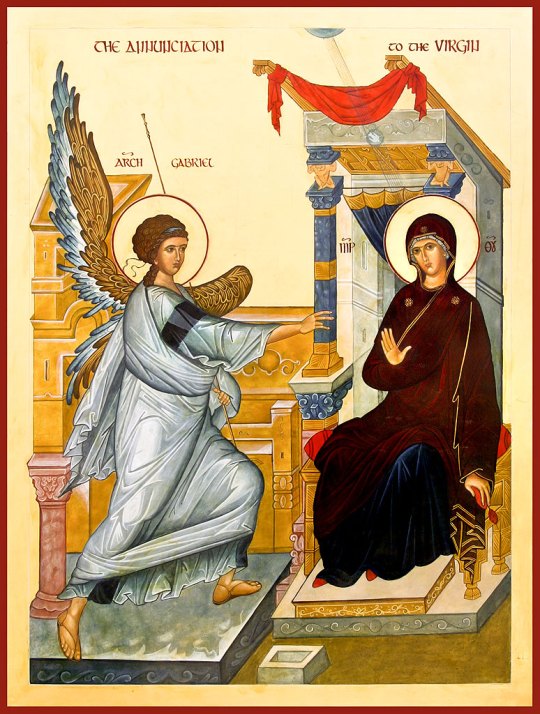
The Angel Gabriel from Heaven Came…

…His wings as drifted snow, his eyes as flame…

The first lines of the carol “Gabriel’s Message” take my imagination straight up to Heaven, and down again to the encounter the Virgin Mary had with the Angel Gabriel. This song of the Annunciation I heard for the first time a couple of years ago. Nowadays, if I so much as think about it once in the morning, or often even without consciously bringing it to mind, it plays in my head all day, beautifully, joyously.

In looking for a YouTube video of it to share here, I found that I don’t like the ones in which boys’ choirs are singing sweetly bird-like. It seems a strong man’s voice should speak the message of the first two stanzas, which come from Gabriel.

This version is my all around favorite, in which a choir sings in lower registers.

This man singing solo is my favorite manly rendition. I like the way he sings it straight, and the only way I’d improve on it is to not have to look at him as the performer.

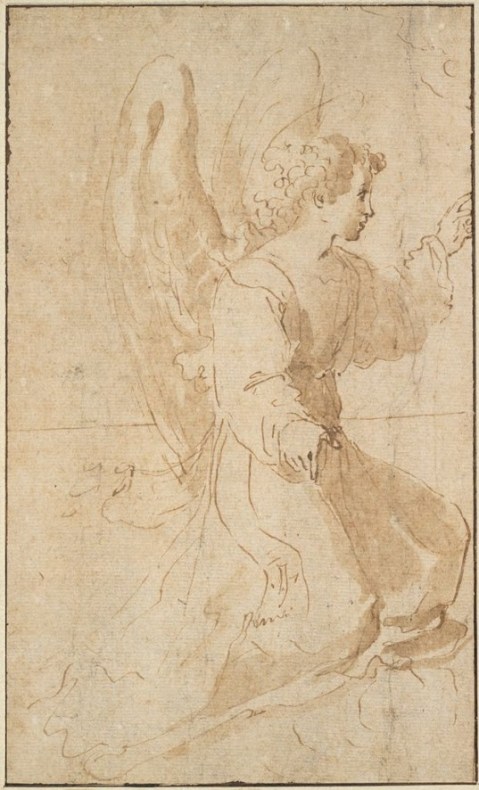
I was interested to see that there aren’t many icons or paintings of Gabriel in which his wings look anything like drifted snow. In fact, the image of drifted snow doesn’t evoke the idea of the strength that would be necessary for the swift messenger of God we know an angel to be. In many paintings Gabriel’s wings look very powerful, and poised to be in flight in an instant, at the next word from God. But the phrase does make me think of purity, and certainly the scene of fresh snow is somewhat other-worldly.

Angels do not have any inherent form; they are spiritual beings who only take on human-like form in order to be seen by those who are given the spiritual eyes to see. We don’t have a record of how the Archangel Gabriel appeared to the eyes of the Virgin, but we do know his message:

GABRIEL’S MESSAGE

1 The angel Gabriel from heaven came,
his wings as drifted snow, his eyes as flame;
“All hail,” said he to meek and lowly Mary,
“most highly favored maiden.” Gloria!

2 “I come from heav’n to tell the Lord’s decree:
a blessed virgin mother you shall be.
Your Son shall be Immanuel, by seers foretold,
most highly favored maiden.” Gloria!

3 Then gentle Mary meekly bowed her head;
“To me be as it pleases God,” she said.
“My soul shall laud and magnify his holy name.”
Most highly favored maiden, Gloria!

4 Of her, Immanuel, the Christ, was born
In Bethlehem, all on a Christmas morn,
and Christian folk throughout the world will ever say,
“Most highly favored maiden.” Gloria!

Annibale Carracci, 1600