Category Archives: nature

Snap, Crackle, Wisteria Pop

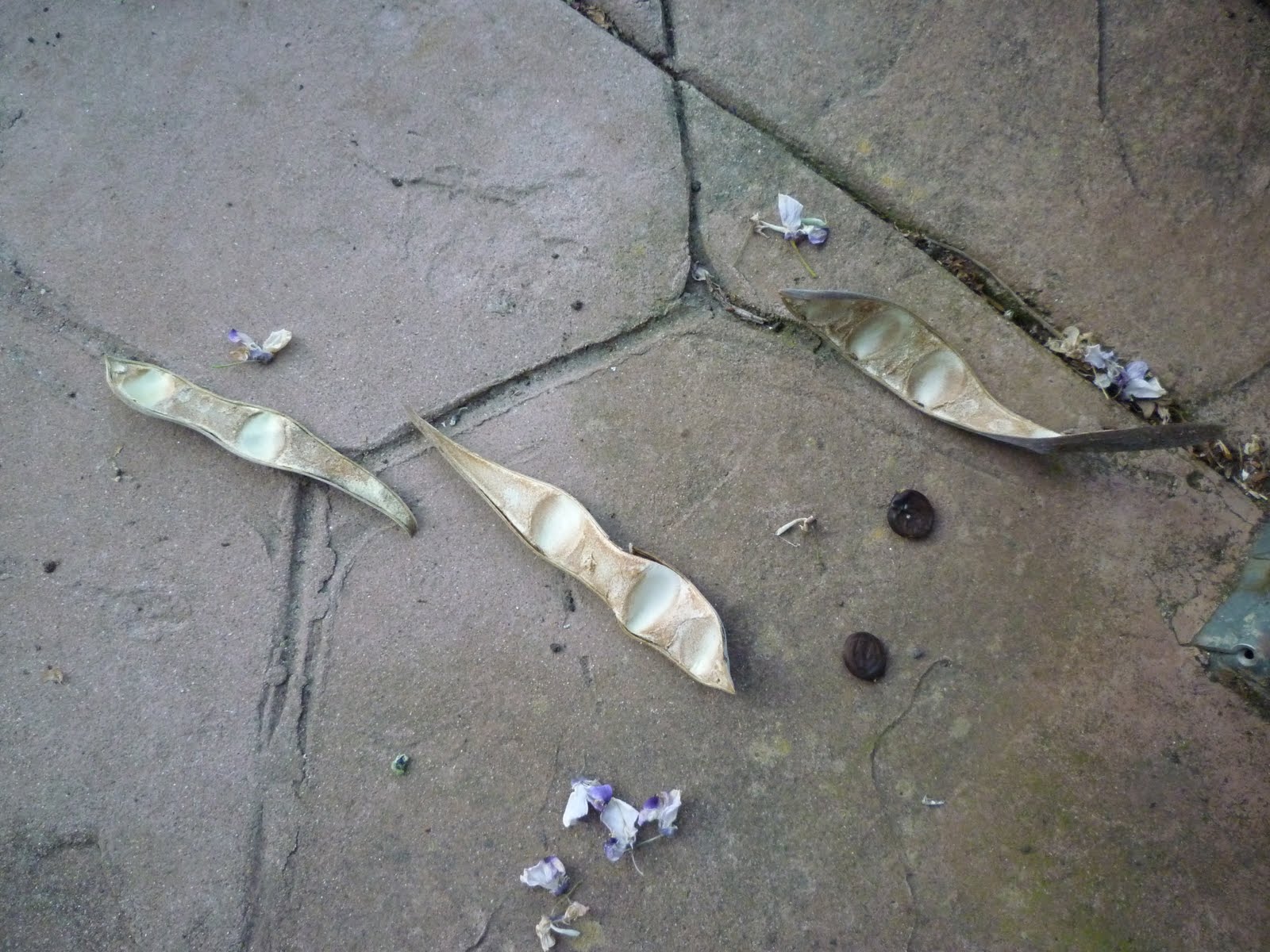
As Husband and I were lingering over our soup this evening, the sharp cracks began to interrupt our conversation. Our wisteria is at the peak of bloom, but some seed pods from last summer are hanging on. Just now, after a winter that was wetter and longer than usual, followed by several windy and warm days, they are exploding and shooting their seeds across the yard.

I went outside just before the sun went down and caught some pictures. Here is the evidence on the patio, along with fallen blossoms.


This picture shows two pods, one unopened, and one and seemingly just waiting for the wind to bring its seeds down.

At right, one seed sticking out from its pod, holding on by a thread.

It must be a complicated formula that tells the pods when to burst open, or a certain number of hot and cold contractions, combined with humidity, that determines why some shoot in the spring, and some in the fall.

One September our neighbor whose yard backs up to ours phoned us after dark and said, “I am really afraid; it sounds like someone is shooting at my house!”

We told her it was the wisteria. Hers always blooms way earlier than ours in the spring, being on the east side of her house, while ours is on the west, and in its own tardy micro-climate. They probably do their seed-scattering alternately as well.

We are kept busy pruning or sweeping, smelling or listening to this vine through all the seasons of the year. It’s a great back yard resource!

Waterfall with Train and a Dipper

Over the weekend Husband and I enjoyed a trip together to visit Pippin and her family; this time it was a short vacation, not the grandma-only working visit. Though I must say I prefer not to split life into such categories; I like the attitude that we tried to take as homeschoolers: Always on vacation, always in school. When traveling, I always learn things, whatever you call it.

We were in too much of a hurry on the drive up for me to take pictures, but I have to at least mention that my eyes were sated with lupines, great spreading fields and banks and roadsides full of them, on and on for two hours. The farmland, once we got toward the center of the state, was impressive with plantations of tiny tomato plants, onions in rows, and clouds of wild yellow mustard filling the ditches and anywhere the fields hadn’t been plowed.

A smudge on my camera lens turned into a glaring spot on most of the photos I took (and yes, it was the real reason, I know now, for the mysterious brightness of that calendula I posted a while back), but we will just have to overlook this imperfection when it shows up, as in this shot showing how my socks happened to match the tiny violets that have sprung up all over Pippin’s back yard.

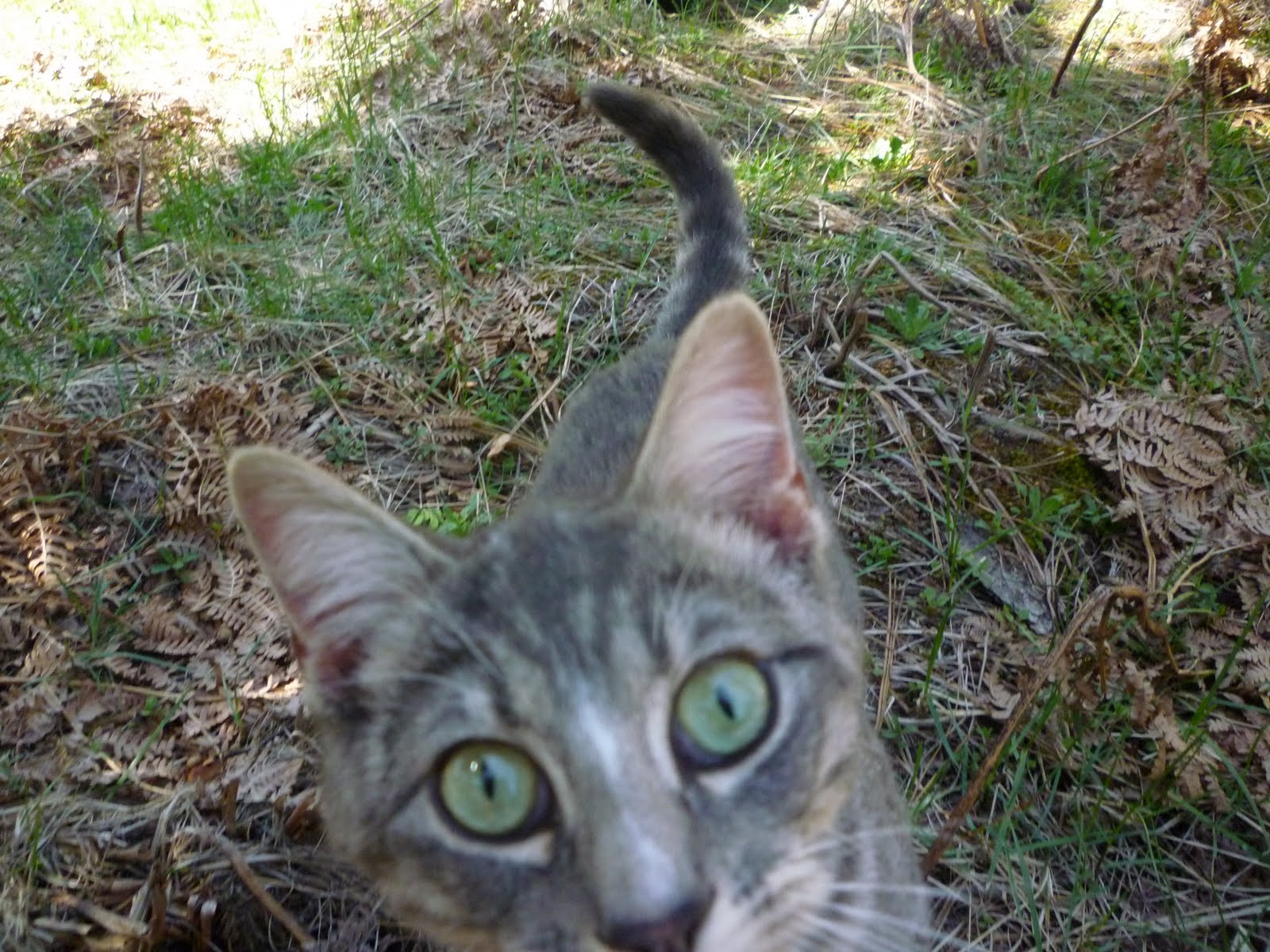
Four cats still co-exist in the household, where they line up for meals twice a day. The big eyes belong to Little Cat.

A highlight of the weekend was seeing some waterfalls that flow year-round. Near the parking area from which one sets off for the falls, we had to wait for a train to pass over the crossing, before we could get to the other side and leave our car.

Everyone thought that someone else had put the diaper bag and the baby backpack in the car, but no one had. We did without, and took turns carrying Baby Scout.

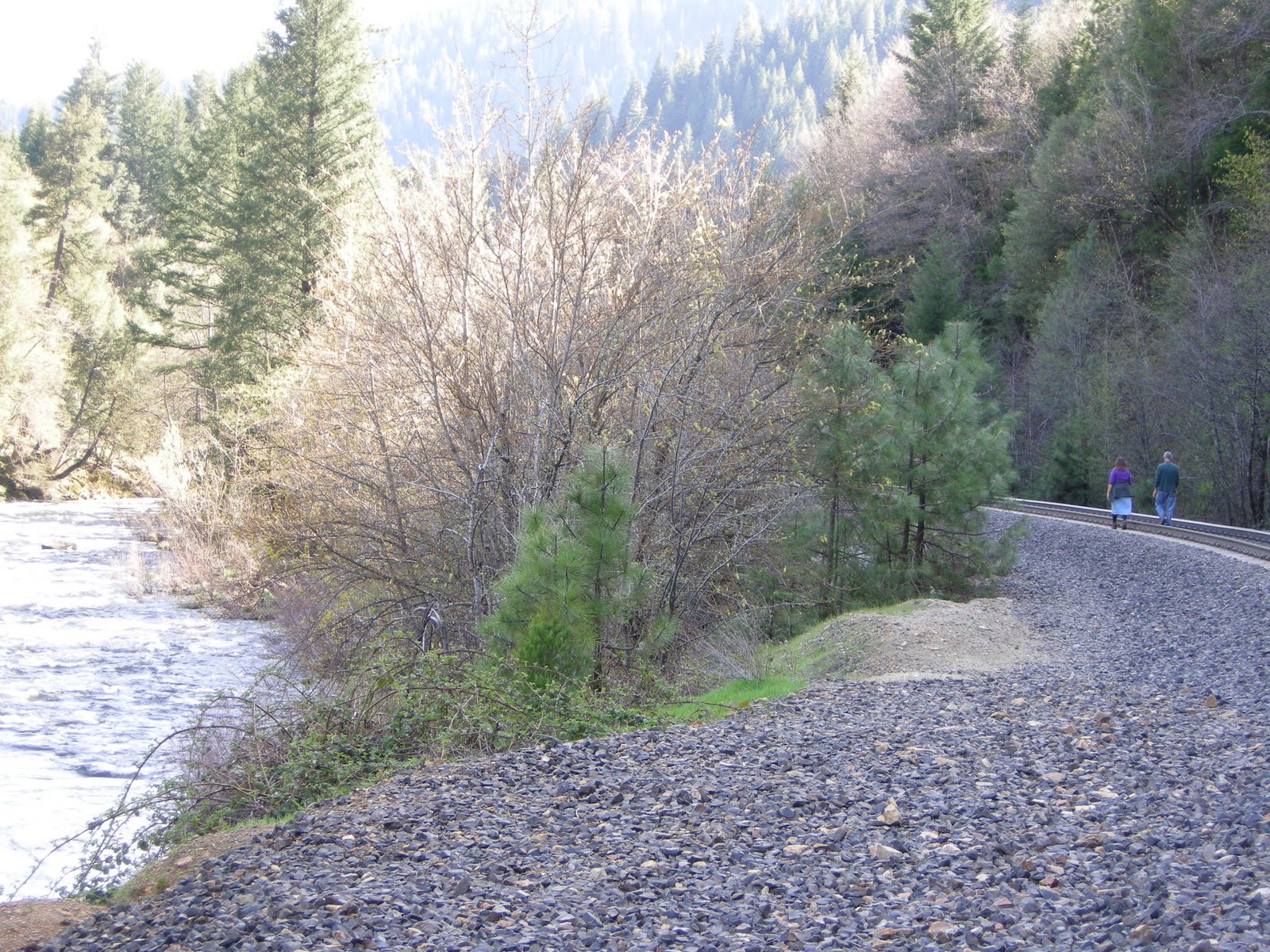
We had to walk close beside the railroad track for a mile to get to the scenic spot. As soon as we began hobbling over the rocky slope next to the rails, the train that had just passed reversed direction and slowly came back alongside us hikers. If I had any hobo blood in me, I’d have wanted to pull myself right up and go somewhere, anywhere, just for the romance of it.
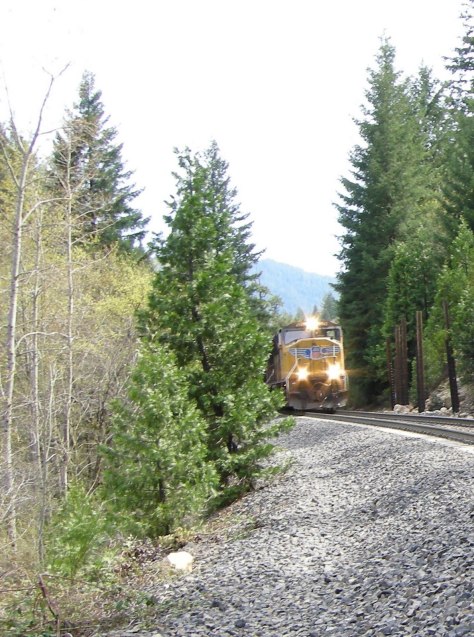
The train was remarkably quiet, rocking gently on its tracks. Our boots made more noise crunching on the largest gravel I’ve ever seen. After five minutes or so of this unreal intimacy with the looming cars, they had rolled away behind us, and we could see the Sacramento River, down the mountain where the train had blocked our view. We looked back to see this image of the locomotive backing away behind us.

The falls come right out of the hillside, not from a specific creek or spring, and fall into the river, which bends into a curve at that spot, so that it’s not possible to catch the whole span of water falling. It’s even hard when you stand in the middle of the river downstream, as we learned from one who has done it. So my photo shows about 1/4 of the total waterfall.

Pippin notices birds. She pointed this one out to me after she’d been watching him for a while.

She’d also seen his kind before at this falls, and was pretty sure she’d seen it go under the water. When we got home she looked him up in the Peterson Guide and found out he is an American Dipper or Water Ouzel. And they do walk on the bottom of streams! My picture didn’t come out as clear, so I give credit to my daughter for this one.

On second thought, my photo is so different, I think I will show it to you, too. But it’s hard to see my guy in all the glitter of the water spray.


John Muir called this bird the Waterfall Hummingbird, and wrote a lot about it. The illustration below comes from his writings, and I assume is by his hand.

ec1e2-muirouzel

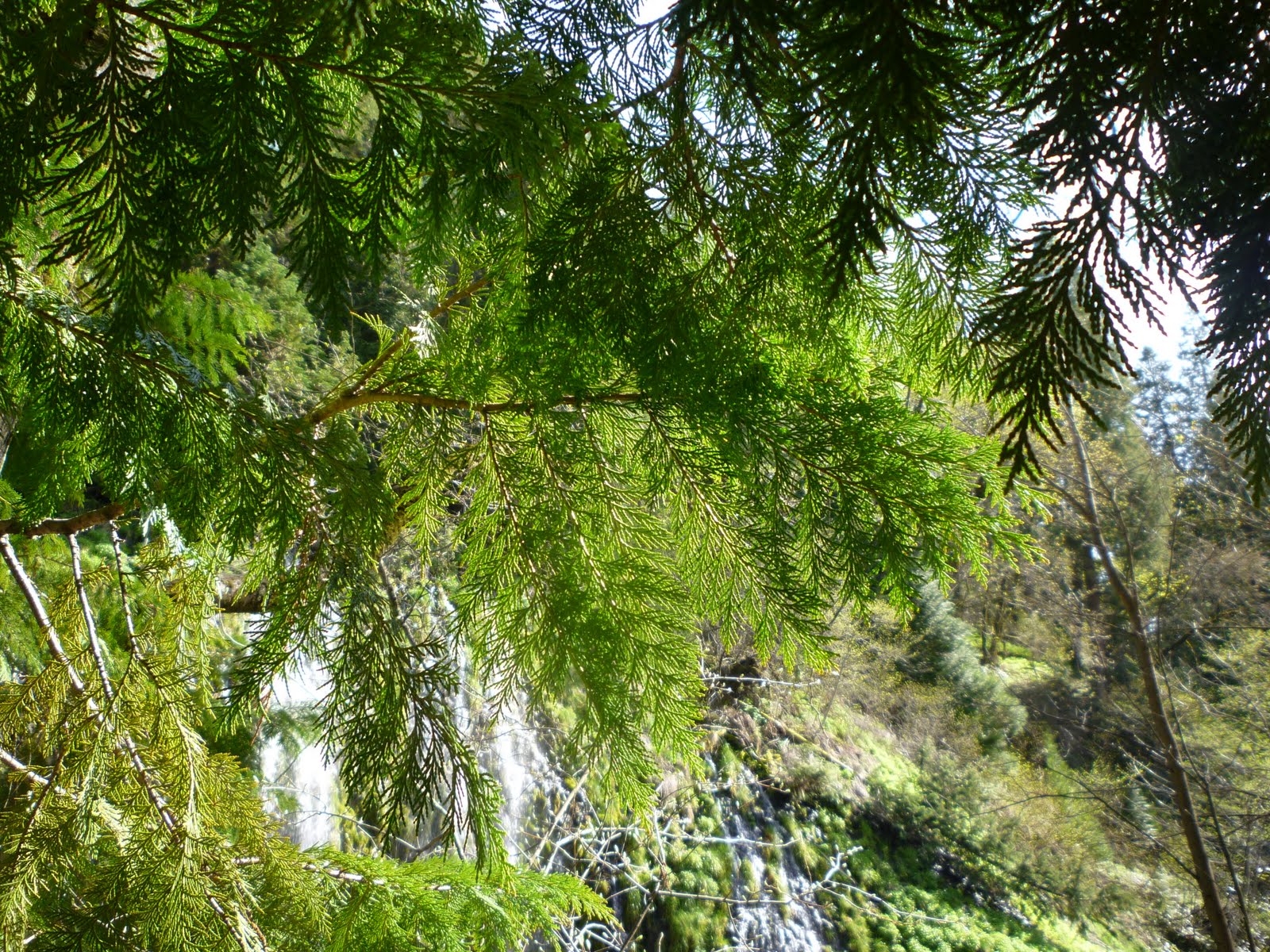
I never know what I will learn when I’m with my “Nature Girl” daughter. We looked at the cedars growing around the falls, and she showed me that some of them were Port Orford Cedars, which love shade and water. Their needles are softer and finer than the incense cedars that are more common.

The contented Grandma and Grandpa are walking back along the tracks
in the westering sun.

I learned the name of a brilliant bush that startled me several times on my journey earlier this spring driving this route, it was so dramatic popping out of the grey-green hillsides. Pippin told me it is Redbud.

Frequent sightings of Redbud cheered our way home again yesterday, and we weren’t too hurried to stop and capture it in one dimension.

It was a very full weekend. I haven’t told half of what I saw and heard–but writing this fraction in a blog I hope will help at least some of it stick with me a while.

Spring Plants Come Home

It was a bit of a drive this morning, to get to the spring organic plant sale at an “ecology center” I’d never visited before. My main reason for going was to get tomato plants that are grown and tested in a place that is of a similar climate to us; I don’t want another Pitiful Tomato Summer. Oh, our tri-color cherry tomatoes saved us last year, but all the space and attention we gave to the regular tomatoes was not equal to the reward.

I was a little puzzled as to why they were having their sale so early; we never plant tomatoes until the first of May. But I thought I could just keep the plants under cover for another couple of weeks. As it turns out, I won’t have to do that, because when I arrived at the sale right after it started at 9 a.m., I couldn’t find what should have been a giant collection of tomato plants. “We will sell those at our next sale, May 1st,” a staff person told me. Aha! I hadn’t nosed around long enough on the website to learn all I needed to know.

My trip was not for nought, however. I’m glad for my error; otherwise I wouldn’t have bothered going there. I’d have missed the lovely drive under clouds, along fields spotted with Spanish Broom. This plant always reminds me of a time when Pippin was a toddler and I’d pack her on the back of my bicycle in the mornings to ride for a few miles along banks of broom in bloom, our heads filling with the sweet scent as we breezed by.

Today I also saw one of the remaining fields of fava beans. I love how these grow almost secretly all winter, and then when we emerge from our winter dens they are already tall and robust. Along with asparagus and artichokes, they used to keep my former (bigger) garden busy until we were ready to plant more tender things. I forgot to take my camera, so I found the fava pic on the Internet.

Even though there were no tomatoes, I found several enticing items to spend my money on, what with so many healthy looking young specimens spread out on tables under trees.

As long as we’ve lived in our current place, I have been unsuccessful at growing New Zealand Spinach from seed. Though it’s not a true spinach, I really appreciated it in the past for the way it grows all the hot summer long and is handy to toss into any dish where you want the flavor of spinach. As I recall, I mostly used it in Creamy Green Soup, a Laurel’s Kitchen cookbook recipe. My gardener-heart rejoiced to see a six-pack of my old friends, so I snatched that up first thing.

After a friend gave me a cutting once, I had rose geraniums propagating all over the yard for several years. But they had all died; I brought this one home to parent a new generation.

I bought some bachelor’s buttons, which I don’t recall growing before, and a Hummingbird Sage, which I might plant at church instead of home.

And three little pots each holding a different type of flat-leafed parsley! In the picture you can see a fourth little pot on the left, of Copper Fennel. Don’t know what I’ll do with that, other than chew on the feathery leaves if there are enough of them.

To get back to my car, I had to hike up a steep hill, carrying my box of plants. That was a good thing; I knew at the outset not to choose too big a box, or I’d have to make two trips.

Close to the plant sale is a nursery that I don’t get to very often, so I had to stop in there, to see if they had snapdragons and stock in the colors I wanted. They did! And they had several other things that begged to go with me, which I was kind enough to arrange.

When I got home I took a picture of the whole caboodle. Oh, but that was after I stopped at another nursery closer by, just to see if they had any taller snapdragons yet, which they didn’t.

Rain was beginning to fall, so I decided to just go home and write my report on my morning. I’ve been up since Mr. Glad’s alarm went off at 5:20, and before I went plant shopping I swam at the gym. So I’m almost worn out already.

Yesterday my young church friend C. worked with me in the garden here for almost two hours, and it helped me tremendously to have a willing and diligent companion as I broke through the months-long growth of mammoth weeds.

C. carried dozens of loads of pulled weeds to the garbage can, and cleared layers of pine needles from the path and off the cyclamen and manzanita. He never stopped moving, even while he told me all about his favorite books and movies, and about cartoon characters he has created. I’m going to try to have him at least twice a month, as a concession to my aging body that hurts and slows down when I abuse it by stooping, pulling, hauling and pruning for more than a couple of hours at a time. He might help me with housework, too. But this week we stuck to the garden and even planted some lilies.

An Olive Tree is More Than Interesting

In a recent post I said that my birthday olive tree was “an interesting gift.” I suppose it was because I was dead tired that I couldn’t think of a more telling word. I’m embarrassed to use such an uninteresting word as interesting. Ugh. The truth is, to receive the gift of an olive tree on the occasion of getting older made a huge impression on me. If I hadn’t needed to finish that post quickly and make dinner…well, enough of the excuses.

I love to look at these trees, so as I was browsing them on the Internet I pasted some pictures here. Vincent Van Gogh painted several scenes of olives.

A post about olive trees was one of the first in my string of blogs. And recently on my tree-rich trip I saw old California orchards. My childhood was near the groves that made Lindsay Ripe Olives famous, though as I have mentioned, I don’t like the fruits, and my family never had an olive tree on our property. Olive oil gelato? Very West-Coast, and I would be willing to give that a try.

You can adopt an olive tree growing in Italy, like the one at top, and then receive its produce for a year. I suppose you have to adopt it, or a different one, again the next year. Not very good parenting.

Montenegro is the home of this pocked giant, which is reputed to be 2000 years old. The longevity intrigues me, along with all the Biblical references, which I haven’t even begun to think about. Mention of them often goes along with general descriptions of abundance and productivity of gardens, and with pomegranates and figs and vineyards.

There’s a story of the olive tree who was asked to be king, and the olive branch in the dove’s mouth after The Flood. Doors for the Temple were carved in olive wood. Many people make reference to it being the tree of Peace, and God knows I need that–I need Him.

What does it mean, “I am like a green olive plant in the house of my God.” ?  It means alive, if it is green. Let me flourish in Your House, O Lord. Let me live in You.

Getting back to the trees themselves, the grove I would most like to visit is this idyllic one in Turkey , the fifth-largest seller of olive oil in the world– but trying to get to second place. Olive oil I do much appreciate, and can imagine having a picnic on the warm yellow grass, of bread dipped in oil, sitting on a blanket under the sun. Once during my sojourns in that very country, I helped women in shalvar* gather olives from the ground where they’d fallen. I even sampled one of the wrinkly brined olives they cured in flat pans spread around under the trees, and had to restrain myself from immediately spitting it out.

*(I tried in vain to find a picture of these baggy pants that so many women still wore in Turkey in the 60’s and 70’s. These days a version has become high fashion, and the ones worn by chic models are not the ones I saw and wore. Perhaps this will be be the subject of a future post.)


The Garden of Gethsemane figures prominently in the events of our salvation history, into which we entered last week through the services and events leading up to Pascha. And this tree lives there. What if it is also 2,000 years old?

I planned to post this blog before Pascha, but now here we are post-Gethsemane, post-Golgotha. Wherever olive trees, any trees, are living, this week they are dancing.