Tessa Carman was having a conversation with Paul Kingsnorth last year, on “Following Christ in the Machine Age.” This is an overarching theme of Kingsnorth’s thinking and writing. Their conversation was leisurely and ranged over many topics, everything from books they have been reading, to Kingsnorth’s conversion, to Hollywood, to being “cancelled.” Kingsnorth lives on a “smallholding” in Ireland, so naturally the conversation turned to how we humans treat the land. I liked the point that Carman brings up, about how farmers traditionally have not been sentimental about nature, but because they “have to do” the work of caring for the land day in and day out, they develop an intimate relationship with it:
“Christians were not untouched by modernity. Especially when there’s more uprootedness — I suspect it’s easier to treat things like machines if you are used to living amongst machines. And if you’re used to taking care of a piece of land, where you have to treat it as a living thing in some sense, even if you don’t think of it as a living thing, that’s just what you have to do, because there’s a living relationship amongst the animals and the land and the people. You see that and live that, and you see the reality of it— the cycle of life and death, how manure brings life.
“If you’re in the city, you can have your image of how the natural world is instead of the reality. And there’s the danger of sentimentality, when we have disconnected ourselves from the land such that we think we can decide what’s good for the land without even knowing it, without knowing the people, let alone this specific piece of land, these animals and these plants.”
“What is left to a people who have believed only in politics after they lose their faith is ‘nothing,’ or perhaps ‘The Nothing.’ And what follows the failure of politics is not another form of political order but most likely the end of political community as such and therefore of properly human self-government. We are on the cusp of a new age that is at once post-political and post-human….”
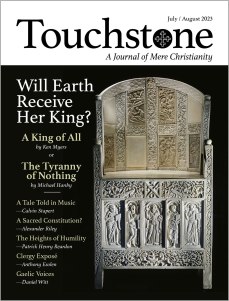
The quote is from the opening paragraphs of Michael Hanby’s article, “Nothingness Rules,” in the latest Touchstone magazine. Hanby writes about the modern mind, especially its expression in the American vision, and how it sees the world from the standpoint of pragmatism. As an example he quotes John Dewey saying, “things are what they can do, and what can be done with them.” Any consideration of what things are in themselves, what their nature is, is unnecessary; more likely, it is a bothersome hindrance to getting on with controlling and changing what is.
“At the core of this metaphysical vision is the elevation of possibility or power over the givenness of the actual world. The celebration of possibility takes on mythic tones in American romanticism about the ‘frontier,’ in our political homage to the ‘American dream,’ and in a thousand mind-numbing commercials. But it is also deeply inscribed into our public philosophy, both political and natural.
“Liberalism elevates possibility over actuality in the political sphere by identifying freedom with rights. Rights create what D. C. Schindler calls an ‘enclosure of a field of power’ around each citizen, transforming every given reality that would define me prior to my choosing—God, the moral order, and, now we discover, even my own nature—into a possible object of choice. Liberal order thereby undermines these basic realities while appearing to uphold them.”
Hanby goes on to discuss the difference between Marxist atheism and previous versions, why authority and not power is the “true source of the law’s efficaciousness,” and how “technocracy is not the rule of technocrats, but the rule of nobody.” He points out that the seeds of the new vision of nature are right there in our U.S. Constitution:
“The U.S. Constitution grants Congress the power to ‘promote the Progress of Science and the Useful Arts,’ prompting Leon Kass to comment that ‘the American Republic is . . . the first regime explicitly to embrace scientific and technical progress and officially to claim its importance for the public good.'”
The fortune that you seek is in another cookie, was my fortune. So I’ll be equally frank—the wisdom that you covet is in another poem. The life that you desire is in a different universe. The cookie you are craving is in another jar. The jar is buried somewhere in Tennessee. Don’t even think of searching for it. If you found that jar, everything would go kerflooey for a thousand miles around. It is the jar of your fate in an alternate reality. Don’t even think of living that life. Don’t even think of eating that cookie. Be a smart cookie—eat what’s on your plate, not in some jar in Tennessee. That’s my wisdom for today, though I know it’s not what you were looking for.
I wrote the post below before my husband died, and before I had a smart phone and GPS to use when on road trips. This morning when I was getting ready to walk the grandboys over to the playground, which is only around the corner, I felt the need to bring up its location on my phone and look at the layout of the streets for a while (lacking a paper D.C. map), even though Kate was going to show me the way. I still prefer paper maps of any sort to what one can view on a screen, and I hope they’ll continue to be available.
The accompanying poem is not about this practical aspect of maps; you might even say that it is about how maps fail to give us information that might be necessary to our survival. And there is a third aspect of the subject that I dip into. I hope there is something you might enjoy musing on.
……………………
Most people in our family love maps. The previous generations loved them, too, and I treasure the memories and pictures of various father-son or sibling groupings around a map, planning a road trip or a backpacking adventure, or just getting a better idea of the world we live in.
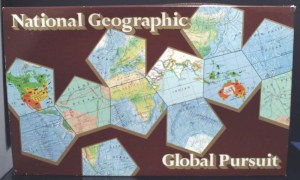
Geography games including maps can also be fun, such as Global Pursuit that was put out by National Geographic in 1987. It was a little challenging for someone like me who isn’t sharp in spatial orientation skills, because the map of the world was all chopped up into pentagons which never fit together all the way.
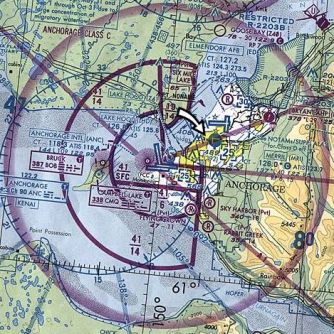
It’s easy to lose all track of time when poring over maps. One of my favorite parts of an unusual aviation ground school that was offered at my high school was studying the aviation maps pilots use to plot their course. In those days it was all done on paper, and I was fascinated by the concentric rings around airports, and all the copious information including odd names of towns in Texas, which was the area our school sample was showing. (The one below, I realize, is of Anchorage, Alaska.)
The whole concept of a map, a simplified form by which we can get a mental handle on a vastly greater reality, became useful for me in a different manner when I was introduced to the way M. Scott Peck uses it in his book, The Road Less Traveled. I have never actually read the book, but the the image of a mental/emotional map has served me well through the years. Some excerpts:
CHOOSING A MAP FOR LIFE – Truth is reality. That which is false is unreal. The more clearly we see the reality of the world, the better equipped we are to deal with the world. The less clearly we see the reality of the world–the more our minds are befuddled by falsehood, misperceptions and illusions–the less able we will be to determine correct courses of action and make wise decisions.
Map of Life – Our view of reality is like a map with which to negotiate the terrain of life. If the map is true and accurate, we will generally know where we are, and if we have decided where we want to go, we will generally know how to get there. If the map is false and inaccurate, we generally will be lost.
-M. Scott Peck
I brought all of my real and metaphorical map history to this poem I read today. The poet is another woman who also likes maps, but her poem shows clearly the ways that they fail to reflect reality. That doesn’t bother her; even in their failure she praises them for the vision they give us, “not of this world.”
Perhaps we also don’t need to worry about whether our heart-maps are all matched to our surroundings. Might they also serve a great-hearted and good-natured purpose, so that instead of giving up on our inner maps we strive to bring the full reality closer to the vision? I’m thinking of our daily prayer, “Thy Kingdom come…” and of “Love hopes all things, love believes all things….” May the Lord write the map of His Kingdom large in our hearts.
MAP
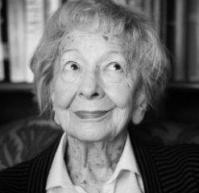
Wislawa Szymborska
Flat as the table it’s placed on. Nothing moves beneath it and it seeks no outlet. Above – my human breath creates no stirring air and leaves its total surface undisturbed.
Its plains, valleys are always green, uplands, mountains are yellow and brown, while seas, oceans remain a kindly blue beside the tattered shores.
Everything here is small, near, accessible, I can press volcanoes with my fingertip, stroke the poles without thick mittens, I can with a single glance encompass every desert with the river lying just beside it.
A few trees stand for ancient forests, you couldn’t lose your way among them.
In the east and west, above and below the equator – quiet like pins dropping, and in every black pinprick people keep on living. Mass graves and sudden ruins are out of the picture.
Nations’ borders are barely visible as if they wavered – to be or not.
I like maps, because they lie. Because they give no access to the vicious truth. Because great-heartedly, good-naturedly they spread before me a world not of this world.
–Wislawa Szymborska
Translated from the Polish by Clare Cavanagh The New Yorker, April 14, 2014
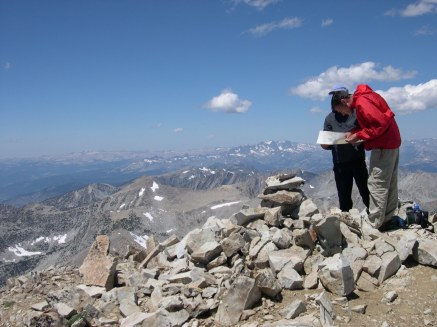
My two sons consulting a topographical map on a peak.

 The quote is from the opening paragraphs of Michael Hanby’s article,
 Gladsome Lights