Category Archives: Theophany

Blessings with gingerbread and Flour.

Grandson who is now married.

By the time the book was ready to pick up at the library, I’d forgotten that I’d ever put it on hold; there must have been a good reason for me to look beyond the hugely generic title of Flour. Probably it was back before Christmas when I was still looking ahead, to Christmas baking, whereas now I’ve moved on.

Normally I am more drawn to provocative titles like Samarkand or Bravetart, two other cookbooks on my shelf at present, though I also have had plainer in my possession, such as The Onion Book, and Salt and Pepper — or was it Pepper and Salt? I gave that one away. The Moosewood Cookbook from my youth comes to mind, named after a restaurant, and Mollie Katzen followed it up with The Enchanted Broccoli Forest. I guess she had a knack for evocative names!

Before I leave the subject of Katzen, I have to tell you that one of her own three favorite cookbooks has an ambitious title: Honey from a Weed: Fasting and Feasting in Tuscany, Catalonia, the Cyclades, and Apulia, by Patience Gray. I definitely need to check my library to see if I can borrow that one; it has several words that arouse my imagination. Katzen’s latest published work has the lovely title, The Heart of the Plate ❤️

I did bring  Flour home, and leafed through its pages a bit. It turns out that the word is in this case a reference to a very specific thing, and place, the Flour Bakery that the author Joanne Chang owns in Boston. Chang graduated from Harvard with honors, and degrees in math and economics, and also studied astrophysics. But even while she was in college she was selling cookies to her classmates.

today’s flour

All these facts make me start wondering about different personalities and how they use language; I’m fairly certain no one whose mind works like mine would ever come up with such a name for a bakery or anything. Her more recent book is titled Flour, Too, which is even more puzzling. In spite of all this distracting analysis, a recipe for Deep Dark Spicy Gingerbread caught my eye, and I decided to make it to serve after my house blessing that was today.

It’s not as though I needed another gingerbread recipe. If you are fond this kind of cake you might explore the other versions I’ve written about here over the years, like the vegan Gingerbread Pear Bundt Cake and Wheatless Gingerbread; I’ve made chocolate chip gingerbread many times but evidently never shared it here.

For the house blessing, we began our prayer downstairs, not far from where I had displayed the air clay owl that my granddaughter Ivy made for me last year. This year someone made a clay sloth for me. Not long ago I was also given a sloth tree ornament. Is there something about me that makes the family think of sloths? Now the sloth has joined the owl, and what they mean together, I am still pondering.

Knowing while sleeping last night that I would bake a cake in the morning, attend my friend Gwen’s house blessing, and drive back here for my own — all that made me wake up earlier than ever, and I had the cake in the oven before 8 o’clock! I was not channeling my sloth friend today.

The cake was not that special. I think it had too much butter — a full cup for a 9×13 cake — which bogged it down; the gluten-free flour probably contributed to its heaviness, and it included a whole 12 oz jar of molasses. It was not as spicy as I expected considering the fresh ginger and lots of black pepper that went into it. If I make it again I will use half the butter, and more egg. And maybe try another sort of flour.

But it was easy to eat
with a dollop of whipped cream on top,
and I sent a big chunk home with my priest,
because it was his birthday.

They drank of that Rock.

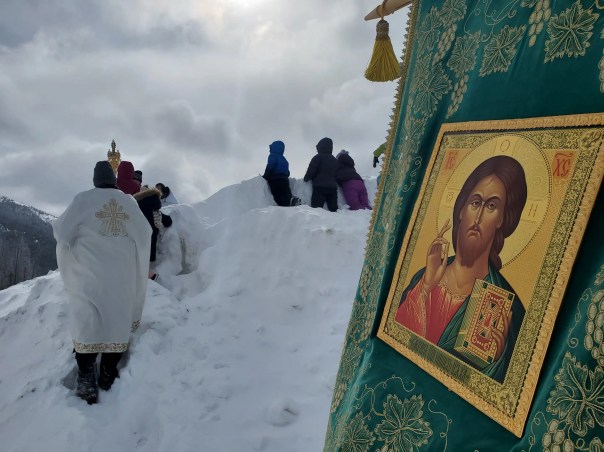
Joshua Passing the River Jordan with the Ark of the Covenant – Benjamin West, 1800

Moreover, brethren, I do not want you to be unaware that all our fathers were under the cloud, all passed through the sea, all were baptized into Moses in the cloud and in the sea, all ate the same spiritual food, and all drank the same spiritual drink. For they drank of that spiritual Rock that followed them, and that Rock was Christ.

-Reading from I Corinthians 10 for the Great Blessing of Water, Eve of Theophany

Illuminations on this January weekend.

At Vespers last night, the lighting was unusual, in that electric lights had been turned on in the dome; typically we do without those, and in the winter it means that we see the icon of the Pantocrator only dimly. Because the amount of light, and the angle at which it enters through the cathedral windows, is always in flux, every service at every time of day is differently illumined — but the effect is always sublime.

Over the last two days, at church and on my neighborhood path, I was warmed by the beauty of physical lights, not separate from their symbolic role: They represent and mysteriously convey the presence of Christ Who is, as the Evangelist said, “The true Light, which lighteth every man that cometh into the world.”

Today was the Leavetaking of Theophany, and I was the chanter of the Third and Sixth Hour prayers before the service. On Sundays we always have hymns of the Resurrection, and usually hymns of that Sunday’s feast or saints as well. It was the Kontakion of Theophany that got my attention this morning:

On this day Thou hast appeared unto the whole world,
And Thy light, O Sovereign Lord,
is signed on us who sing Thy praise,
and chant with knowledge:
Thou hast now come, Thou hast appeared,
O Light Unapproachable.

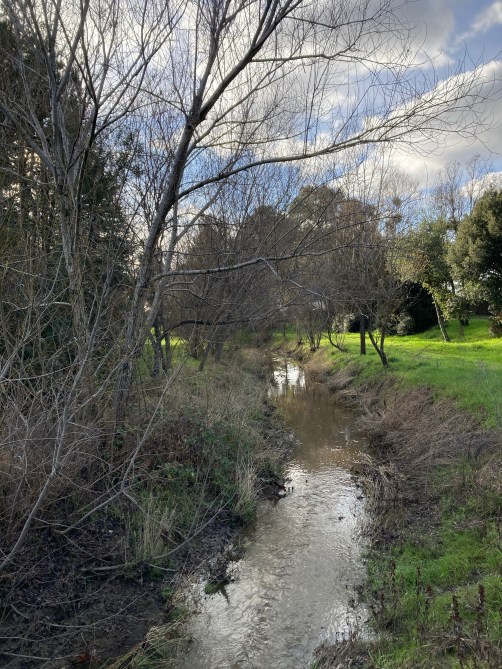
As soon as I returned after church, I (shock!!!) changed my clothes and went for a walk. We had been surprised by the sun coming out in the afternoon, so it was delightful out there. Even though the creek was muddy from rain, the light shining on it made it lovely.

And I practiced Psalm 89 some more. Reading the same lines and stanzas over and over, thinking of links to help me transition from one thought to another, has been the most rewarding kind of meditation; the theology and the poetry fill my heart, certainly in much  the same way as one line states:

We were filled in the morning with Thy mercy, O Lord,
And we rejoiced and were glad.

But this line is in the latter half of the psalm, when the mood has turned upward. A few stanzas before, the psalmist is considering how in the evening man “shall fall and grow withered and dry.” “We have fainted away,” “our days are faded away… our years like a spider have spun out their tale,” and “Return, O Lord, how long?”

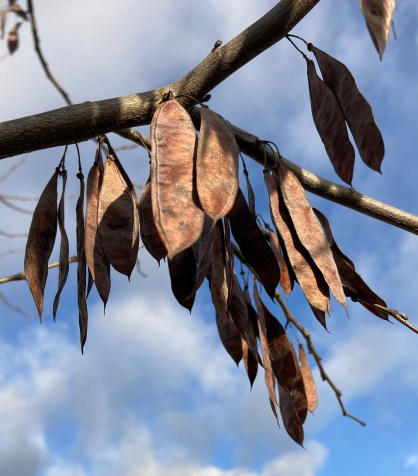
Withered and dry, but still handsome.

I have looked at two other translations of the Psalm, one of them a different version of the Septuagint, and compared with the one I am using (see sidebar note), to me they both are clunky and harder to read, though they do have many of the same vivid images that help me to learn this poem.

I stopped a couple of times on my walk to sit on a bench and think about these things. And when I got home again I looked at the notes in the Orthodox Study Bible, which points out that this is “a morning prayer designed to keep one focused on the Lord rather than on this temporal life and its hopelessness. For He exists outside time, and is therefore our only refuge…. It is read daily at the First Hour.” 

There are many references to morning and evening, days and years, and our lifespan being “in the light of Thy countenance.” But one reason I have wanted to learn the whole prayer poem is the last verse, whose first line brings me back to “Thy light is signed on us” in the hymn we read and sang this morning:

And let the brightness of the Lord our God be upon us,
and the works of our hands do Thou guide aright upon us,
Yea, the work of our hands do Thou guide aright.