Tag Archives: St. Herman of Alaska

Brave and faithful servants.

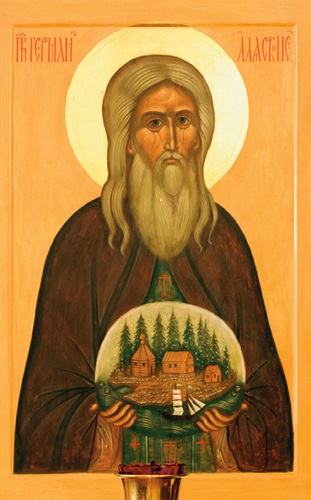
Over the years I’ve often written about St. Herman of Alaska and Father Alexander Schmemann, two important people in my life whom we remember on this day. This year I want to add St. Lucia of Syracuse, whose day it also is; we are blessed to have four Lucys in our parish, one of whom is my dear goddaughter.

This morning we had a glorious Divine Liturgy in honor of the saints, with our rector testifying to the power of Fr. Alexander as well, saying that if it weren’t for his influence, teaching and prayers, he would not be our priest today. We sang “Memory Eternal” for Fr. Alexander and for Leonid Ouspensky, whose legacy as an iconographer continues to enrich our parish year after year.

St. Herman and Fr. Alexander have both contributed hugely to the presence of true and living Orthodox faith in America, that Church in which I’ve found the fullness of Him Who fills all in all. Every year that we come to this date finds me more thankful.

Saint Herman of Alaska arrived in Alaska in 1794 and died there in 1837. On the occasion of his canonization in 1969 Bishop Dimitri spoke:

The Church on earth lives in a loving fellowship with the saints who have already run their race, who have fought the good fight, and have received their crowns (2 Timothy 4:7) (James 1:12). This is what the Apostle means when he says that we are compassed about or surrounded by the witness-martyrs or saints. We are assured both of their presence and their interest in us. In fact, they are concerned about the whole world and its salvation, for “there is joy in heaven over the repentance of one sinner” (Luke 15:7).

Father Schmemann was born in 1921 into a family of Russian emigres, and came to the United States in 1951 to join the faculty of St. Vladimir’s Seminary, where two of my own parish priests sat under his teaching. He reposed in the Lord in 1983. Not only has my life been enriched broadly by his contributions to the whole of Orthodoxy in America, but by my reading directly what he wrote, especially For the Life of the World, and his journals. Most recently I read his The Eucharist, which was a treasury of living truth, so vast, I haven’t known how to begin to say anything about it here.

It seems fitting that we commemorate St. Herman of Alaska on this date, when winter is making itself felt. I’ve written before (and yes, before that) about how he spurned the cold, befriended the animals, and interceded between the Aleuts and the powerful people who would exploit them. His is a good example in the Advent season, of how to keep our hearts and activities focused on the Kingdom of God in the face of distractions. 

Santa Lucia buns from a previous year.

The mother of the youngest Lucia in the parish brought darling Santa Lucia buns as she always does, and a few of us stayed to drink coffee in the parish hall. But now I am home, with hospitality on my mind and heart: I have been welcomed into the household of God and fed at His table, and will go in that strength throughout the day and on to the Feast of the Nativity of Christ.

May we all prepare ourselves for the celebration by entering into the spirit of St. Herman, who advised us:

“…let us make a vow to ourselves, that from this day, from this hour, from this very moment, we shall strive above all else to love God and to fulfill His Holy Will.”

Missionary humility and splendor.

In December we Orthodox commemorate the repose in 1837 of Saint Herman of Alaska, who came as an Orthodox Christian missionary to America in 1793. When he was glorified as a saint in 1970, Fr. Alexander Schmemann was present for the ceremonies. He wrote a non-official account of the event, seemingly from an overflow of joy that compelled his “weak attempt to express to those who were not there that which I cannot call anything other than a miracle of the mercy of God.” You can read it here: Days of Light and Joy.

Of the last of the three days of services and celebrations, Fr. Alexander writes:

“… very early in the morning, five priests with Archbishop Kiprian go to Spruce Island where for almost thirty years the Elder Herman lived as a hermit. And I know that we have never in our lives experienced anything better, purer, more joyful than what we’ve experienced there that morning: the walk through the wooded paths along the towering evergreens keeping their eternal vigil before their Creator, to the little chapel over the cave of the elder, and the liturgy in that chapel. I served the liturgy; but to say this is totally inaccurate. The liturgy served itself. It was only necessary for us to give ourselves to it completely, to immerse ourselves in it, to enter into the thanksgiving without reservation. I know as well that we did not deserve this at all but that it was given to us as a gift. I can only pray that it will also be given to us to preserve but the smallest portion of this gift of grace.”

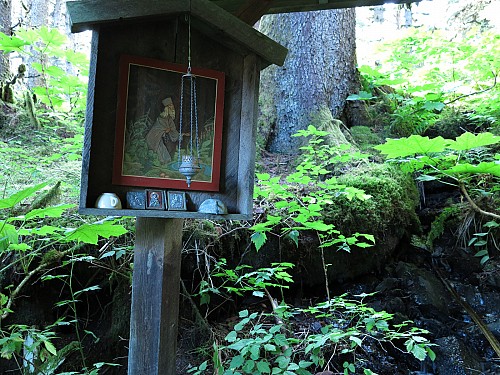
At Herman’s Spring, Kodiak

This was in August of 1970, and since then a steady stream of pilgrims from across the globe has visited St. Herman’s grave, including descendants of the Aleuts who knew and loved him before his repose. In 2020 for the 50th anniversary of his glorification there were many festivities and pilgrims there in Kodiak and on Spruce Island.

Father Herman’s repose was in December, so we commemorate him at this time of year as well. I leave you with the closing paragraph of Fr. Alexander’s report:
“In this light and in this joy, all of our human disagreements, accusations and condemnations become so petty, so human, so sinful. The whole time it seemed: If only we could give ourselves humbly to this joy we would understand without words in what and for what the Church exists, and the scales of our wickedness and suspicions and divisions would fall from us. There, at the tomb of Saint Herman, in the splendor of his humility, it was given to us to see that reality which alone gives authentic life to the Church, that reality which is indeed the only thing which the Church has to reveal to this world, that reality by which alone the Church will be able to overcome every power of evil in this world.

“Holy Father Herman, pray to God for us!”

An everlasting joy shall be upon their heads.

I can’t let Theophany pass without posting something. The poetry and the glory are truly over-the-top, on this feast that is second only to Pascha in conveying the fullness of our salvation, the marvelous works of the Lord.Theophany 16 fr j read

At Royal Hours on Monday, and today on the feast itself, I kept taking out my little notebook to scribble down a few phrases that I could use to do research at home, with the idea that I could find prayers and hymns in their entirety on the Internet, for later meditation and writing. But I find that not everything is online.

And most of my scribblings turned out to be almost identical to the phrases that had caught my attention last year. That’s okay. It was good for me to read last year’s post, and probably some of you didn’t see it then or would enjoy it again as well, so here is the link: “We are watered by mystical streams.”

The very earth of our neighborhoodTheophany 16 girls end of processions has recently been well watered by rains that we acknowledge to be gifts of God, so it seemed this week that all of nature was participating in our celebration of the baptism of Christ.
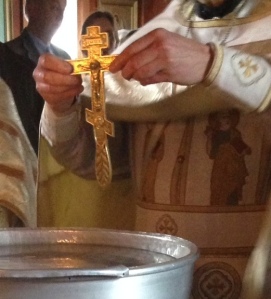
Water itself is a basic element of the cosmos and is fundamental in the the Creation story: “And the earth was without form, and void; and darkness was upon the face of the deep. And the Spirit of God moved upon the face of the waters.” When Jesus came to him for baptism, John was baptizing people in the Jordan River, the same river their ancestors had crossed on their entrance to the Promised Land, and in the homily today we heard that he was calling the people to come back to that event, to their beginnings, to their first love.Theophany 16 cross dip crp2

The Spirit of God also appeared at Christ’s baptism to affirm that He is the bearer of God’s Spirit. It’s all about the renewal of the Spirit in our lives, as at Theophany we are reminded of our own baptism and pray again that the Holy Spirit would revive and refresh us, as the showers of life-giving rain water the plants and make them fruitful.

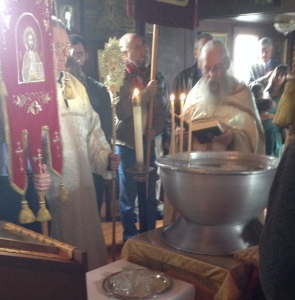
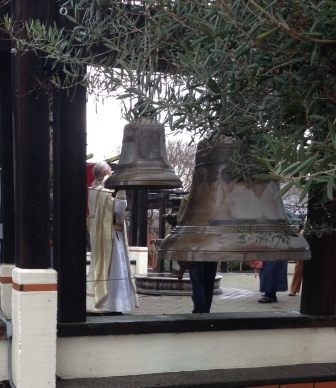
We celebrated Divine Liturgy in our “big church” and then processed singing to the small church — the rain kindly letting up so that we didn’t have to carry umbrellas along with our banners — where water was blessed and sprinkled all around. While some of us filled our bottles with holy water others processed all over the property and ended with blessing the bells. Theophany 16 bless bells & choir

The many celebrations I’ve been part of at church since Christmas have watered my soul immeasurably. Theophany (and the splashing of water on my head!) is like the final drenching of this season, so that I feel wet through with the love of God and His Church, with the joy spoken of in Isaiah 51 (and mentioned in my title here). I want to go on day by day and find His mercies that are new every morning. If I follow the counsel of my priest I’m sure I will. He said that we shouldn’t bother with New Year’s resolutions, except perhaps to imitate St. Herman of Alaska who encouraged a constant repentance, saying, “From this day, from this moment, let us love God above all.”