Over the years I’ve had happy surprises in the garden, and disappointing surprises. Today I have a composite. My initial puzzlement began when I saw this view from my kitchen window; back in the corner by the fence I could see two whitish flower stalks:

I was confused, because they were of a kind I had not planted, so I went out to get a closer look, and it didn’t take many steps in that direction before I saw that yes, the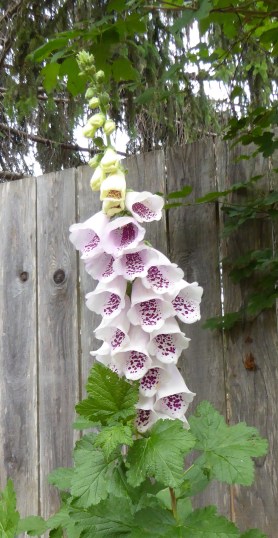 y were lovely foxgloves!
I haven’t grown foxgloves for a good while, I did not save any foxgloves plants from my old garden, and in the past when I did grow them it was far from this area of the garden. However, close to this spot I had planted one of the Indigo Woodland Sage plants that I had carefully saved for months in an old watertrough. It was there a couple of months ago, and now it is nowhere. Did a bit of foxglove come with the mulch, as I assume was the case with my surprise horsetail grass on the other side of the garden?
You may also be confused, seeing a decidedly not-foxglove leaf form here. That’s because the foxglove is emerging from behind a currant bush and hiding all its own leaves back there.
I’m sadly surprised that the salvia didn’t make it. It was a vigorous grower under what I considered less favorable conditions in the past; perhaps it didn’t like the shade from the snowball bush, nor the pushy calla lilies. But I know where to get another one if I want to try it somewhere else in the garden.
 In the meantime, across the way I have three salvias growing in a sort of triangle: Indigo Spires is huge, the Clary Sage is growing very close to the ground so far, and a little culinary sage plant lives modestly.
Today is windy and cool. I was wearing my flannel nightgown last night and I was still cold. The morning was overcast, though, and not so windy, and that’s perfect for picture-taking. I got a good photo of my acanthus.

“My acanthus” sounds odd, because I haven’t wanted to take ownership of that element of my new landscape that was suggested by the designer. When I had met acanthus in the past I always thought it scraggly and too like a thistle; one I particularly remember by someone’s front door was huge and full of spiderwebs and litter besides. But a year ago I greatly lacked confidence and creativity, so I didn’t know what to suggest otherwise. I let several plants go in and thought without energy about what I might replace them with next fall.
My attitude began to change when a friend told me that acanthus leaves as a decorative form were common in ancient Roman architecture. Before that I was trying think of the plant as a representative of a Scottish thistle, which is also not beautiful to me, but it is meaningful historically, in several ways. Soldier and Joy featured purple thistle flowers as boutineers at their wedding. But honestly, that wasn’t doing it for me.
When the acanthus began to send up its elegant flower stalks, I softened. This morning after I took the picture, I looked on Wikipedia and found that the leaf form is ubiquitous in ancient architecture and popular in more modern art such as William Morris’s wallpaper designs.
And not only the Romans, but Byzantines and Greeks liked to use it. Here is an example from the Hagia Sophia:


So, I am surprised that I have changed my mind about acanthus. I’m glad I wasn’t in too big of a hurry to switch it out. I’m very pleased with my whole garden, actually, and I no longer feel that it belongs to someone else.
It doesn’t seem that most of it is taking three years to “leap,” and it really is full of delights every day. Those Iceland Poppies are certainly a wonder, how they keep blooming here in the middle of June! It’s strange to have the poppies right alongside echinacea; those two normally aren’t normally seen together.


To my consternation, the bindweed is more prolific than ever. I seem to be constantly pulling it out, but it sneaked past me and climbed to the top of a currant branch before I noticed. Very inelegant behavior, that.

The hydrangea I was gifted has nothing in common with this succulent except that they are both in pots on the patio.

There are yarrow fields, a variety of achillea called “terracotta.” Beyond it you can see that I have finally got the olives into their pots, and if one is not level it’s actually the one in the foreground — I guess that means the photo is not level. Anyway, the garden is in pretty good order now, and when you come for a tour you may be surprised to find, no thanks to me, patches of elegance.
 Gladsome Lights