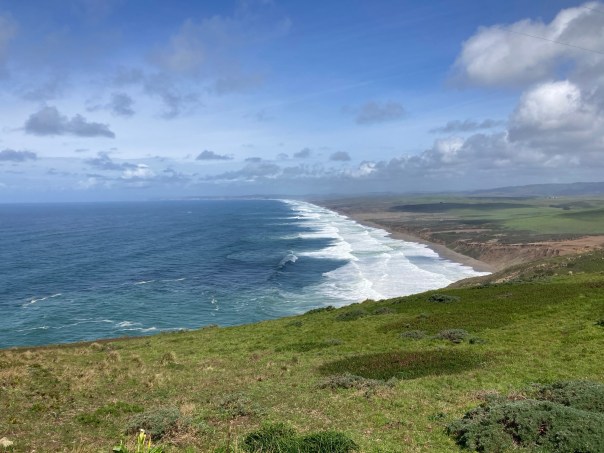
Daughter “Pippin” and her children were with me for a few happy days. The weather was not forecast to be friendly to our desire to be out of doors the way we like, but it cooperated in the end by bringing rain mostly while we slept, and we managed to go 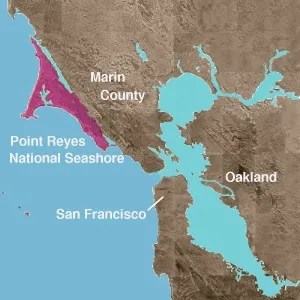 exploring all four days. It would take another full day of blogpost-crafting to tell you about everything that blessed my soul, but I want to share about two surprises we encountered.
At Point Reyes National Seashore, we made a wrong turn and ended up on Drakes Beach, where we thought we might as well get out for a minute and look, before we turned around to go to nearby Chimney Rock. The beach was mostly closed, because elephant seals were currently “pupping” there; several park staff were milling about near the temporary fence to tell us all about the animals. As of the 1st of March, this article says there were 870 weanlings on the Point Reyes beaches.
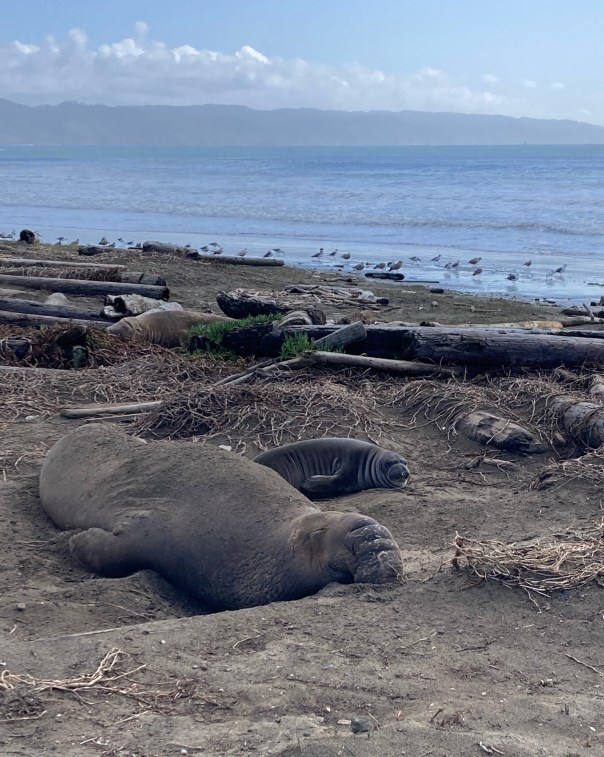
We watched this big guy above (4,000 to 5,000 pounds, they say) throwing sand onto his back to cool off, and wiggling his whole body down a little farther into his damp bed. It’s curious to watch oneself watching heavy animals doing mostly nothing; I think one reason we don’t get tired of staring is the principle of unpredictable rewards. They lie still for who knows how long — do I get vicarious enjoyment from just watching a seal seemingly sleeping like a log? — and it is rewarding to still be watching when suddenly they lumber across the beach a few feet, or merely lift their heads to check out how close the visitors are getting.
At one point a docent opened the fence and escorted us out on to the beach to get closer to the seals, while keeping at a safe distance. The gigantic males can move pretty quickly if they want, and we watched from afar as a couple of them challenged and threatened each other over territorial rights.
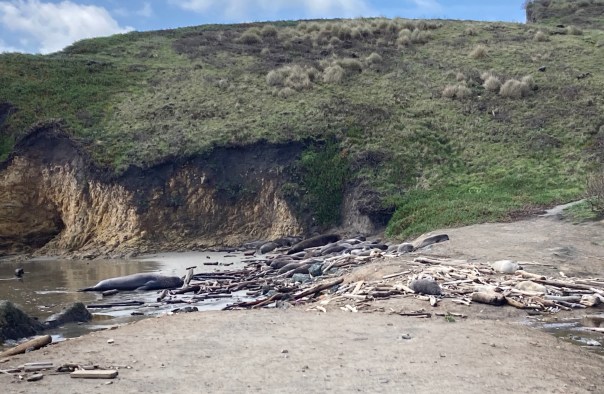
The day before our visit, the last female had left the beach after being impregnated, and it was expected that the males and pups would soon leave, too. In the meantime, they were resting, the pups living off their mothers’ milk of which they would get no more. They’d have to get out into the ocean pretty soon, and learn to find real food, not just whatever trash washed up on the beach. A volunteer was collecting trash even while we leaned against the fence, getting sunburned.
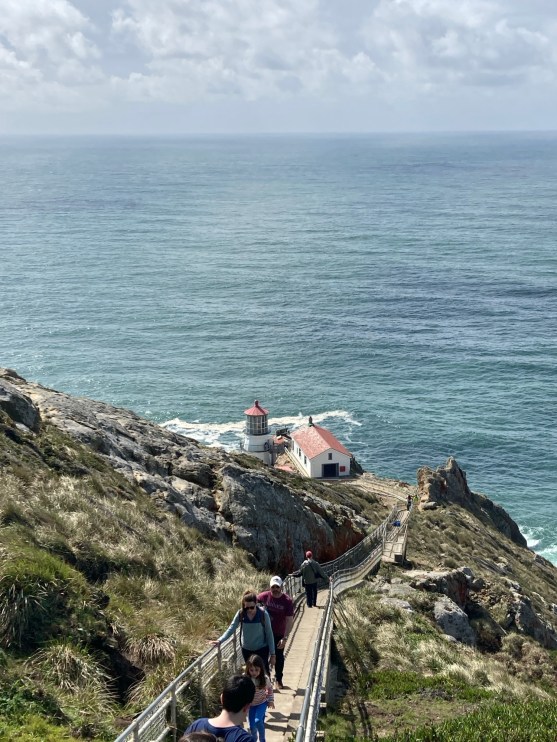
We didn’t go to Chimney Rock after that, but to visit the Point Reyes Lighthouse, where we walked down the 300+ steps and hiked back up again, after eating our picnic lunch beside the path.
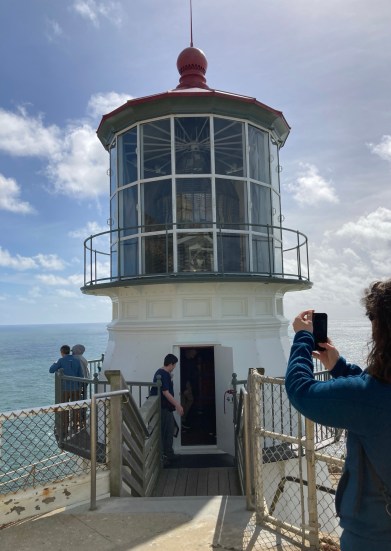

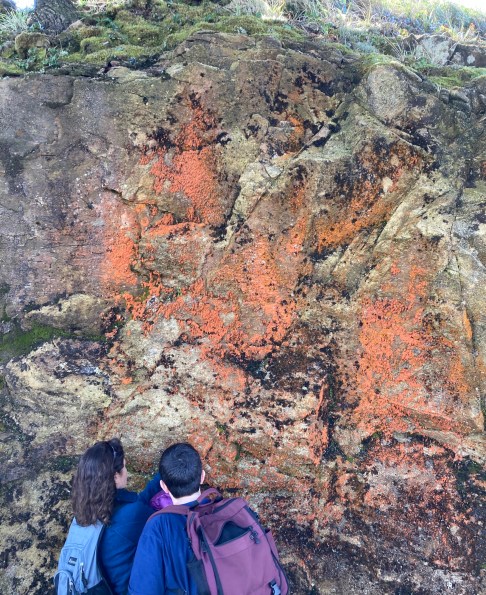
Out there we looked at Leathery Polypody, Polypodium scouleri; and Orange Rock Hair, Trentepholia aurea.
The second surprise was the following day, when the ocean tides also were not as convenient as we might have hoped; the moderately low tide would not happen until about 7:00 p.m., and we went out to the coast again, hoping to find some tidepools to explore. At least, Daylight Savings Time was just recently in effect, so we would have sunlight.
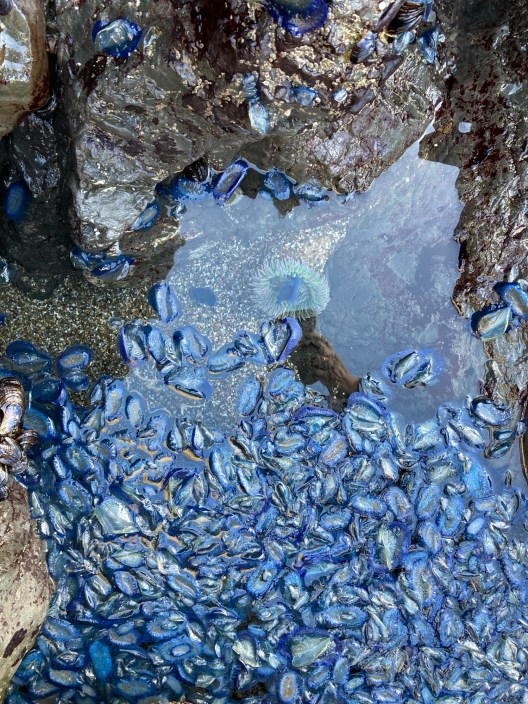
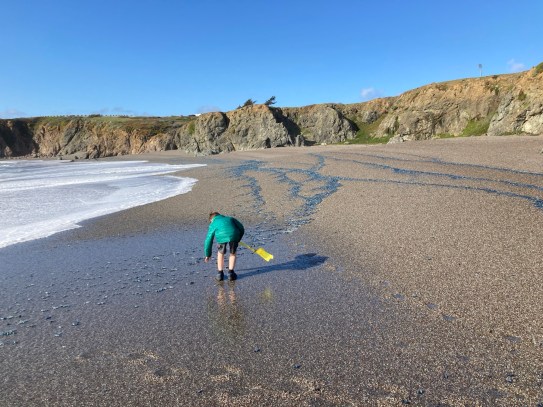
What a wonder! After we’d hiked down the path, we realized that the dark ripples on the beach that we’d seen from above were fields of stranded Velella velella, or By-the-wind Sailors. Once upon a time I found one of these creatures on a beach, and it was very small. We never dreamed we’d see them like this, here on our North Coast beaches that are not typically so colorful.
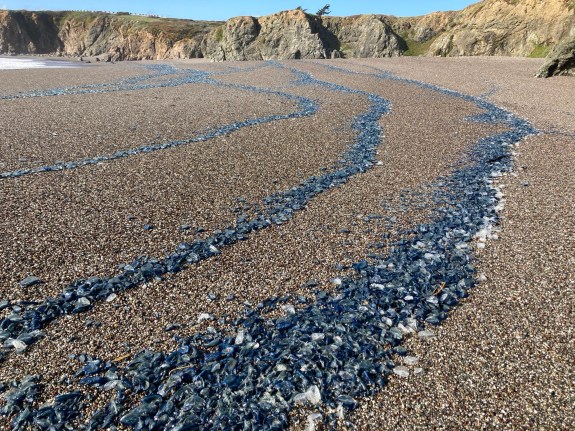
They are described online thus: “This hydroid polyp remains afloat on the suface of the Pacific Ocean for most of its life. It never touches or even comes close to the ocean bottom, and the only stage in its life when it is completely submerged under water is the larval stage. The Velella velella begins its life in the middle of the Pacific Ocean, is brought by the wind to the shores, and is usually cast up on a beach where it dies and disentegrates.” source

We had to wait around for a while for the tide to go out as far as it would, but what few tidepools we saw were mostly full of sailors.
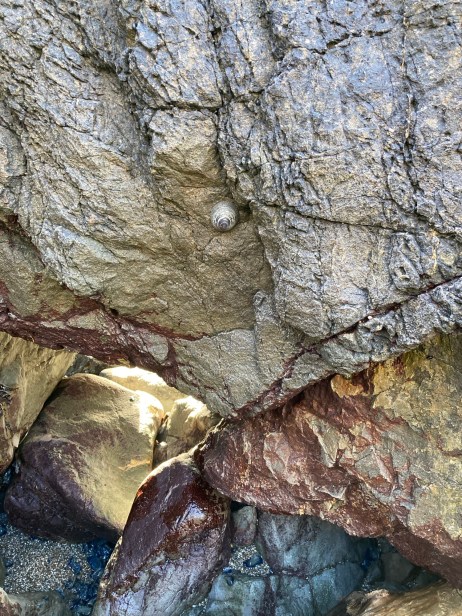
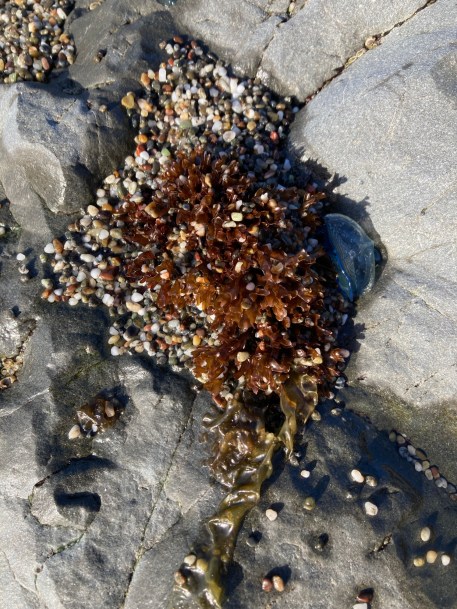
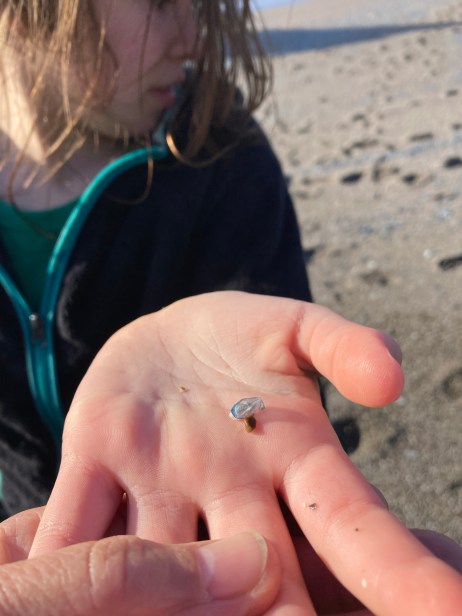
Ivy and Jamie spent a lot of time collecting pebbles and pieces of shell, and sometimes running in the surf, which throughout the year ranges from 50-55 degrees in temperature.

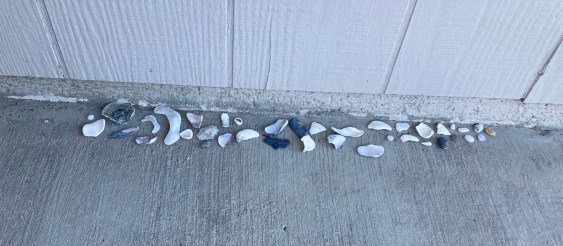
When we returned home they left their treasures on the front walk, and in the morning sorted them carefully, asking me to choose some to keep. As they were packing up to leave for home, Jamie arranged mine where they will be a daily reminder of our beloved beach outings.
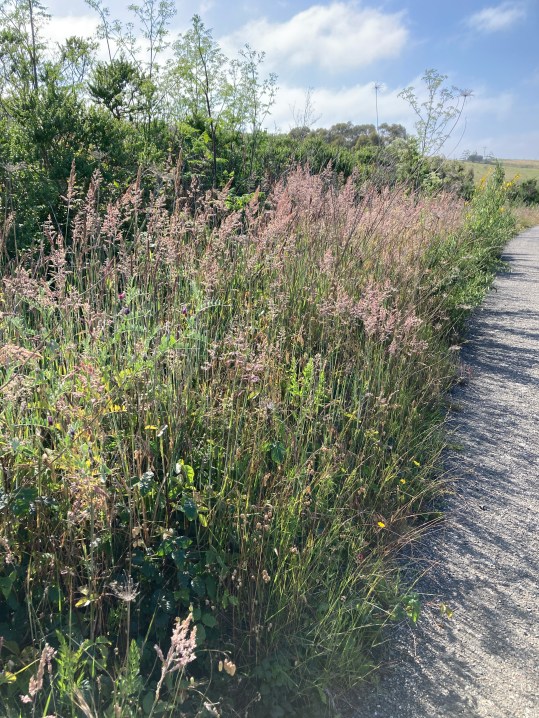

 The only stop we made for wildflower appreciation was on the way home, and it wasn’t for flowers at all, but for grass. Stands of pink grass waved in the breeze a the edge of the road; I discovered it is common velvetgrass, holcus lanatus. I think this is the first time my Seek app has been able to tell me anything about grasses; maybe it has truly been adding to its knowledge base. After all, one often does get the message that “Seek doesn’t know what this is. We are still learning!”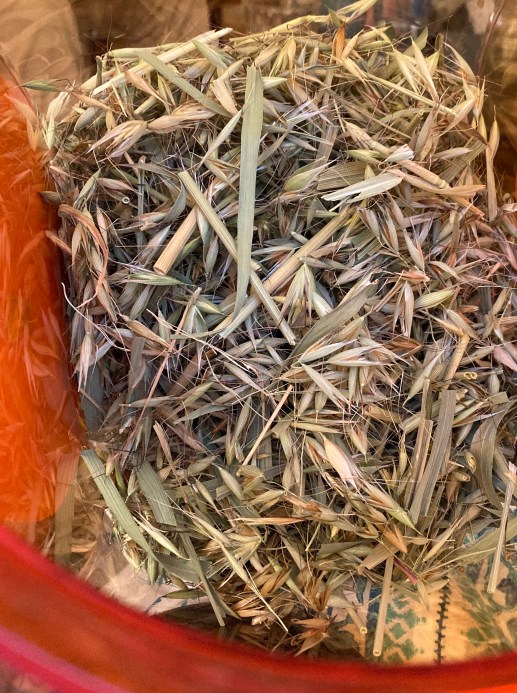

 Gladsome Lights