Monthly Archives: May 2011

Unusual Monastery Visit


This time when I drove to the women’s monastery about an hour from here, it was not for a lecture or a service or for contemplative time; it was for a stint of strenuous gardening. The nuns had put out a call for helpers to get the woodsy place under control after the rainy winter and spring have brought out tall weeds of many sorts.

When I came through the open gate I didn’t see anyone around, so I wandered a bit in the direction of some hammering noise. It was Sister Xenia repairing a rabbit hutch. She took me to find Sister Mary, whose day it was for gardening, and she in turn led me to the area I’d be working in.
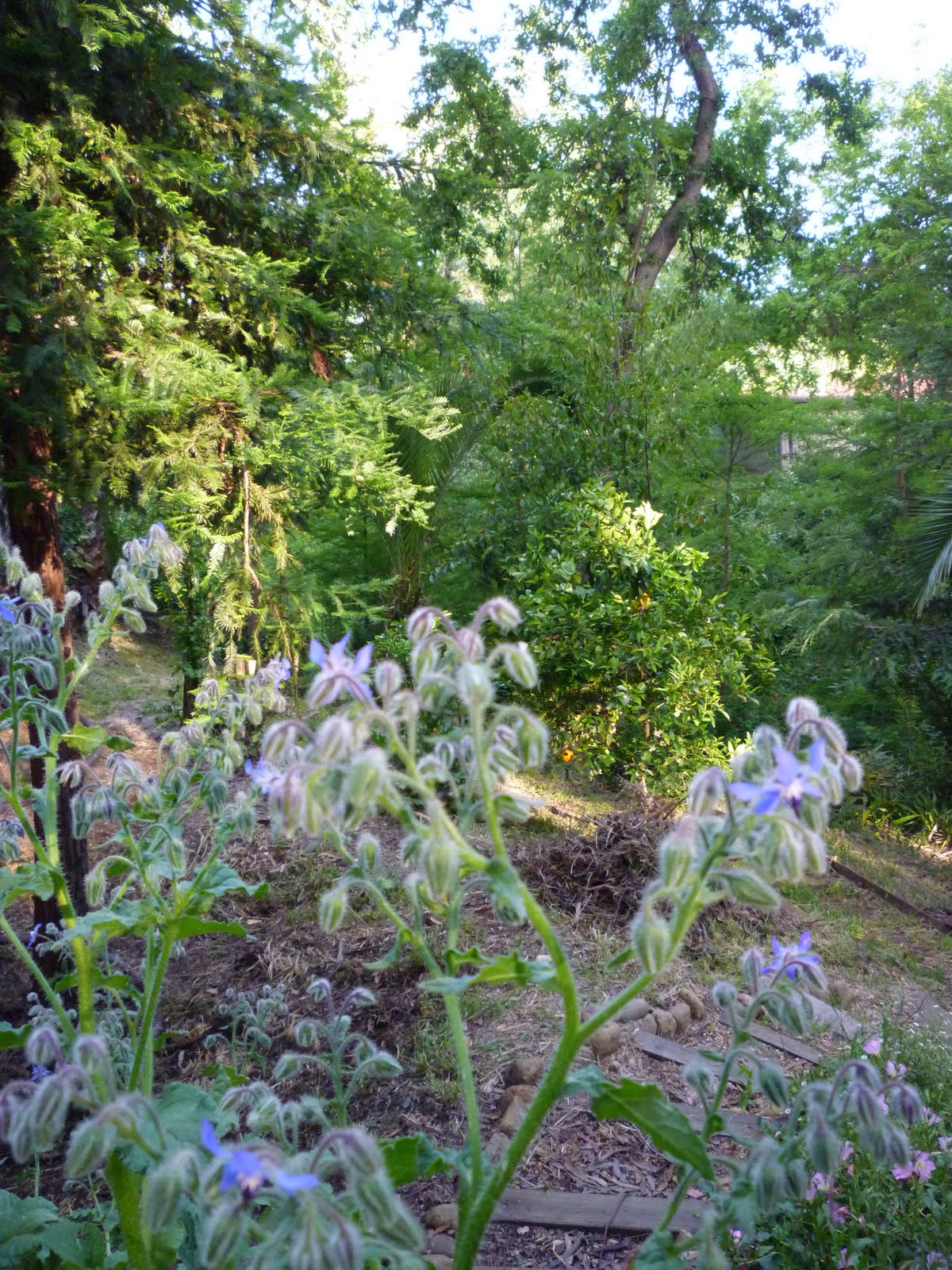
borage

“We got the weeds whacked down the other day, and now they need to be raked….This plant that is falling across the path needs to be trimmed back….Ivy is growing all over the quince tree and we want to get it out so the tree will have a better chance of bearing more than the three quinces it did last year.”

I put on my gloves, apron, and bandana to keep hair out of my face, and trimmed the blooming borage, leaving some branches so that the sisters could put the flowers in their salads.

Then the raking – whew! A giant eucalyptus tree stands above the monastery grounds and constantly drops pieces of bark, which combined with oak leaves and various other organic material have made a thick and tangled layer of debris that is turning into duff. On top of that were the strewn grassy weeds.

I pulled and yanked with my rake, and piles of scraped-up stuff grew tall in no time. “Someone” with a truck is now looked for both to haul all these piles away, and bring in some topsoil for the vegetable garden. I didn’t see the vegetable garden, but Sister Xenia said she works in it Wednesdays and Thursdays and maybe I would like to join her once a month or something like that? I always do think I can do anything, once a month. Maybe.

The poor quince tree took a long time. I hope he feels better and more fruitful. The sprucing-up was a challenge because on one side of the tree yard waste has been thrown down for many years, as we were led to understand (I had been joined by Tatiana and her son), creating a sort of man-made terrace. The ground level on that side is a several feet higher than on the other side, so that the tree is sort of growing out of a bank.

When I was below, I scrabbled up the “bank” that was mostly eucalyptus rubble, and stretched my tallest to pull as much ivy as I could from the branches. Sometimes three strands of ivy would be twisted round-and-round a thin branch, but at least this kind of ivy was tender and with care could be torn away.

Rescued quince

Then I walked back up the path to the other side and leaned way out, trying not to fall through the mulch, to pull at the ivy from that direction. After the ivy was gone, the many dead limbs were revealed, so I began pruning them out as well as I could with loppers. Several of them are so big they need to be sawed off, but I didn’t try doing it by myself in a precarious spot like that.

Galium aparine

Sticky weed is one plant that I went to war with at the monastery. Sister Mary called it that; I had never heard a name for it before, maybe because I never even saw it before a couple of years ago. Its usual common name is bedstraw or catchweed; it is Galium aparine. I pulled lots of this icky-sticky vine out of shrubs and flowers and everywhere, and it fought for its survival by depositing sticky little seeds all over my hair, gloves, socks….trying to come home and thrive here, no doubt.

Gardening is always a workout for me these days, given my age and the way the work always seems to have multiplied by the time I get there. A weed is easier to pull when it is small, to give a small example of what I’m talking about. Today was no different in that way, but the tasks I did made me use some different muscles, so I feel well exercised, shall we say.

It was lovely being at the monastery, and I’m glad I could be of use. I might have had some contemplative time while gardening if my mind hadn’t been so engrossed in solving garden problems and keeping my two feet under me. So if I go again, I’ll plan to spend the day and take breaks with the sisters in the church.

George Eliot and The Paralytic


This Lord’s Day we were remembering the paralytic, who sat by the pool waiting for a chance to get into the water at those times when an angel stirred it, so that he might be healed. After 38 years, Jesus came by and healed him.

Father John in his homily highlighted one aspect of the Gospel story: how we are like that man in our seeming paralysis when it comes to overcoming our sins. Priests often hear in confession the lament of the Christian who continues to battle the same weaknesses and failings year after year, feeling that he makes little progress.

I think a lot about the truism that habits are like a second nature to us. As we read in Jeremiah 13:23: “Can the Ethiopian change his skin or the leopard its spots? Neither can you do good who are accustomed to doing evil.”

It sounds very little like one chipper exhortation you might have read: “It’s never too late to be what you might have been.” Well, yes, why not just start today? When I read that on Tuesday, I remembered the paralytic, and I thought on my own unchanged bad habits. After his 38 years, wasn’t it in fact too late for many things? (The assumption is that one might have been greater; the reverse is probably more true, that it’s never too late to start a downward spiral.)

For myself, let’s see…how many years have I been cultivating certain of my bad habits? More than that, I’m afraid. But it’s a simple thing: “The only thing that stands between me and greatness is me.” (Woody Allen)

George Eliot

George Eliot is credited with having made that bold assertion, “It’s never to late to be what you might have been.” She was the subject of a New Yorker article from February of this year, “Middlemarch and Me,” by Rebecca Mead, who questions the validity of the quote and whether it even reflects the true outlook of the author Mary Ann Evans.

Mead has been a lifelong lover of Eliot’s books, Middlemarch in particular, and she points out some hints that the author leaves in her novels, as well as forthright confessions from her journals, to show that her general attitude was wiser and more modest.

In Middlemarch, we read of the main character,  “Dorothea herself had no dreams of being praised above other women, feeling that there was always something better which she might have done, if she had only been better and known better.”

Mead writes: Middlemarch is not about blooming late, or unexpectedly coming into one’s own after the unproductive flush of youth. Middlemarch suggests that it is always too late to be what you might have been — but it also shows that, virtually without exception, the unrealized life is worth living. The book that Virginia Woolf characterized as ‘one of the few English novels written for grown-up people’ is also a book about how to be a grownup person — about how to bear one’s share of sorrow, failure, and loss, as well as to enjoy moments of hard-won happiness.”

Let’s look back at the Paralytic by the Sheep’s Gate Pool. He must have had some way to propel himself, perhaps one limb that was functional, so that he could sit there for much of his life hoping to get down to the water first. He certainly had patience — and perseverance, to keep trying.

Father John said that even if we feel we have nothing more than a big toe’s worth of strength against our sins, we must keep struggling. Because we never know when Jesus will come to us. When he came to the cripple by the pool, He Himself was the source of the healing, and the man was delivered from his afflictions and was able to walk and carry his bed. For most of us, we will not receive the equivalent healing until we are resurrected in the coming Kingdom.

In the meantime, we will have failures. Maybe we will even think we are failures. It is very discouraging when one realizes what Samuel Johnson found: “The chains of habit are generally too small to be felt until they are too strong to be broken.” On another aspect of this human experience, Dorothea said in Middlemarch about her husband’s intellectual labors: “Failure after long perseverance is much grander than never to have a striving good enough to be called a failure.”

The most helpful sort of activity to persevere in, if one wants to be on the path to God, is prayer. “A long perseverance” of this sort would never be disappointing. The very moments of prayer have the potential to be Heaven itself, in the presence of the God Who is Love.

“In patience you possess your souls,” we read in Luke 21, and Mark Twain elaborates: “Habit is habit, and not to be flung out of the window by any man, but coaxed downstairs a step at a time.”

Whether we are being too easy on ourselves is the question. If we are being lazy, of course, that is one of the sins we are trying to overcome. And pride in thinking we are equal to any task, we can be anything we put our minds to — that also must be set aside.

Mary Ann Evans put it this way in her journal: “The difficulty is, to decide how far resolution should set in the direction of activity rather than in the acceptance of a more negative state.”

But I like best the way St. Seraphim of Sarov speaks about this, and will close with his gentle words: “One should be lenient towards the weaknesses and imperfections of one’s own soul and endure one’s own shortcomings as we tolerate the shortcomings of our neighbours, and at the same time not become lazy but impel oneself to work on one’s improvement incessantly.”

I made flan!


Ever since I met him, my dear husband has spoken very fondly of flan. Perhaps it has something to do with the associated memories of a trip he took to Mexico with his family when he was a teenager.

Until this moment, when I was looking for a link to post, I didn’t realize that flan is just the word Mexicans and some others use for crème caramel. Perhaps because we have so many Hispanics in California, I always assumed it originated in Latin America.

I’d never tried to make anything of this sort fancier than cup custard, from milk and eggs. But recently Mr. Glad came home from work with a recipe gleaned from the many Filipina women he works with, and when we were next at the market together we bought the main ingredients, in three cans.

Before removing from baking dishes

I did some more research before attempting to make this dessert. It was the sugar-melting-to-caramel that was new and frightening to me. The cans sat on my counter for a couple of weeks until I could also lay in a supply of eggs and find myself with time to cook on this rainy and cold day.

There are so many family recipes out there, and so much advice about techniques, I think I’ll just post the ingredients I used, which were pretty much according to one of the “Mexican Flan” recipes. I noticed disagreement about whether to stir or not stir the sugar when it is caramelizing; I stirred. I ended up filling one small pie plate and four ramekins with the quantity I made, which, by the way, would not fit at one time into my blender. I used:

1 cup sugar for the caramel
1 12-oz can evaporated milk
1 14-oz can sweetened condensed milk
3 large eggs
3 egg yolks
2 teaspoons vanilla extract
1 cup canned Nestle Media Crema (Mexican food aisle)

I thought the finished custard should be smoother on the sides. One has to run a knife along the sides to loosen the custard before turning it out on a plate, and that seems to rough it up a bit. Maybe a ramekin is not the best shape of baking dish? Also, a lot of the caramel stayed in the bottom of the ramekins as hard as candy, so you don’t see the flan sitting in a puddle of the syrup. That’s o.k. There was plenty of sweet stuff on the top. I haven’t turned the pie plate out yet to see if it is smoother.

The caramel wasn’t difficult. I was sure I would burn it or spill it when my husband came into the kitchen and started asking me a stream of questions at the crucial moment, but it survived even that distraction.

I baked the custards for about 40 minutes. I ate mine when it was still a little warm, but firm, and it was one of the best flans I’ve ever eaten. It wasn’t watery as they sometimes are.  The husband also pronounced it Very Good.

Cold Snap Gardening


As I was about to stick a gazania into its hole next to the church parking lot, I got a call on my cell from my husband, telling me the weather forecast: it’s supposed to snow down to 3500′ tonight. I immediately thought of Pippin, who is weary of the cold, and wondered if she is getting snow tonight.


I was a bit chilly myself, but at least I had gone back in the house to put on more layers before driving off with my garden tool kit, because there was no sunshine or warmth. And it didn’t ever get up to 60° today.

The north wind was blowing, but the filtered light was perfect for taking pictures of all the flowers there at church — if my shutter could keep up with the fluttering of blossoms.

Look! A hose is lying around even at church; someone was washing her car nearby.

There are several people who do yard work on the property, but I pretty much take care of the containers. Several times a year everything I’ve planted seems to look good together, but often things are a bit ragged or odd.

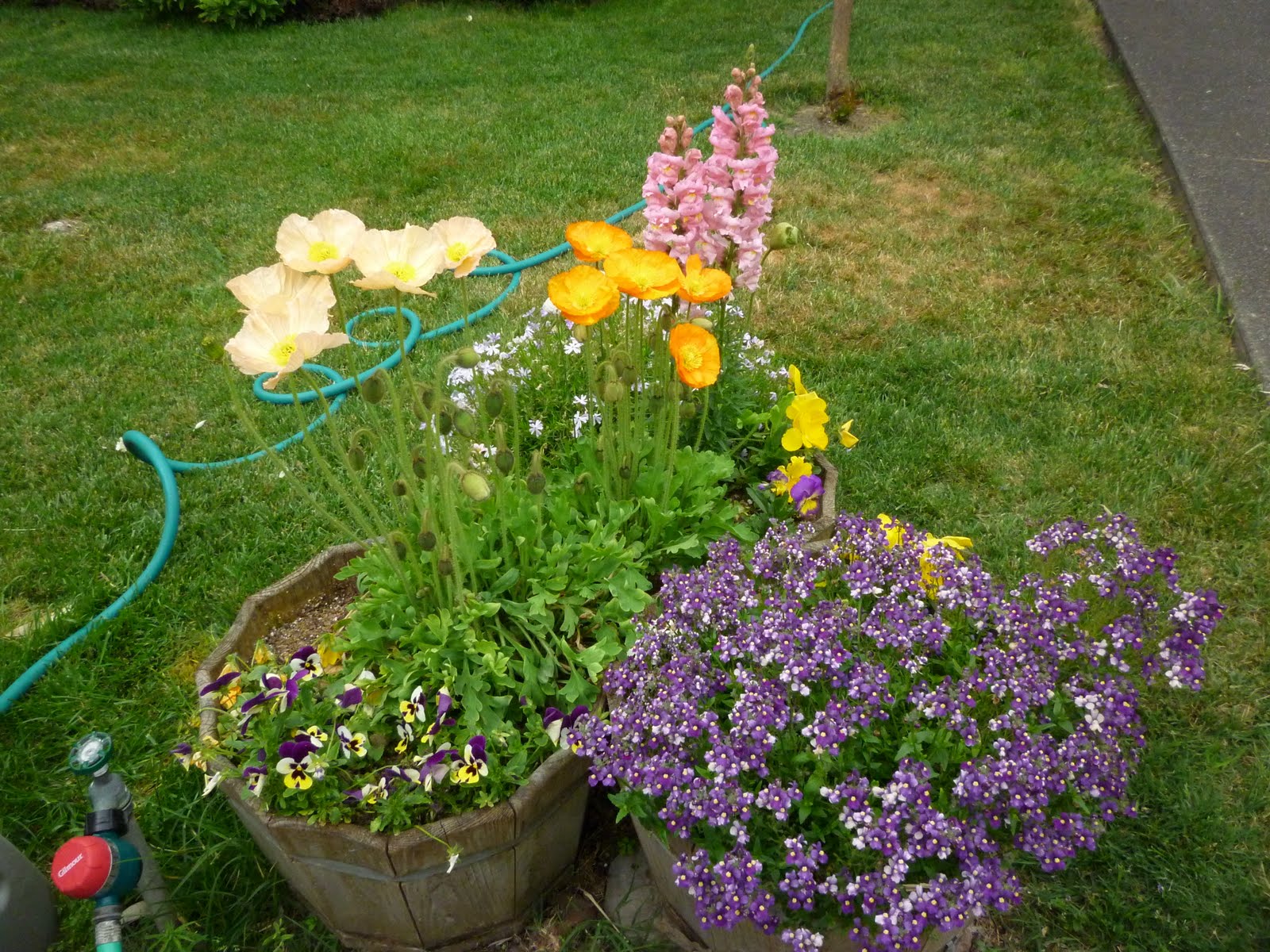
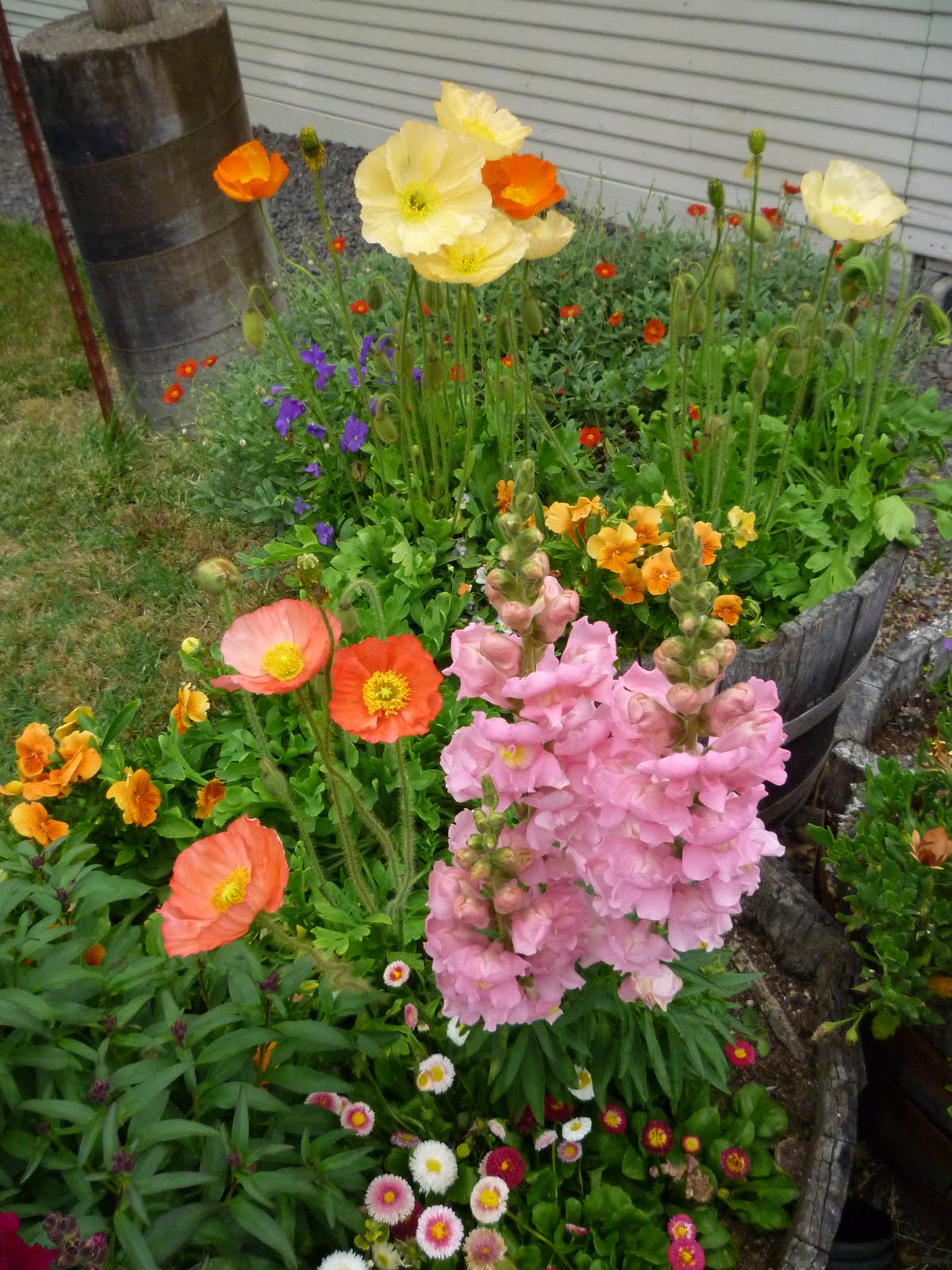
Today I added some snapdragons so that when the poppies and pansies expire from heat, perhaps the snaps will be making a show. I planted a lovely pink geranium in an empty clay pot.

I haven’t had much to do with this rose display lately, but we all are currently raving over the giant apricot irises.

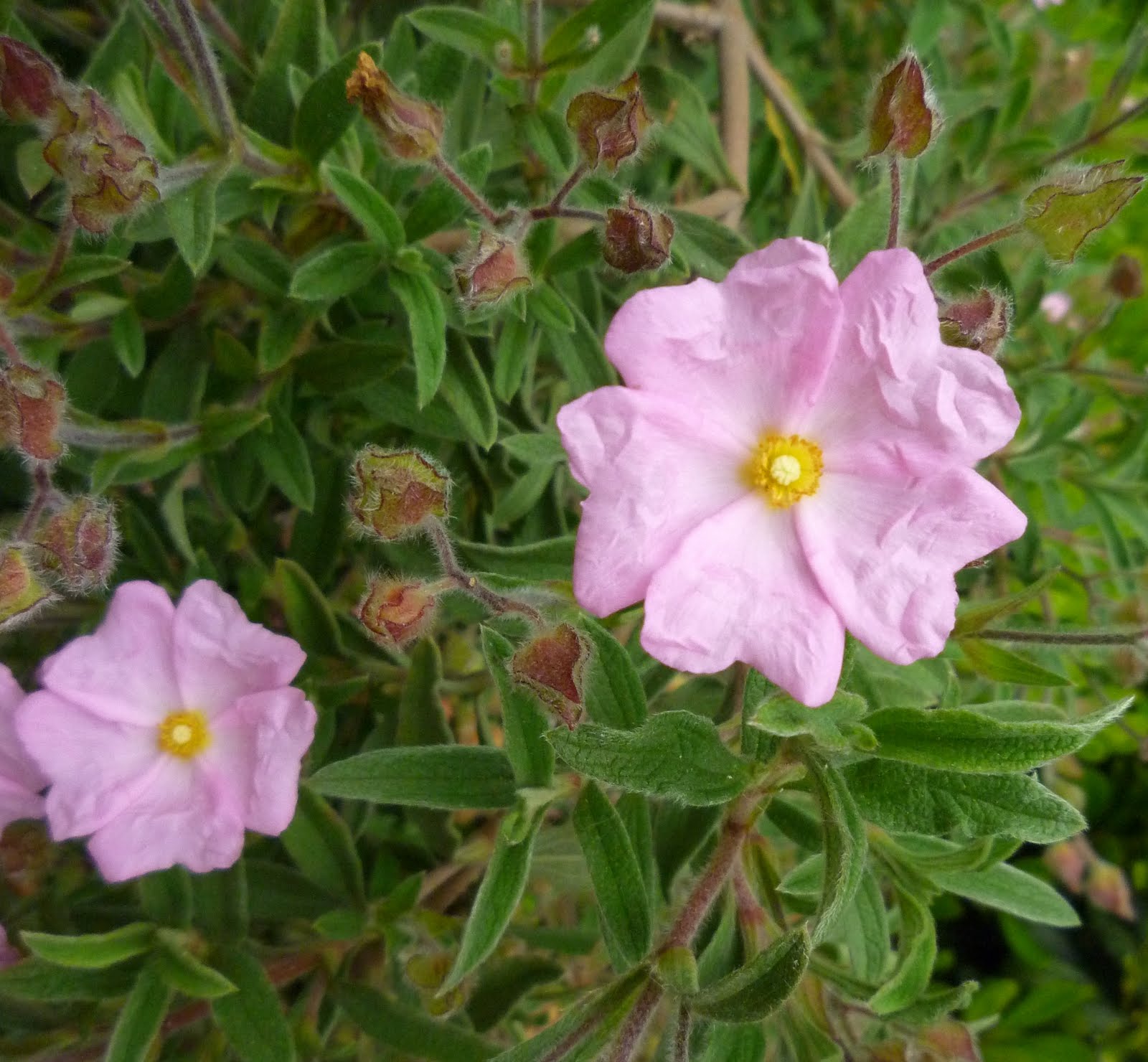
My favorite cistus

At least the cool weather makes the Iceland poppies happy. I found out that the small orange-flowered perennial on the right is helianthemum, and from searching around on the Net I think this one is called Chocolate Blotch.

I know there was noise of traffic on the street, but it was a long time before that entered my consciousness. I heard mourning doves as I was wiggling clover roots out from the bed of ajuga. The neighbors seem to have a new bird, which I couldn’t see, but it cried like an angry peacock. Bird calls impress on my brain more easily on cloudy days.

Three hours is about my limit for at stint at church, weeding, planting, trimming, feeding, and carrying buckets of garden waste to the compost heap. All the bending and stooping must be worth a few pilates sessions; I recover by walking across the property to the next half barrel or perennial bed.

But this afternoon when I pulled into my own driveway and saw all the weeds in the cracks, I couldn’t bear to go into the house until I had hacked away at them for a while. Now I’m hoping to rest up and stretch out enough to have stamina for Vigil this evening.
I checked the weather, and it looks like Pippin will likely be having “snow showers.” That girl needs a greenhouse. But here, of course, we are not that high, or cold. So I can say, bring on the thunderstorms!