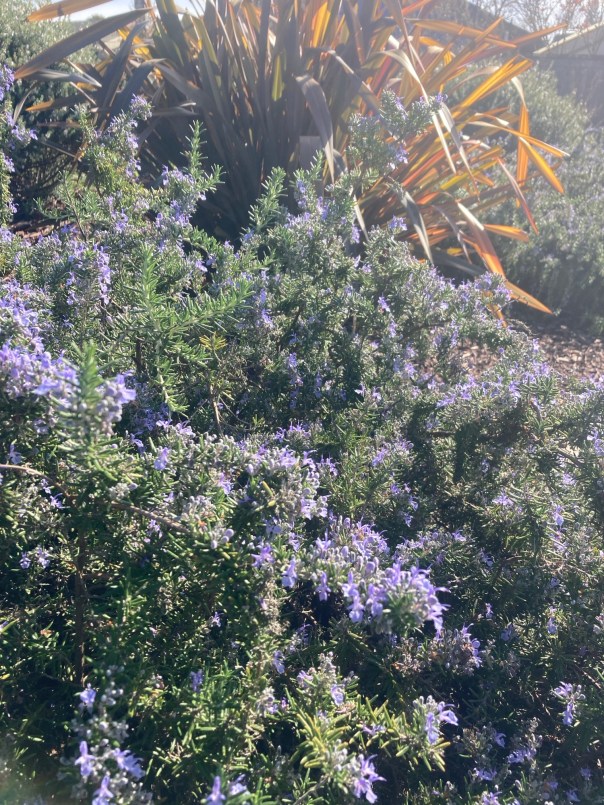
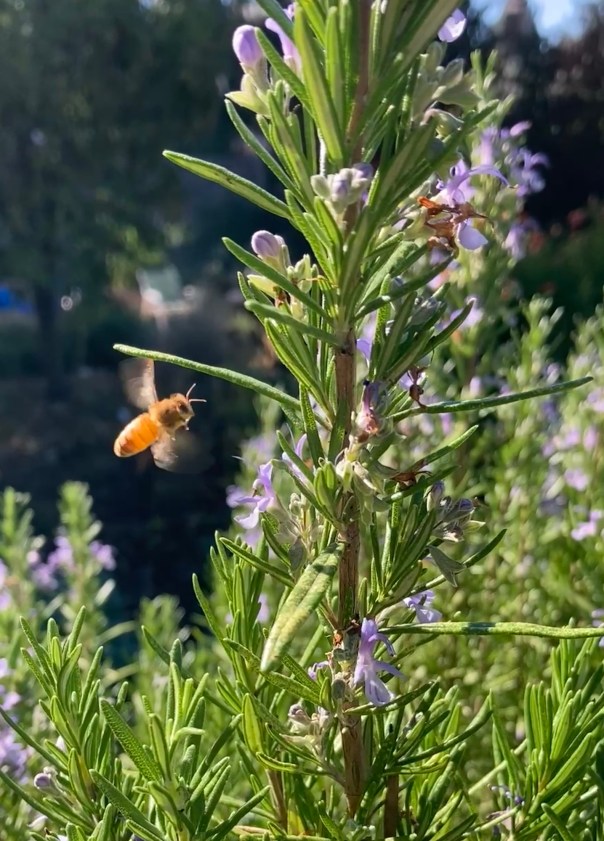
By the time I got out for a walk today, the sun was shining. My neighbor’s rosemary bushes are in bloom — unlike mine which gets no morning sun in winter — and lots of bees were drinking their breakfast there. I seemed to soak up some of their energy just watching them for a minute.
As of this evening my neighbor who said he would cut up my Christmas tree seems to have forgotten. But this morning, as I continued past the rosemary, I greeted a third neighbor loading up her own green bin with prunings from a shade tree. She offered to come down with her chain saw to cut my tree, but I declined; then she suggested that I put the whole tree at the curb, where she thinks the garbage man will kindly pick it up. So I did that. Tomorrow will show the results of the experiment!
First there was the mega mega gardening week, when I dug chicken manure into 23 little holes and dropped in starts of four different leafy greens; I wrestled with juniper roots to reclaim space; and put back into the ground eleven iris rhizomes of the dozens I’d lifted a month before — and hours upon hours of other such work. It was thoroughly happy-making.
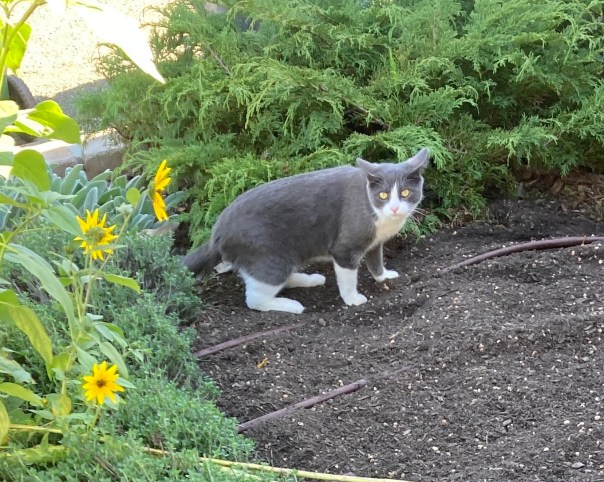
The yard worker had brought in and spread 1.5 yards of soil during my last absence, so that I would be ready to plant when I got home. This neighbor cat thinks its for her potty purposes:
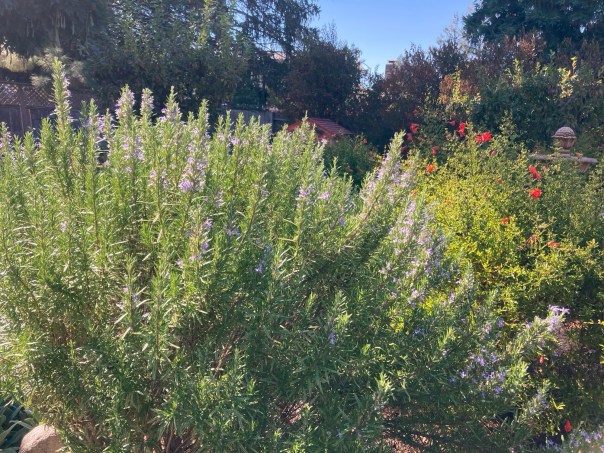
Rosemary and Pomegranate
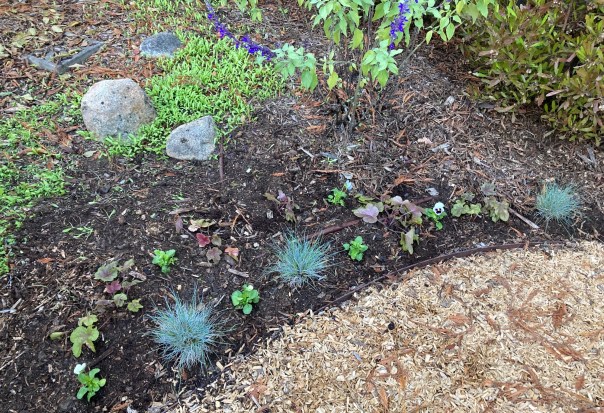
It must have been extra grace and strength God bestowed on me for the week, because every day I was at it again; the nights gave sound sleep, and that surely helped. I moved heuchera that were languishing in deep shade, to be near my umbrella table corner, where they will likely do better in partial shade.
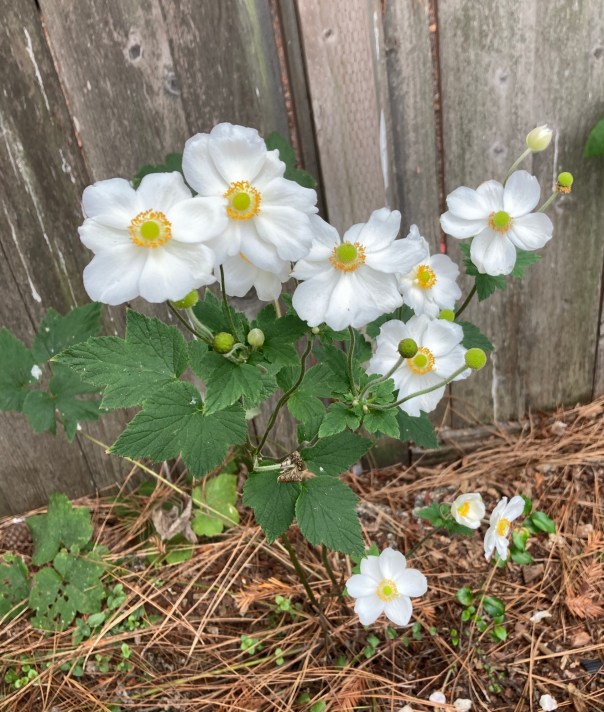
In that area where I like to sit with guests it’s been hard to find flowers that do well, but since I’ve realized that the increased shadiness of the back garden is the problem, I hope to improve the situation by using more appropriate species. I set out pansies along there, too, for the winter, and in the spring I plan to add Japanese anemones. The goal is to have something blooming most of the year.
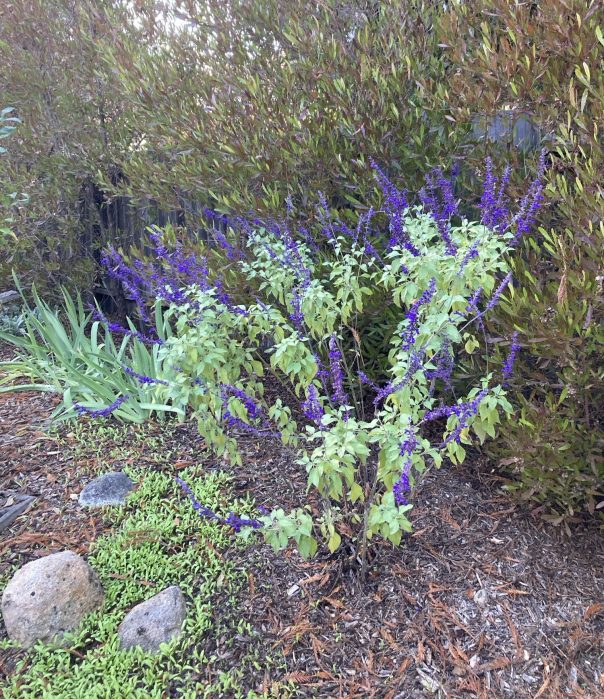
SalviaAbelia with comfrey.Nodding Violet
Propagation is a joy! I finally dug out at least some of the comfrey that has been shooting up from under the abelia, and put three pieces in nursery pots; if they grow I will stick them against a fence somewhere. I know they do fine in deep shade; when I first brought a start from my former garden in 1990 it grew for years under the osmanthus. But since the osmanthus is gone the comfrey has planted itself in undesirable places nearby.
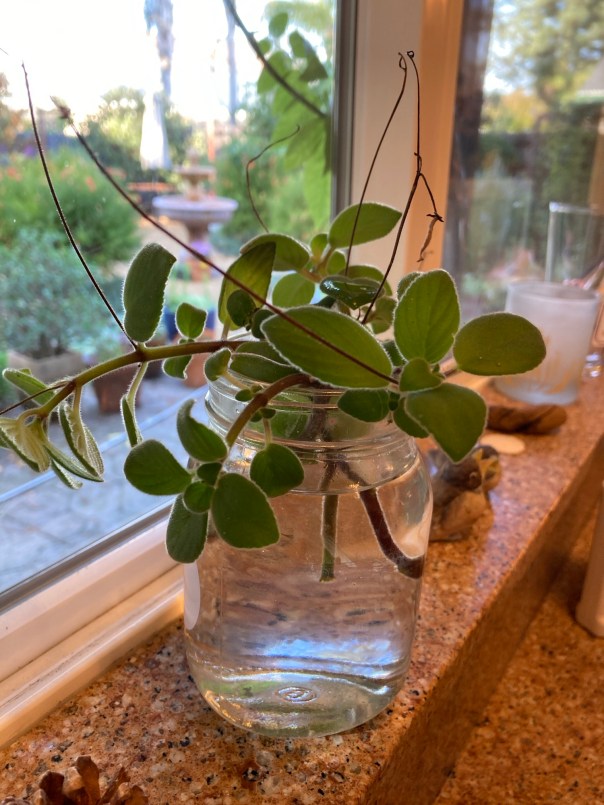
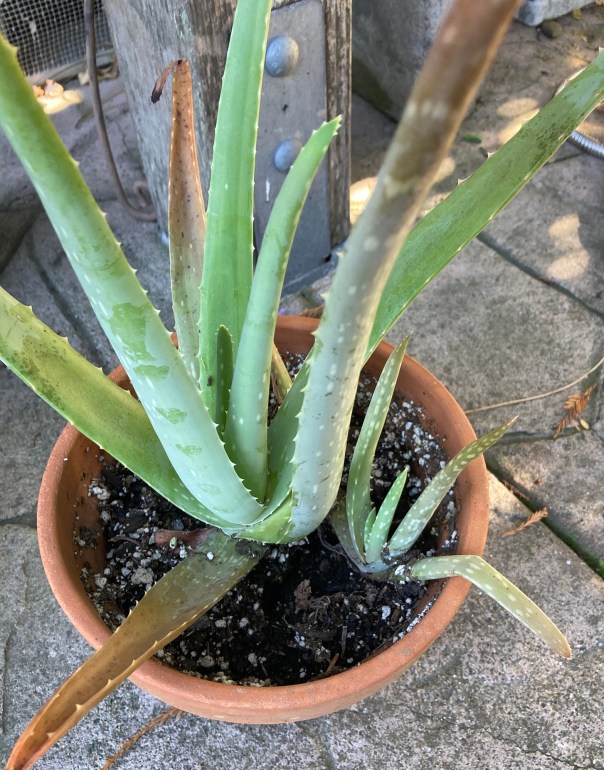
A friend told me that her Christmas cactus and aloe vera had died, and I happened to have a small Christmas cactus that I had propagated a year or two ago to give her. Also I have three aloe vera plants in pots and they all have babies right now, so I potted one up for her. When I trimmed the apple mint and rose geranium and nodding violet I stuck a few stems in water, where they are likely to send out roots.
Aloe Vera offering her child.
It’s been fun visiting nurseries at this time of year, though I do have pangs of (I hope false) guilt that I am tempting myself to plant gluttony. I always forget about Iceland poppies until I see them in the nurseries… and let’s see, what else did I find that I wasn’t expecting? English daisies. They do well in part-shade, also. At the moment I haven’t figured out where to put those daisies.
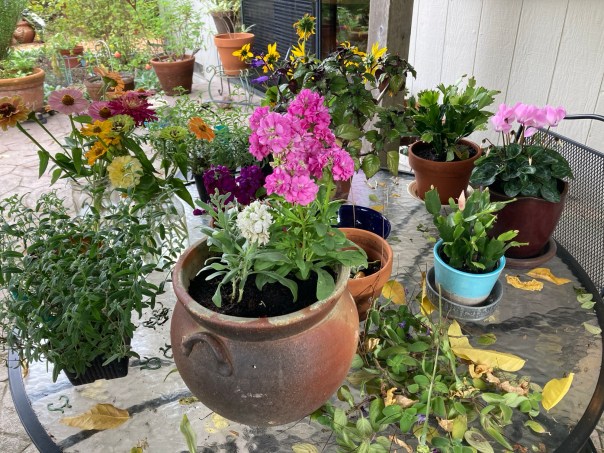
Above is one of my work tables, showing another of my finds at the nursery: stock. I put three plants in a pot to have ready when the asters stop blooming: then I can remove their pot and put this one by the front door.
The gardening spree hasn’t ended, and probably won’t for another few weeks. In the meantime the garden as a whole is a paradise to walk around in, and just look at. In the middle of the afternoon when the sun is shining, the bees are busy still, but they get up late and go to bed early now. The multitude of plants that don’t need attention of any kind at the moment appear especially lovely; they are contented in their slowing down. The atmosphere is quieter and less bright, more meditative.
Pineapple guavas are still tiny, but growing.
In the rain.
Last week I was racing the rain, which arrived Friday night. I could hardly walk Saturday morning anyway, so that marked the end of the most strenuous week, and ushered in the glorious weekend. From Saturday evening to Monday morning it was again and again granted to me to be in my other happy place, the Orthodox church temple where I worship. First the feast of St. Demetrios, the first celebration of that event since I visited Thessaloniki in June, at which time I had became better acquainted with the saint. He is wonderful.
The next day was the first commemoration since her canonization, of our 20th century American saint Olga of Alaska, Mother Olga Michael. It was especially significant for me, because our parish is suffering alongside a family whose wife and mother is in the hospital; we all are needing extra mothering of the consoling and encouraging sort Saint Olga is famous for.
“Her name in the Yup’ik language was Arrsamquq, a name meaning lowly, hidden, or unadorned—like the seed sown quietly in the earth. It was a name that would prophetically mark her life, for she lived not in boastfulness or acclaim, but in humility, reverence, and love.”
Stories abound of Mother Olga’s loving midwifery, how she helped women sufferers of abuse, and was overall a calming and motherly presence to her own children and everyone around her. You can read the source of these quotes and more about her here: “Righteous Mother Olga of Kwethluk.”
“As she matured, she married Nicolai Michael, the village storekeeper and postmaster, who would later be ordained to the holy priesthood. In time, she would become known not only as Olga, but as Matushka Olga—a mother to thirteen children of her own, and a spiritual mother to an entire village. Quiet, gentle, and strong, she became a pillar of warmth and grace in Kwethluk.”
“The Yup’ik elders say: ‘A real person does not disappear, but remains in the hearts of those they have loved.’ In the Church, we say more: A real person in Christ becomes a saint, and the hearts they have loved, in communion with the Lord, become the Church, the living body of Christ in the world.”
The presence of Mother Olga was a Happy Place for many people.
May we all lean into the Lord,
and into becoming our real, personal selves.
Let us seek and find and live in
the Kingdom of God.
In Wisconsin my daughter Pearl has been tending a large house and garden for about eight years. She’s much more artistic and organized than I, about all of the design and execution of beautiful spaces indoors and out. She does all the work herself, even to the point of laying bricks to create a quiet and somewhat hidden corner to sit in, with morning sun and afternoon shade. It’s a wonderful spot winter or summer, and I enjoyed it with Pearl on one of my visits. This time, she had little time for sitting, what with being the wedding planner for Maggie. While she was bustling about, on my first morning after arriving late at night, I made the rounds to see all the flowers that are still blooming everywhere.
Her hydrangeas are gigantic — and I saw others in the area that are just as impressive. Along the side of her driveway, and in big pots, a multitude of plants all grow thickly and complement each other; she doesn’t know the names of them all. She showed Izzy and me this Blackberry Lily, iris domestica, displaying its seeds — something different!
At the airbnb where some of the wedding party stayed, closer to the venue, I sat on a wide porch where giant trees shaded the lawn and tire swing. Pearl’s house has similar ones, though maybe not as tall, that charm me at any time of year.
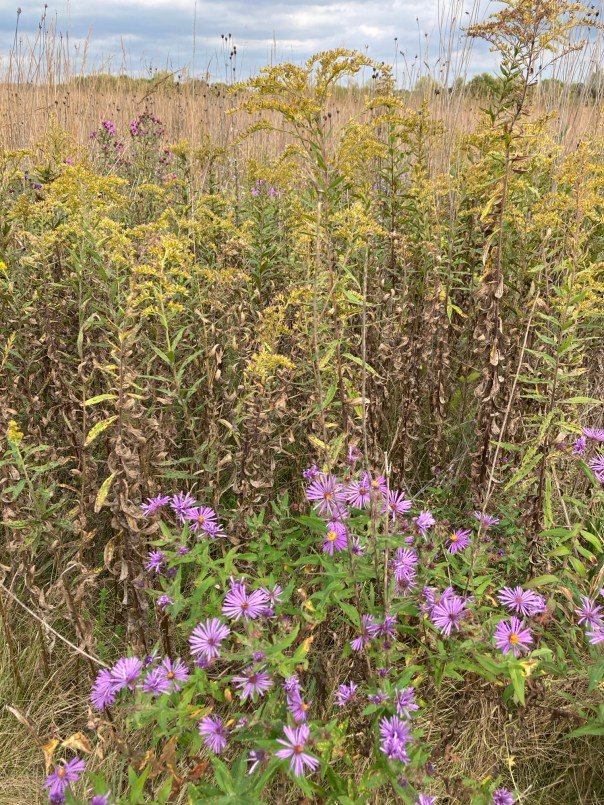
One day Roger and Izzy, Lora, Pearl and I went to a nature preserve in the middle of wide fields that are being restored to wildness from agricultural land. The asters provided the brightest splashes of color in the midst of the various drying grasses and seed heads, and bees were all over the several species of them.
Most of the Gray-headed Coneflowers (Ratibida pinnata) had faded to simply gray heads, but this one was still going strong:
Hairy White Oldfield Aster
The temperature had dropped some, rain was coming in. Everything was delicious.
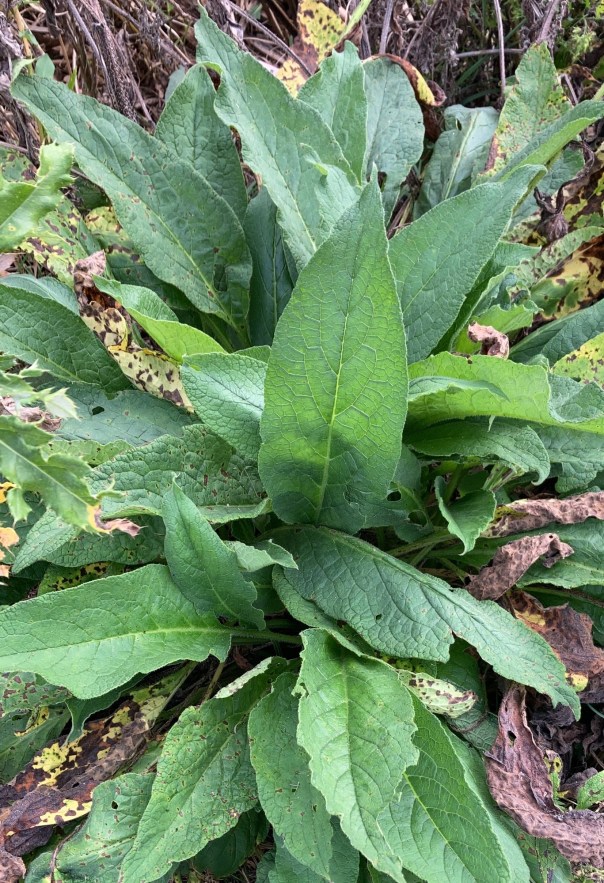
Common Comfrey
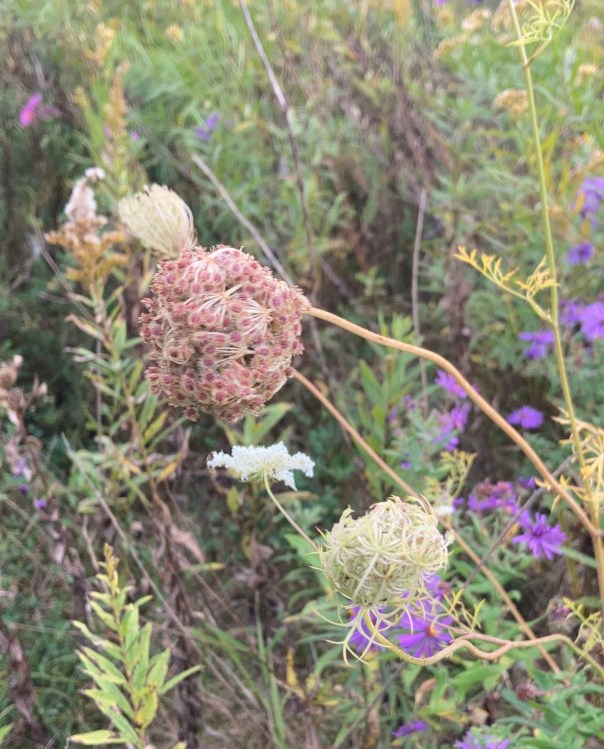
Wild carrot seed heads, here and above.
That encounter with native plants of Wisconsin pretty much filled my Nature cup. When I came home, just as at Pearl’s, this first morning I wandered around and around again to see how my own garden had fared in my absence. In spite of all the unfinished projects waiting for me, I felt warmly welcomed. It’s been a little rainy, and cloudy. For some reason my furnace is not turning on, so I gave in and just opened the door to the coolness, and put on a flannel shirt.
I guess the Japanese anemones heard me saying that I plan to move them to a different spot, and they are putting on a display five times bigger than ever in their ten years of life. I’ll have to reconsider… If nothing else, I will at least wait until they finish blooming before I move them. Other things blooming now are bulbine….
The salvia is producing more blooms since I rather tardily trimmed the old ones.
And always, always, the pomegranate bushes are blooming, from spring until frost! Rosemary is flowering right now, too.
I’m finding it quieting to my spirit to be among the plants as they adjust to the changes of fall. I thought the urgency and too-muchness I was feeling leading up to my time away would be waiting for me when I got home, but it seems not.
This humble native succulent is quietly waiting, not demanding more than a few drops of water from time to time. It appreciates a little shade. When I bought it, there was a sign nearby saying it was not ready for transplanting yet. So it was just the plant for me. We will be ready when we’re ready!
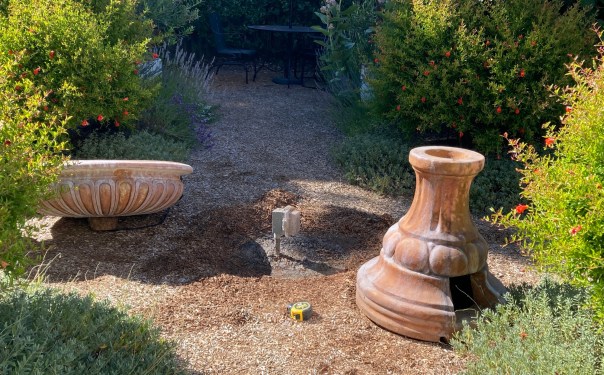
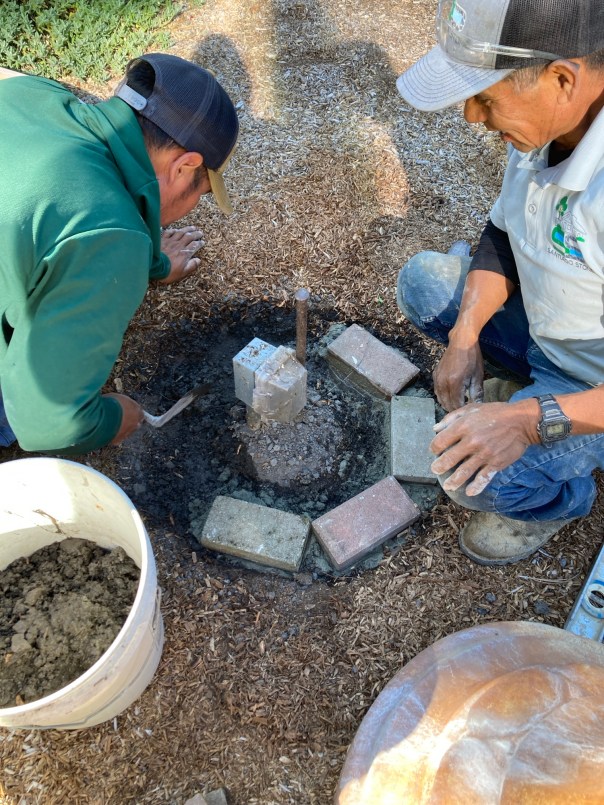
Getting things done. It’s so much fun to check off a few boxes on my “After Greece” list. One of the tasks was to get the fountain leveled. Just before the stonemason was going to come to do that, the pump motor died; I’m glad that happened just before, not after, the leveling. The man who always cleans my fountain when I let it turn green, about once a year, got me a new motor and installed it while I was out one afternoon. That was easy! The stonemason leveled it last night, and gave it a more secure brick-and-mortar base.
I returned from Greece two weeks ago but haven’t got back in the cooking groove. Part of the reason is, I hadn’t made it to the store to buy supplies, and was trying to assemble meals with whatever I could find in the cupboards and freezer. This morning I took my one onion, a can of tomatoes, a small container of mixed sauteed vegetables I’d stored in the freezer, and my home-grown fava beans also stored in the freezer, and made a really nice soup. “Before Greece” I’d roasted all the peeled garlic cloves in the fridge, which was a giant bag — I threw a bunch of those in, too. The soup was good hot, and also cold, as I found out later when the day had warmed up and it didn’t seem necessary to warm up dinner as well.
Recently I decided I wanted to mulch my vegetable plantings with rice straw the way I did ten years ago. So this morning I drove to the feed store where I hadn’t been since then, and was pleased to park next to the shed where baby chicks were peeping. While waiting for the bale to get loaded in the back of my Subaru, I noticed that they had not only rice straw, but rye, wheat and teff as well. The fibers of the teff straw were different from all the others, appearing to be fine and fluffy; I’d like to try that for mulch sometime.
In the past it was a hassle to keep the straw bale dry in the winter and at the same time prevent the rats from bedding down in it and chewing on the tarp that was protecting it, so I thought I’d keep it in the garage this time. Problem was, there was no space for it, unless I would get rid of the plastic storage bins that have been piling up in there as I empty them one by one. So I took them all out and put a notice on our parish email list asking for takers.
My goddaughter Esther came over midafternoon to get some lavender to use in cosmetics. I loaded her bag with rosemary, oregano, and yerba buena herb as well. She said that everything she cooks, if she puts oregano in it, it tastes better. And she’s not even Greek!
I have several types of English lavender growing here; she thought the small, darker purple blooms had the nicest scent, so I made her a couple of bundles of those stems only.
While she was still here, another parishioner stopped by to get some bins. She took almost all of them, and later another person took the remainder.
After the first batch of bins was gone, Esther and I were still standing in the driveway when I saw a field mouse run past. What? At that time of day one doesn’t expect to see such a critter, and I actually haven’t seen a mouse around here in ages, at any time of day, though we are always battling rats that come up from the creek. I could only guess that the mouse had been inside the bale of straw. Uh-oh. Now I am not sure about storing it in the garage.
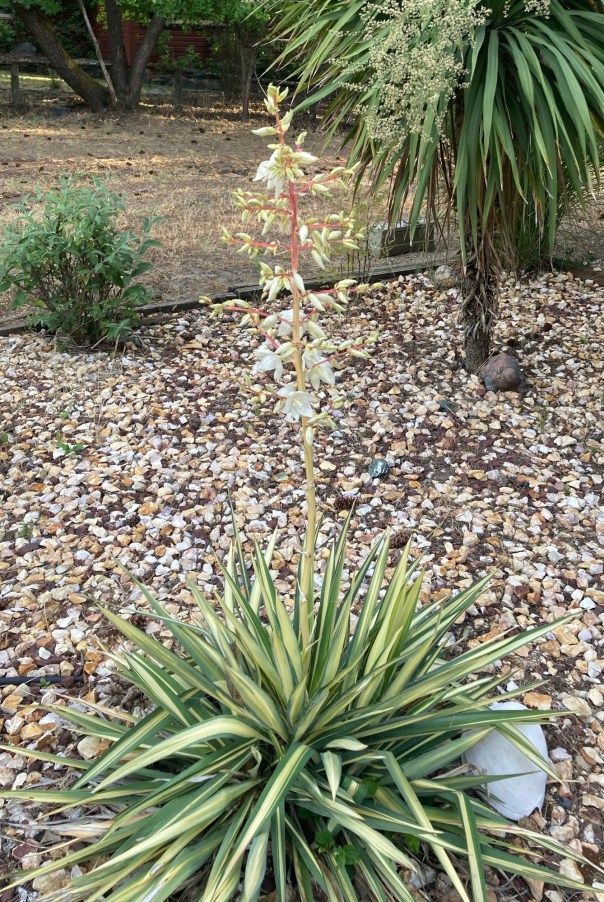
Son Pathfinder has a new house, with new-to-him plants scattered around it. So he texted me a photo of one of them, wondering if I knew what it was. I had seen an almost identical one on my neighborhood walk the other day, but my Seek app couldn’t identify it correctly. We kept looking up plants and trading ideas back and forth for an hour via text (we’re very slow texters), and finally figured out that it is a yucca: “The flowers are edible and have a peppery flavor. Fruits can be roasted or dried and are sweet and fig-like.”
Here, the bees are finding the teucrium to be full of their favorite sweet food.
And with that I will say good-bye for now.





 Last week I was racing the rain, which arrived Friday night. I could hardly walk Saturday morning anyway, so that marked the end of the most strenuous week, and ushered in the glorious weekend. From Saturday evening to Monday morning it was again and again granted to me to be in my other happy place, the Orthodox church temple where I worship. First the feast of St. Demetrios, the first celebration of that event since I visited Thessaloniki in June, at which time I had became better acquainted with the saint. He is wonderful.
 In Wisconsin my daughter Pearl has been tending a large house and garden for about eight years. She’s much more artistic and organized than I, about all of the design and execution of beautiful spaces indoors and out. She does all the work herself, even to the point of laying bricks to create a quiet and somewhat hidden corner to sit in, with morning sun and afternoon shade. It’s a wonderful spot winter or summer, and I enjoyed it with Pearl on one of my visits. This time, she had little time for sitting, what with being the wedding planner for Maggie. While she was bustling about, on my first morning after arriving late at night, I made the rounds to see all the flowers that are still blooming everywhere.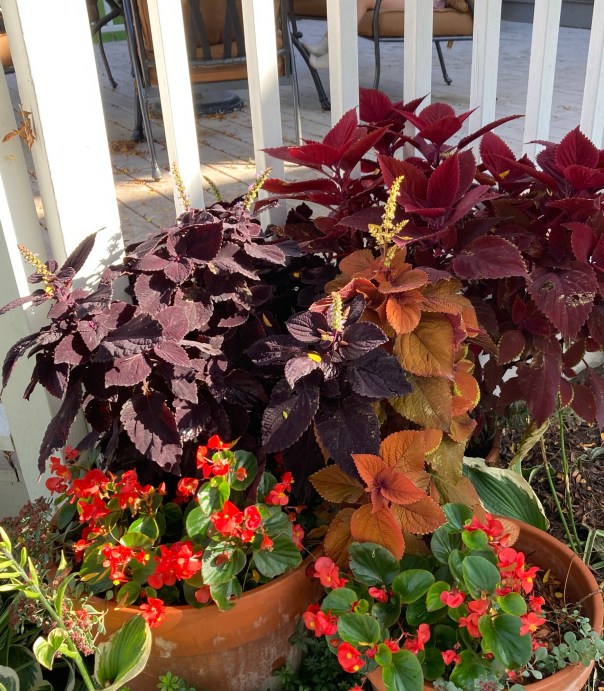





 my one onion, a can of tomatoes, a small container of mixed sauteed vegetables I’d stored in the freezer, and my home-grown fava beans also stored in the freezer, and made a really nice soup. “Before Greece” I’d roasted all the peeled garlic cloves in the fridge, which was a giant bag — I threw a bunch of those in, too. The soup was good hot, and also cold, as I found out later when the day had warmed up and it didn’t seem necessary to warm up dinner as well.
 one by one. So I took them all out and put a notice on our parish email list asking for takers.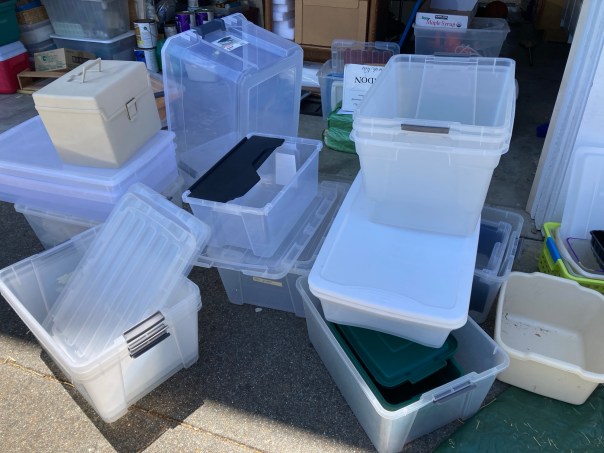
 After the first batch of bins was gone, Esther and I were still standing in the driveway when I saw a field mouse run past. What? At that time of day one doesn’t expect to see such a critter, and I actually haven’t seen a mouse around here in ages, at any time of day, though we are always battling rats that come up from the creek. I could only guess that the mouse had been inside the bale of straw. Uh-oh. Now I am not sure about storing it in the garage.
 Gladsome Lights