Category Archives: books

The rose’s story, and others.

“What Was Said to the Rose” is a poem by Rumi, the Sufi mystic. I listened to it along with several others on a recording played through my car’s stereo on my drive up to daughter Pippin’s house last month.

Sac R above No Fork 5-15
Sacramento River headwaters

For the first hour or more I didn’t listen to anything. I am surprised to find that I like just looking at the scenery in our beautiful state. I live in Northern California, and so does Pippin. But she is five hours farther north than I am, and still not at the top of the state.

Some people who have never been here imagine the cities of Los Angeles and San Francisco and have no idea that there is anything north of the latter. But if you’ve read my blog very long you know that there is a wide realm of land to love, and every time I drive through it I love it more.

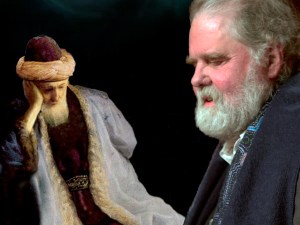
It is said that Rumi is the most popular poet in the United States. I have one book of his poems, which I rarely crack, and I heard a recording of the translator Coleman Barks reading Rumi a few years back. I enjoy Barks’s personality and southern drawl almost as much as Rumi’s poems. You can hear him reading this poem on a YouTube recording; I think it might be from the same event I was listening to.

Rumi was a Persian Muslim mystic in the 13th century. It seems that the order ofGL Rumi & Barks whirling dervishes was formed to propagate his poetry and wisdom. He does write as though his meditation and asceticism opened his heart to God, whom he calls “The Beloved” in many poems. The tone of this one is representative of many that I have read, and it inspires praise and joy in me. The version I transcribed here does not have the first line as its title.
WHAT WAS TOLD, THAT

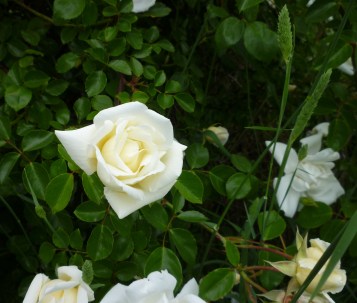
What was said to the rose that made it open
was said to me here in my chest.

What was told the Cypress that made it strong
and straight, what was

whispered the jasmine so it is what it is, whatever made
sugarcane sweet, whatever

was said to the inhabitants of the town of Chigil in
Turkestan that makes them

so handsome, whatever lets the pomegranate flower blush
like a human face, that is

being said to me now. I blush. Whatever put eloquence in
language, that’s happening here.

The great warehouse doors open; I fill with gratitude,
chewing a piece of sugarcane,

in love with the one to whom every that belongs!

–Jalal al-Din Rumi, 1207–1273, translated by Coleman Barks

Perhaps I listened to some music after Rumi. I hope I didn’t jump right into Percy Jackson’s Greek Heroes, which though it references the ancients, is on the opposite side of the literary world from Rumi. I reviewed Rick Riordan’s earlier series a few years ago, about Percy Jackson the demigod and his adventures with the super dysfunctional divine side of his family. I can’t remember much of that one book I read, but when I discovered that the author had more recently retold the original Greek myths (starting with Percy Jackson’s Greek Gods) I thought it would be an even more helpful and fun addition to my haphazard effort to be better educated.

It is more hilarious than the original series. I think that it might also be more entrenched in the middle-school vernacular, including that four-letter “S” word for anything disappointing or bad that is so mainstream now that my own grandchildren are using it in my presence. It’s a sign of the degradation of society, but I guess that fits right in with this collection of stories, because certainly the Greek gods exhibit lots of degraded behavior themselves. Still, it makes me not want to recommend the book to kids.

As I drove up tGL percy-jackson-greek-gods-cyrenehe interstate I could not helping laughing out loud at the lighthearted descriptions of the silly gods and goddesses and the way that Percy tells the drama and draws the characters using modern-day cultural phenomena and slang. Aphrodite sits around reading fashion magazines and looking at herself in the mirror, and various beautiful humans and gods are described as “hot.” The egotism of many of the gods is easily recognized as being like that of some foolish celebrities in the news, or the kids at school who get into trouble, or hurt someone innocent, because of their stupidity and selfishness.

I played a few minutes for Kate the other day and she laughed a lot, too, but she could see why after a couple of hours of these stories I might get tired of them. Is it really necessary to write for such a narrow target audience? How soon will these books sound dated to that age group? I don’t really care that much. The stories are hugely entertaining even for this grandma, and I hope Riordan won’t stop writing for a long time. I don’t know that I will buy a hard copy, though, even though the illustrations are well done.

I turned off my tablet when I got close to Pippin’s house. I drove into the driveway and unloaded my goodies, including an armful of books for the children that I had bought at the thrift store. We read about Ping and Paul Bunyan, and I was glad that these dear hearts aren’t at the age for hearing about Percy and his cohorts yet. They’ll be ready for Rumi sooner.
Sn Ln giant rose bush indiv 5-15

When Husbands Die

Soon after my husband’s death I read When Husbands Die by Shirley Reeser McNally. The author who was a widow herself surveyed a group of women who had been widowed within the previous ten or more years, and organized their responses into a book. 

It was what I needed to read at the time, a sort of controlled support group, where I didn’t have to interact in real time with anyone, but could glean comfort from hearing from women who were in the same situation and who knew what I was going through. It’s strange, when I think about it, that an experience that is so common to humanity, the death of one’s spouse, can be so outrageous and solitary and impossible to prepare for.

One reason for the solitary aspect is the uniqueness of every relationship, and of each griever. This collection of women’s stories was interesting in that the women were all educated and able to write articulate and thoughtful responses to the questions, whether they were in their first months of grieving or years down the road. Most of them did not have to struggle financially, even if their husbands had died fairly young.

Shortly after reading the book I told people that it was something like reading a sociology textbook, and a little dry, but now I think, wasn’t that what I needed? I certainly didn’t want to read anything dramatic about someone else’s trauma. C.S. Lewis’s A Grief Observed was not as helpful, partly because it was only one person’s story, and that of a man, one who hadn’t been married very long. I am a woman who had been married a long time.

I especially liked hearing from women who were at a later stage of grief, about how their lives had changed over the years since their husbands had died, and the ways in which they had built new lives that were good. I went back this week and reviewed the passages I’d highlighted on my Kindle. Here are a few of those favorites:

“…the shared stories indicate that women must work through three to five years of grief and change before they feel well on their way to a recovered, reinvented life. The hard work of grieving must be accomplished before healing takes place.”

“…disorientation, fatigue, loss of self-confidence, feelings of abandonment, shock, and bone-deep sadness.”

“…our culture…is not open to the commonality of death, and how important it is that we come to terms with it in our lifetime.”

“I think women are better able to cope. We are greater realists and more skilled at accepting change as part of life because of our biological natures: monthly changes, pregnancy, childbirth, etc. Widowers tend to remarry sooner. They don’t know how to nurture themselves.”

“Is it ever possible to have no regrets; to have accomplished all you wanted to do; to have said everything, done everything? No. Omissions you recall later may bring sadness, sometimes guilt, until you understand that it was important for you and your husband to do things in your own way. That’s the only way you and he had.”

“…dying is something each of us has to do alone, at least in a human sense? The moment must come when, in dying, we move beyond our surroundings into another space.”

“…it is a sudden time, when things must be left unsaid and undone.”

Maggie and I share stories.

P1010081 crp
grevillia


Now that Pearl’s family has moved to California, I have nearly half of my grandchildren within an hour and a half’s drive. It was so easy to pick up Maggie on the way home from the mountains, and to bring her here to spend almost a week with me.P1010015P1010096

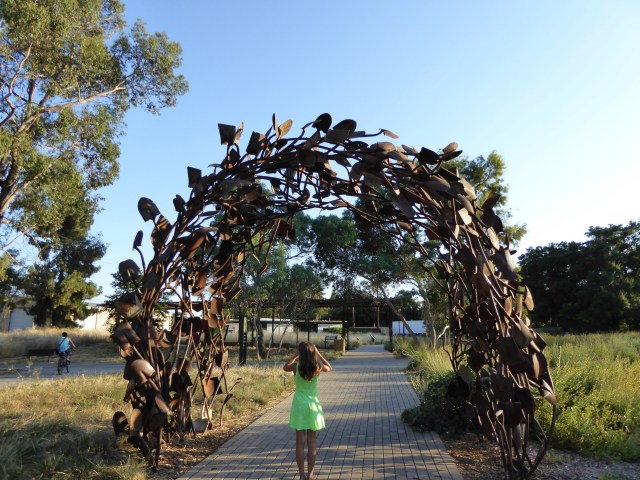
First, though, the evening I arrived, her mom took a few of us to the Arboretum on the University of California campus in their town of Davis, so I could check out some of the many plants with low water needs. A rustic and rusty arch of shovels signals the beginning of this part of the gardens, with wide plantings of grasses and native California plants leading on into the Australian section, which is what I was most interested in. I have noticed in books that a lot of striking and unthirsty species come from Down Under.

Maggie had her camera, tP1010093oo, and found families of ducks to take pictures of. We didn’t spend too long, but I managed to take many pictures with identifying signs next to the plants that I liked, so I didn’t have to take the time to write down names.

I’m only posting a few of those, of the nicest looking, which I wouldn’t mind having in my new garden if I can find them in nurseries.

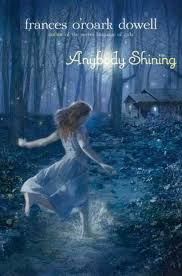
The next morning Maggie and I drove off to my town. I had downloaded Anybody Shining by Frances O’Roark Dowell from Audible on to my tablet so we could listen on the way home, which we did for about an hour, Maggie in the back seat because she’s a lightweight. We shopped that afternoon and evening, to resupply my fridge, and we watched “Cheaper by the Dozen,” under blankets on the couch.

P1010115

Shopping took a lot of our time during the next few days, because we were planning a tea party that we held last Saturday, and also were having company on Sunday. Giving the tea party was the focus of our time together; Maggie came up with several good ideas before we even got home.

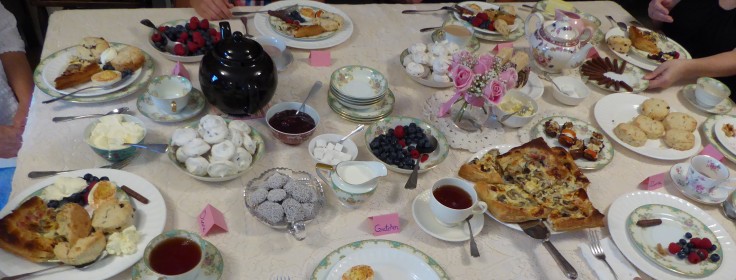
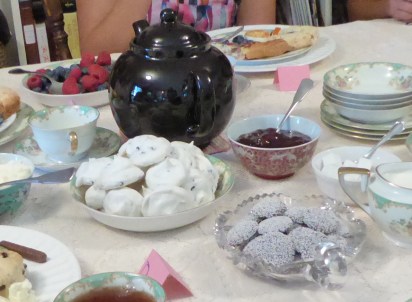
We planned and shopped and cooked and in the end we served: deviled eggs and mint chocolate chip meringues made by Maggie; two kinds of P1010119 crpscones with jam and creme fraiche; chocolate pastilles; ham and Swiss quiche made on puff pastry; fresh blueberries and raspberries; chocolate orange sticks; some fancy chocolate and sprinkle-dipped Rice Krispy treats we discovered on one shopping trip; and of course the tea, black and rooibos, and hot cocoa for little girls who preferred that. They all did.
P1010140 crp

Eight of us ladies whose ages spanned the decades down to four years old enjoyed our party very much.  My little goddaughter Mary, four months old, was also present but not enjoying the goodies. The conversation was edifying and stimulating. I sent scones home to the menfolk, and that evening Maggie and I ate leftovers. P1010142 crp

We listened to more of our book on the computer and came to the satisfying end. The next day Maggie mentioned it in her own blog post. It is about a girl about Maggie’s age, living in the mountains of North Carolina about a hundred years ago, and her desire to have a friend. The history and the culture of the mountain people are the background of the story, in the telling of which the protagonist Arie Mae expresses her good heart and charming wholesome self through letters she writes to her cousin in the city. The descriptor “shining” she applies to at least two other people in the book, but Arie Mae herself is the truly shining character.

I made Maggie pause the recording so that I could write down a wonderful word of advice from Arie Manybody shiningae – but could I find the paper I wrote on, just now? No! So I washed dishes and listened again to the last few chapters of the book till I could find the place again.

A sub-plot of the story is about the more educated people coming from the city to write down the songs and stories of the mountain folk, to start schools, to help them in various ways. One conflict concerns the dynamic of the outsiders coming in with their ideas and advice for the people who get the feeling they are not appreciated for who they really are.

The way Dowell ties this aspect of the story in with Arie Mae’s growing friendships is delightful. She writes to her cousin, “It takes time to get to know people. You got to listen to their stories, and you got to tell your stories back. It all goes back and forth, back and forth, until one day you turn into friends. Until that time, I expect it’s best to keep your opinions to yourself.”

My Maggie and I enjoyed more stories together during her visit, in the form of two more movies: First “Hook,” which we watched here at home. I find that story delightful, but I think Maggie at her age couldn’t enjoy the Robin Williams character as well as I. And maybe the lost boys were too familiar in their exaggerated annoying boyishness to a girl with three older brothers. Then we saw “Inside Out” at the theater. How wonderful to go out to a movie, just us girls. We even shared a bag of popcorn. I am liking this new phase of grandmotherhood!

Soon after the opening credits we were amazed to find out how perfect “Inside Out” was for us right now. The main character Riley has a few big things in common with my granddaughter: They are both twelve, and each has just moved with her family across the country to California. So many good ideas, so much wisdom is in this movie, I think I need to see it a few more times to be able to think about it more. Movies always go too fast for me, and there is a lot of fast action in this one, too, so that I found myself several times musing over the possible symbolic significance of an event – musing for a few seconds – and then another metaphor would interrupt me to suggest itself in the next scene.inside-out-

Riley seems to be at the mercy of her emotions in this story; you might even say that the emotions are the real main characters, as they try to manage her life to make it good. What seems obvious to the ringleader Joy is that Riley needs to be happy, so Joy is always working very hard to program the right thoughts and memories into Riley’s mind to make her happy. The other emotions eventually find out that they have a role to play as well.

Both Maggie and I were uncomfortable with the implication that Riley’s decisions were based solely on her emotions, but there is a lot of truth to the way the thousands of memories in her bank could be used to cultivate various emotions. I loved the image at the end of the movie, after Riley has connected painfully well with her anger and sadness, and the islands of Family and Honesty have seemingly sunk into the sea — she ends up in the arms of her parents, being comforted. She has grown up a lot in the recent weeks and months and is stroncross Maggie July 2015ger than before, and I’m sure her parents are wiser, too.

My granddaughter who was sitting next to me in the theater had decided a few months ago that she wanted to be baptized in her church before moving away. Back then I couldn’t get it together to celebrate such a happy event with her across the miles, so this week we went shopping for the present I wanted to give her, and found this lovely cross that we both liked. It is a symbol of Something  deeper than a memory or an emotion, the great Story of God’s love and our salvation. I’m so thankful He is with us and for us as we go through all the trials that accompany every stage of life. He is the only one who really knows us inside-out.

Attention to gnats and devils.

pig IMG_5528One of the books that Richard Wilbur wrote for children is Pig in the Spigot, which any lover of words should enjoy, whether you are a child or not. I can see reading it with a child who is well on the way to reading, but when I was homeschooling I often would introduce material “too early,” and that can work, too. If used with a notepad and pencil, I bet I could make this book serve as reading/phonics lessons for at least a week.

One of my favorite elementary school assignments was when the teacher would write a word on the blackboard, and tell us students to make as many more words as we could, using those letters. I always won this contest! Wilbur’s exercise is more stringent, but that only gives him the chance to show his poet’s skill in imagining the logical ramifications should the words within words become literal.

The illustrator must have had fun coming up with the sometimes-wacky pictures to go with the stories that one can create with this kind of activity. Here are a few of the examples of fun verses that often carry some even deeper implications.

The Devil is at home, as you can see,
In Mandeville, Louisiana, but he
Is often on the road, and in the line
Of work he visits both your town and mine.

Some tiny insects make a seething sound,
And swarm and jitter furiously around,
Which seems to me sufficient explanation
Of why there is a gnat in indignation.

pig IMG_5523

Moms weep when children don’t do as they say.
That’s why there is a sob in disobey.

I just noticed that the mother in this last picture is wearing a cross. There are many other interesting details to be explored in the images, but it’s the language of words that I get excited about. Anything that helps children slow down and pay attention to the details of letters and sounds will help them to be good readers and writers — and spellers!

But I don’t want to sound too pragmatic, even if the level of literacy in the country is dismal. John Holt said that it is not good methods but good books that make good readers, and here is an example of what he was talking about. What makes me happy is the knowledge that good readers will read more because they enjoy it, and if they keep reading good books their inner worlds will grow ever larger. They are more likely to become good writers and thinkers, and maybe they will write some more good books for children that are fun for me to read.