I agree with Alana about bad smells (and thanks to Marigold for the link), but because my blog’s subtitle doesn’t include “things I dislike,” I don’t want to spend too much time on this topic. Those offenses I like to nip in the bud, but it’s not always possible. When we moved into this house 20 years ago I began to strip it of the smell of cigarettes, and it took a few years before people started to say that the house smelled as mine ought–whatever that meant.
But that odor was released again and assaulted my sensibilities this week when B. and I went at our ceilings with a will and removed the decades-old acoustic junk, a.k.a. popcorn or cottage cheese, stuff I hate because it can’t be cleaned. Perhaps because I clean so infrequently, I’d like to do a thorough job of it. At least that dirty thing on the bottom of the room, the wall-to-wall carpet, can be replaced when one wants to remove everything that offends.
On the other hand, I grew up in a house filled with the smell of cigarettes, so I don’t think of it as vile, exactly. All the time I thought it was gone, it was probably melding with the me-smells (what are those? cookies and eggs, lemon oil polish and grapefruit dish soap?) the way my mother’s heritage melds with other parts of me. Now that it is more gone than before, the house will smell different again, like the new me.
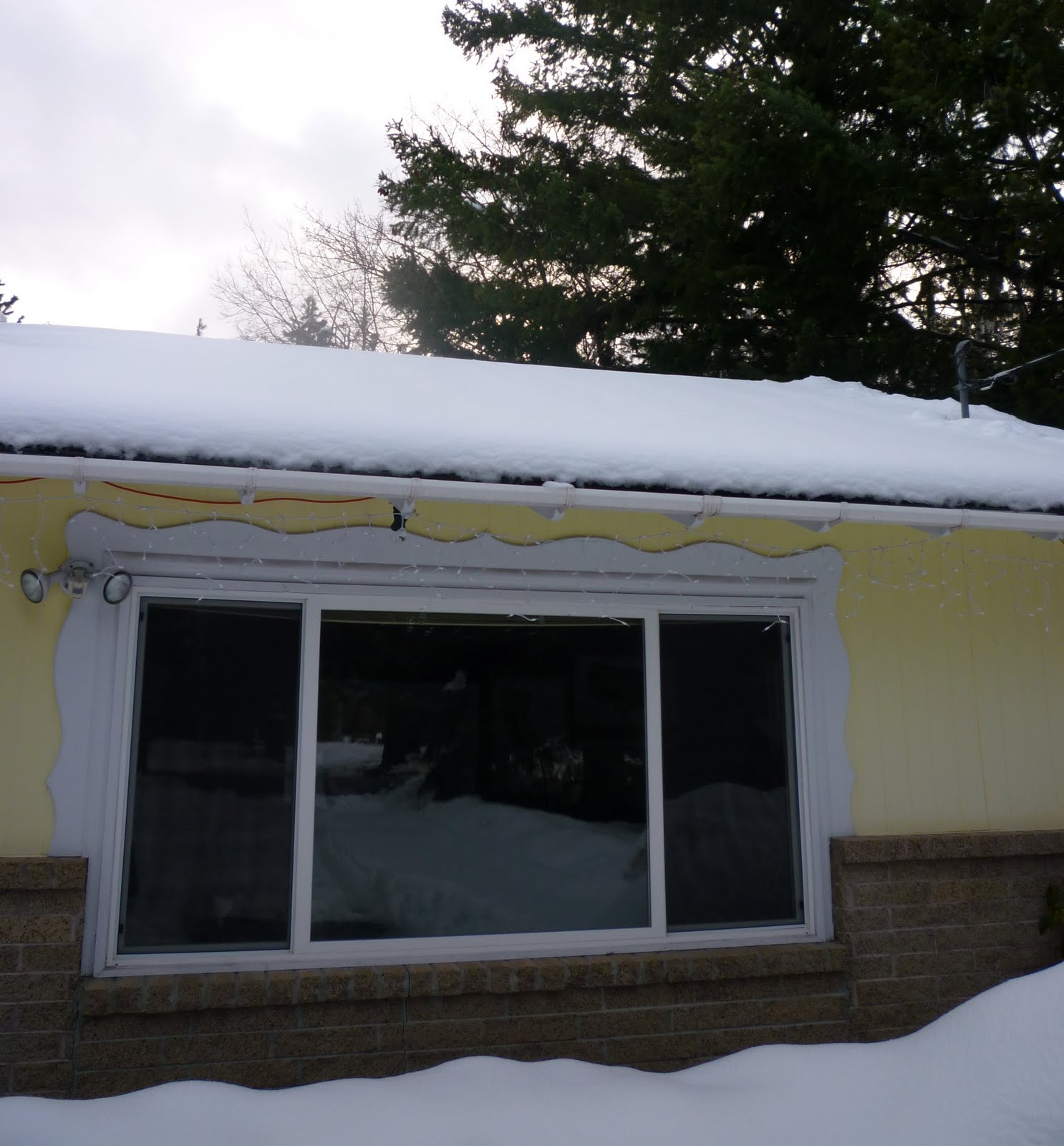
Spring winds are blowing away everything stale in the olfactory department, I think–at least in my marine-temperate zone. But one last picture reminder of the piney forests about 3,000 feet higher up: these gumdrop-colored houses that got a recent blanket of smoothing snow all around, reminding me of candy decorations on gingerbread, and royal icing.
The Broken Computer has prolonged the interruption of my blogging, following hard as it did on the Expedition Without Camera Cable. I’ve been back from wandering for several days, but as I have a dear house guest it’s just as well that I have the machinery problem as my excuse for not blogging. When I get the computer back I’ll have even more things to tell about.
While I’m being otherwise occupied I’ve still found some time to read blogs, on son P’s computer. Posts that have been stimulating include one on Spring Cleaning, with a day-by-day plan carrying the author from one end of Lent to the other. This is a new concept for me, and truly inspiring. We are remodeling during the upcoming months at this house, though, so I will have to try her tidy method some other year, and concentrate on packing up many of my books and all of my kitchen things starting yesterday.
Is it easier to keep a small house clean? That depends. When our family of seven moved from a small house to a big one, suddenly our home seemed cleaner and neater just because there was more space. But the blog This Tiny House is delightful to dream over, the treehouses and little dwellings of various kinds. A recent post is about a tiny vehicle, actually, but might be a fine introduction if you’ve never visited there.
Many people, I’ve noticed, give up TV for Lent. I myself agree with Groucho Marx, who said he found TV very educational: “When someone turns on the TV, I go in the other room and read a book.” Whether you watch or not, you might agree with me that this verse by Roald Dahl is amusing.
A woman I know is trying to find a lot of cooking blogs, as she’s reveling in the idea and trend of Slow Food and recipes. It made me happy to point her to this blogger who opens up a full 60 other cooks’ worlds. Take note, all you snowed-in people (and that includes 3/5 of my own children!) that the theme of his recent group of links is Warming Dishes. Comfort food!
Last and most pertinent to this weekend, I’m sure, is a musing on Forgiveness Sunday.
“Beauty is the promise of Happiness,” said Stendhal, quoted in The Architecture of Happiness by Alain De Botton.
Written in this 21st century, it is billed as an introduction to architecture. As for decades I have been discovering an appreciation for buildings, and at the same time have been realizing my ignorance of artistic principles generally, I was really ready for De Botton’s helpful study, which doesn’t catalog architectural styles –I seem to have a mental block against learning these—but explains why we humans might like or dislike particular buildings:
“We are drawn to call something beautiful whenever we detect that it contains in concentrated form those qualities in which we personally, or our societies more generally, are deficient.”
John Ruskin said that we want our buildings to shelter us and to speak to us, of what we find important and need reminders of. These values can change somewhat across centuries and cultures, but de Botton lists several “virtues of buildings” that are required if they are to be beautiful.
1) Order. But not over-simplified. We like to see complex elements arranged in a regular pattern.
What the author calls the “perverse dogma” from the Romantic Period, that all edifices must be of original design, led to chaos in the landscape. “Architecture should have the confidence and the kindness to be a little boring.”
2) Balance. Some concepts to be mediated are old and new, natural and man-made, luxurious and modest, masculine and feminine. This chapter gave me the most trouble. The photographs showed supposed balance that looked incongruous to me. I don’t like bare concrete, to start with. My tastes prove the point made by another quote from Stendhal: “There are as many styles of beauty as there are visions of happiness.”
3) Elegance. When the achievement of strength or energy looks effortless and modest as in the Salginatobel Bridge in Switzerland, above.
4) Coherence. The building should not be a hodgepodge of styles. I’ll say it should be a clear declarative sentence. [I must like those a lot; I wrote this months before my last book review.] And that “sentence” should make sense in the context of its “paragraph.” As Louis Sullivan said, for example, tall buildings are all about loftiness, and that statement is made by every line of a skyscraper contributing to its being “a proud and soaring thing, rising in sheer exultation….”
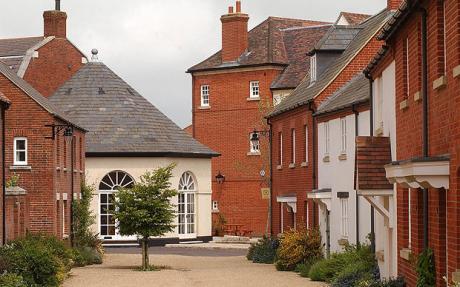
Poundbury
A building should fit into its historical and cultural place as well as its physical setting. De Botton considers one failure in this regard to be the exact replica of an 18th century village style built in the late 20th century in Poundbury, Dorchester, a psychological and practical disconnect. Others have commented on this housing development’s good and bad aspects. It was the brainchild of Prince Charles, by the way, who seems to be always pulling weight against what he considers ugly modern architecture.
The author helped me understand why a building that I have enjoyed is not appreciated in its home town. After reading Death Comes for the Archbishop by Willa Cather many years ago, I was excited to visit the 19th-century cathedral that was actually commissioned by the priest who was somewhat fictionalized in the novel, in Santa Fe, New Mexico. At that time I thought the disregard of the beautiful building was likely because of its Christian history and purpose, in a town that is now in love with its more pagan native roots.
The Cathedral Basilica of Saint Francis of Assisi
Now I understand that while Fr. Lamy conceived of a church he knew to be beautiful, that of his beloved French homeland, if he had been of the modern architect’s sensibility he would have altered the design to reflect his new home and climate. But I don’t believe he was an architect in the first place.
I appreciated the building for its Christian and literary history, even if it is in the Romanesque Revival style. It at least is built of local New Mexican stone; I know of beautiful houses in California that have design elements that required the transport of huge stones from Japan, to keep the whole piece of art Japanese–but what about the context?
The Cathedral Basilica of Saint Francis of Assisi, as it was designated in 2005, looks more odd all the time in the town of Santa Fe, which has, perhaps somewhat in the spirit of Poundsbury, tried to homogenize its architectural style:
“By an ordinance passed in 1958, new and rebuilt buildings, especially those in designated historic districts, must exhibit a Spanish Territorial or Pueblo style of architecture, with flat roofs and other features suggestive of the area’s traditional adobe construction. However, many contemporary houses in the city are built from lumber, concrete blocks, and other common building materials, but with stucco surfaces (sometimes referred to as “faux-dobe”, pronounced as one word: “foe-dough-bee”) reflecting the historic style.” [from Wikipedia]
Of course, these efforts to “pueblofy” the city have meant a loss of the eclectic elements from the past, though it was all done in the interest of promoting tourism and preventing decline of another sort.
De Botton writes of buildings having an aesthetic mission, and if one is on a mission, the last listed quality is crucial:
5) Self-knowledge. When I first saw that heading, I thought, This is carrying the anthropomorphism too far. I was relieved to find that the author was by now speaking not of buildings but of us humans, especially of the architects among us.
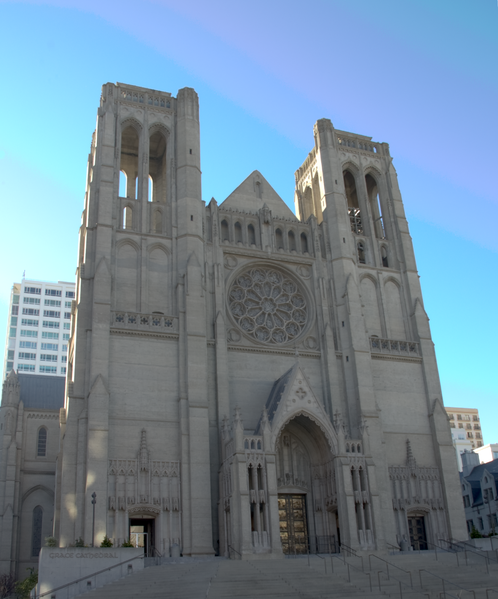
Grace Cathedral, San Francisco
We need to understand our human nature in all its complexity if we want to avoid the utopianism of the famous Swiss-French architect Le Corbusier, who seemed to have many radical plans, at least some of which we can be thankful were not accomplished, such as tearing out the heart of Paris in 1922 to replace it with 16 residential skyscrapers, some of which would house 40,000 people each. He wanted to eliminate suburbs, and abolish city streets, and glancing across the ocean, to raze Manhattan and start over. For one thing, its skyscrapers were too short.
Getting back to that quality of balance, I’m wondering if my own distaste for concrete is perhaps as closed minded as Prince Charles tends to be. My snobbishness made it hard to appreciate Grace Cathedral when I visited it last month, because though it has soaring arches and design beauty, it lacks the natural stone of the cathedrals I enjoyed in England.
I should remember that concrete is only a type of cast stone, which has a long history in antiquity, as I learned from reading The Pyramids: An Enigma Solved by Joseph Davidovits. He argues that at least the outer casing stones of the pyramids themselves were built from a masonry product poured on-site. It’s been more than ten years since I read this book when the children and I were studying ancient history, and I plan to read it again soon.
My own church is built of concrete, though one can’t see any of that base material anymore, covered as it is now in plaster and icons and marble. And on the subject of church architecture, I hope to write more, as my excitement grows into deeper understanding.
Thanks to De Botton, I have a little more foundational knowledge to aid me in my explorations. His style is slow and thoroughgoing in explanations of concepts, so much so that it took some getting used to; but I soon came to appreciate his carefulness. He includes many photographs to flesh out the architectural ideas he presents to the reader.
Alain De Botton is a philosopher as much as an artist, and helped to found a school called The School of Life. He has written several books, and my intention is that The Architecture of Happiness will be just the first of other thought-provoking works of his that I read.
“… for dear to our hearts is our home, although it be the humblest cottage, or the scantiest garret; and dearer far is our blessed God, in whom we live, and move, and have our being. It is at home that we feel safe: we shut the world out and dwell in quiet security. So when we are with our God we “fear no evil.” He is our shelter and retreat, our abiding refuge. At home, we take our rest; it is there we find repose after the fatigue and toil of the day.” ~C.H. Spurgeon (Thanks to Leslie at Abiding.)
 On the other hand, I grew up in a house filled with the smell of cigarettes, so I don’t think of it as vile, exactly. All the time I thought it was gone, it was probably melding with the me-smells (what are those? cookies and eggs, lemon oil polish and grapefruit dish soap?) the way my mother’s heritage melds with other parts of me. Now that it is more gone than before, the house will smell different again, like the new me.


 Gladsome Lights