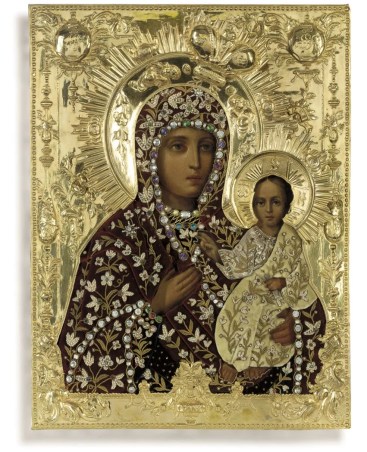
 Icons of Mary with Christ seated on her lap are venerated in the sacramental churches of East and West, Orthodox and Catholic, and have their commemoration days just as saints do. I’m most familiar with the Orthodox tradition, and how these days are scattered liberally throughout our liturgical calendar. Today I was at Divine Liturgy in the morning, but we were remembering various other saints and events in my parish, and I didn’t notice until I was home again that today we also commemorate the Smolensk Icon of the Mother of God.
I would never have foreseen, fifteen years ago, that I would have favorites among icons of this subject, but it happens; this version is possibly my favorite of all because for ten years or more it was the only one I had in my house. My humble print resembles this one:
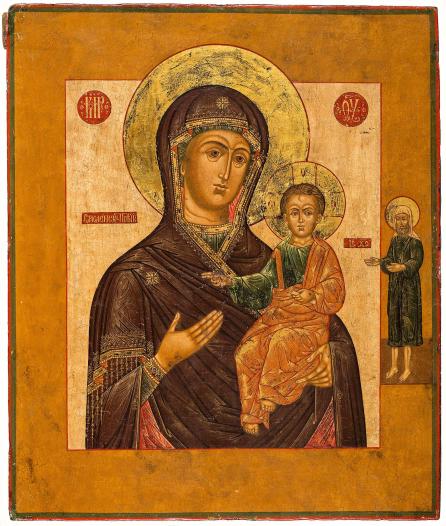
Icon Reader tells us that “It is known as “directress” (in Greek Hodigitria) because the Mother of God is shown directing our gaze to Jesus Christ with her hand. This style predates the Smolensk icon, and is one of the original ‘types’ traced back in Church tradition to St Luke.”

The tradition is that the first icon thus depicting Mary and Jesus originated in Antioch, and went from there to Jerusalem, then Constantinople, where it remained until, “In 1046, Byzantine Emperor Constantine IX Monomachos gave his daughter, Anna, in marriage to Prince Vsevolod Yaroslavich, the son of Yaroslav the Wise. He used this icon to bless her on her journey.” And there it stayed in Kievan Rus’.

Many, many versions have been painted based on this style, and even the Black Madonna of Czestochowa in Poland, in its less innovative versions, can be seen to contain the same elements:

It seems that Orthodox Christians in Ukraine and Belarus are also fond of the Black Madonna version of this icon, as well as sharing a love with Russians of the style generally. One of the icons in this article from 2014 is a Smolensk icon of Mary: “Weeping Icons of Ukraine and Russia.”

While Icon Reader has reservations about the meaning of these tears, he was able to affirm one clear word from the news reports that surely still stands:
“What is certain is [the] tears of the Mother of God
speak directly to the heart of every Orthodox believer,
calling all to repentance, amendment of life and return
to Orthodox faith and tradition in their fullness.”

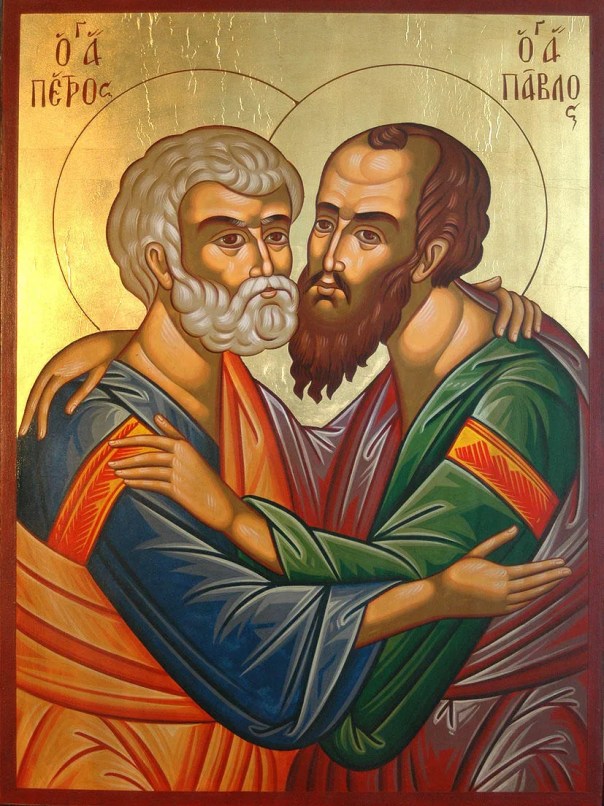 Today we celebrated the Feast of the Holy, Glorious and All-Praised Leaders of the Apostles, Peter and Paul. As it was a weekday, the church was not full, but there were half a dozen strong choir singers and beautiful hymns to sing along with them. During the short Apostles’ Fast beforehand I read the epistles of St. Peter, and I wanted to share a passage here, one that I find especially encouraging.
 Gladsome Lights