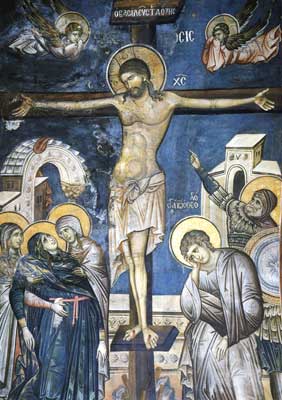
“The prayer of Gethsemane was an expression of horror in face of death, a reaction proper to all human nature, especially to an incorrupt nature which should not submit to death, and for whom death could only be a voluntary rending contrary to nature.”
― Vladimir Lossky, The Mystical Theology of the Eastern Church
Puritans reckoned the cadavers in Anatomy were drunks off the street; idealists said they were benefactors who had willed their bodies to science, but the averted manila-colored people on the tables had pinned-back graves excavated in them around which they lay scattered in the end as if exhumed from themselves.
-Les Murray
This month marks ten years since my husband’s departing from his earthly life, which leads me to meditate again on this topic. And today is one of the Memorial Saturdays we Orthodox have during Lent:
“Saturday is the day which the Church has set aside for the commemoration of faithful Orthodox Christians departed this life in the hope of resurrection to eternal life. Since the Divine Liturgy cannot be served on weekdays during Great Lent, the second, third, and fourth Saturdays of the Fast are appointed as Soul Saturdays when the departed are remembered at Liturgy.” (OCA)
Les Murray’s poem recognizes something about human beings that our modern consciousness rarely grasps: the unity that exists between soul and body, and the brutality of violating the physical aspect of a fellow human.
“…you will hear people say that the deceased is not in the coffin but with Christ, for example. However, if a person dies in Christ, their souls will be with Christ, but until the general resurrection, their body remains a part of them that will one day be reunited with their souls (though their body will be transformed) — and as such, the soul apart from the body is not the whole person (2 Corinthians 5:1-5).
If you are interested to know more about the Orthodox perspective on end-of-life issues, you might check out the Ancient Faith podcast “A Christian Ending” from Deacon Mark Barna, who has also co-authored a book by that title. Episodes of the podcast include: “Understanding Death,” “Cremation,” and “Preparing the Body for Burial,” and about a dozen more.
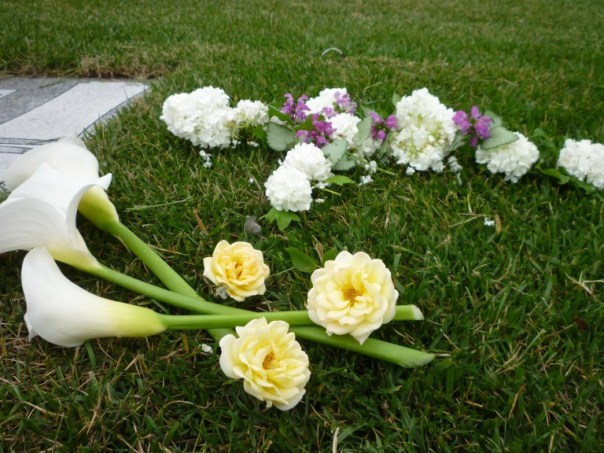
My late husband’s casket in our house.
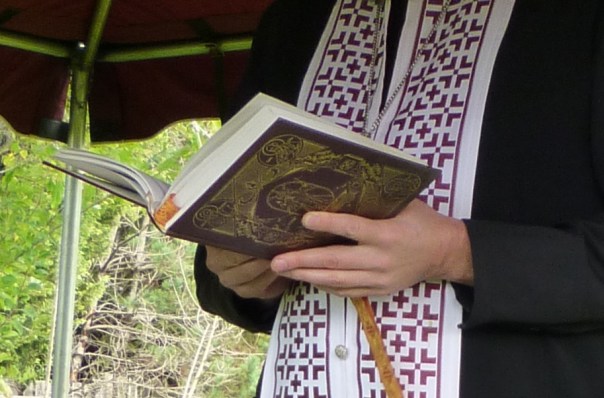
In the wholeness of Orthodox vision and practice, “…death is a change, but not an end. That which we see, the body, remains important and worthy of honor. A funeral, the service of remembrance, is a sacramental gathering in the presence of God. The body is honored, even venerated. The life of remembrance, eternal remembrance, begins.”
Saturday being the day of Sabbath rest, we Orthodox often have memorial services this day, and pray for those who rest in death, waiting for the Resurrection. For that reason I thought to share these words spoken at a funeral earlier this year. But also, my parish has seen two of our community fall asleep in death this month, and we are feeling the sorrow right now. Read on to hear what the rabbis say:
“If you have a heavy heart and are grieving, that is OK. We weep for those we love and who have loved us. One hears from time to time: ‘Oh, you should not cry. He is in a better place.’ But Christ God Himself wept at the death of his friend Lazarus. And the rabbis say that God weeps at the death of every human being. So, don’t be afraid to weep.
“You can also hear it said among some Christian groups: ‘Oh, that is not Father Anthony. He is with the Lord! That is just a shell.’ I ask you then who is that there in our midst?! You see, to be a human being is to be a soul enfleshed, that is, a soul wrapped in a physical body. Angels do not have bodies.
“The tragedy of death is that the union of soul and body is torn asunder! That is why Christ died a real human death, and rose from the dead as a real human person, his body and spirit united again. Fr. Anthony’s body is as much Fr. Anthony as is his soul which awaits the last day when it will receive a new body.”
-Archbishop Benjamin at the funeral of Father Anthony Karbo, March 2024


 Les Murray’s poem recognizes something about human beings that our modern consciousness rarely grasps: the unity that exists between soul and body, and the brutality of violating the physical aspect of a fellow human.
 But Christ God Himself wept at the death of his friend Lazarus. And the rabbis say that God weeps at the death of every human being. So, don’t be afraid to weep.
 Gladsome Lights