I remember when I first learned in a practical way about microclimates, from my friend Rhonda who had a lovely cactus garden in our county. I also tried to grow a few cacti, but they all got waterlogged from rain and then froze to death in their first winter. Rhonda lived on a small mountain, where the cold air descending would usually keep rolling right on downhill so that the plants barely noticed it going by. That was her microclimate, so different from my back yard where the damp and freezing air would settle on my cactus and turn all their juices to ice crystals.
My friend Dick lives on a smaller hill in a generally more extreme climate zone, but a similar weather pattern holds sway so that frosts are often averted. There may be other factors involved in his microclimate that we didn’t discuss, but in any case, starting about 50 years ago, but more intensely in the last decade, he has been enjoying his freedom to experiment widely.
In a previous post I mentioned how before that, he was one of the friends with whom I would ride bicycles all around the country roads and through the orchards connecting our little Central Valley communities. Many of them weren’t actually towns, and the primary one in my life was a shrinking town, even then. I think its population peaked at 100, which was the figure embossed on the town limit sign as long as I can remember.
We had a fire station with a volunteer fire department, but I can imagine that when an alarm sounded, it might have taken an hour for the firefighters to get to the station from out in the groves or fields, if they were close enough to hear it in the first place. In any case, it seemed that every year or two some old building would burn down. None was ever rebuilt. The gas station where we pumped up our bike tires and bought 8-oz. sodas didn’t burn, but when it went out of business, there it sat, to rust.
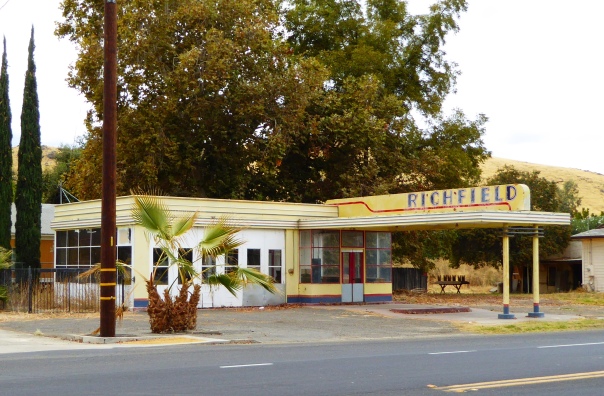
It makes me sad, all this decay of the man-made things, and the lack of prosperity that once was, in former times when people concentrated their energies and money in the local businesses and organizations instead of driving 20 miles to shop and go out to dinner. But I myself wouldn’t dream of investing there, and if I were like my brother and sister who do still live on surrounding farm property, I would be working hard just to keep my own family and property alive. Given the pervasive vandalism and theft, it would take a good deal of optimism to try to renovate anything.
But I do like to visit, and to smell the particular flavor of dusty air that was soft and mild when I was there earlier this week. October is a good month, between the scorching summer and the winter dampness that seeps into your bones, or manifests in tule fog, a driver’s torture to navigate through. But let me try again to stop describing the cons, and get back to all the things I like about my childhood home.
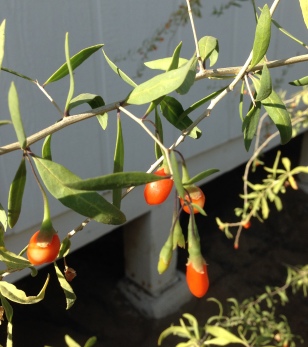
I’m sure I mostly appreciate it because of its nostalgic value, and because of my people living there still. One of them is my friend on the hill, who had gone away for decades and all over the world before he returned and was able to take over the ranch that had belonged to his parents. At least three generations of farmer-gardeners have been farming this particular property, cultivating citrus for commercial markets, and gardens of ornamentals and edibles for home use.
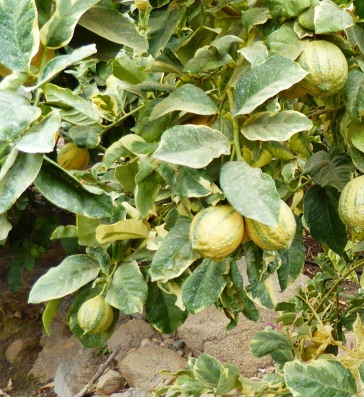
Dick is trying to grow every kind of mandarin orange that exists. These are mostly in the areas close to the house, where he does what he calls the “fun stuff.” Lower down in the flatter areas are the oranges and blood oranges he will send to the packing house. I think he is about ready to plant a section of mandarins for market, too.
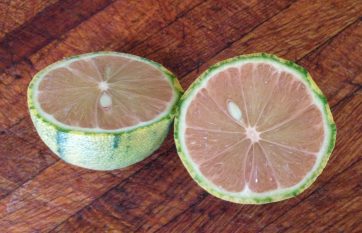
He also grows at least three varieties of lemons, I know, because he sent me home with Eureka, Lisbon, and these striped Pink Lemonade varieties. If you count Meyer lemons, well, he has those, too. I just now cut into a Pink Lemonade to see if it is in fact pink inside, as its name would lead you to believe, and yes, it is:

No one in my family knows what variety of lemon my father raised, but from reading online I had guessed Eureka. Dick says that Lisbon is now the most common lemon grown commercially, but he also said with certainty that my father’s would have been Eureka. Did I tell you that both of our fathers were citrus farmers? Having Dick for a friend is like having another brother. I feel so lucky that both my real brother and my old friend-like-a-brother (not to mention my sister, who is the on-the-ground farmer in her household) are deeply planted in the world of citrus, and that through them I can grow this part of my connection to my father and to those trees that densely enveloped our house and put food on our table.

It was the movie “Ushpizin” that gave me any knowledge or appreciation for citrons. If you haven’t seen this wonderful film please consider my hearty recommendation. Apart from the ritual use of citrons, the interwoven stories of forgiveness, redemption and hospitality make it one of the few movies I wanted to buy for myself, and I did.
It is about Hasidic Jews in Israel preparing for and celebrating the Feast of Booths (in real life Jews are in the middle of this feast right now!), and every household wants to invest in the most beautiful citron they can afford. At the time of Sukkot, a truly perfect specimen – their word for citron is etrog – might cost you hundreds of dollars! This article tells about the history of that tradition, and addresses the question of what is to be done with them after the feast when they are no longer useful ceremonially.
But what is a citron, a fruit that seems to have little to recommend it as a fruit? It is believed to be “one of the four original citrus fruits (the others being pomelo, mandarin and papeda), from which all other citrus types developed through natural hybrid speciation or artificial hybridization.” It does appear to me that it might be an ancestor of the lemon….
Part of the loot that I brought home from the fertile hill in the Valley I arranged on a platter:
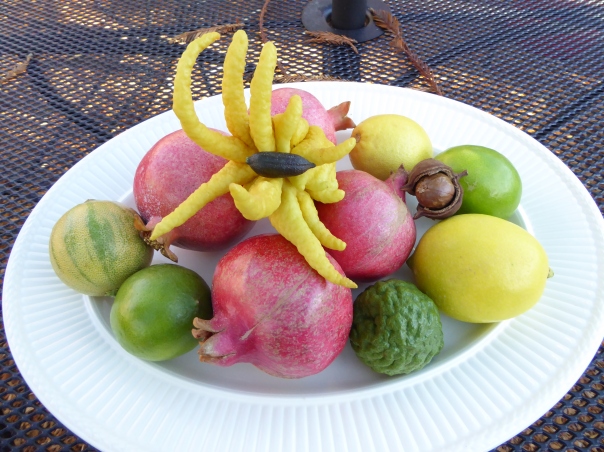
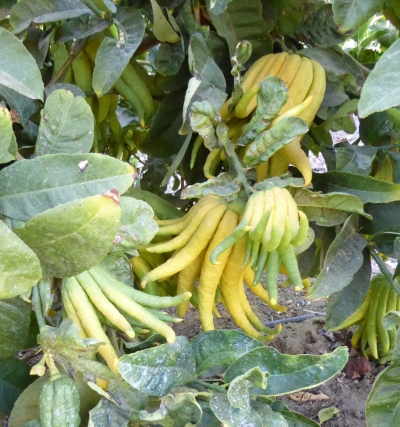
And there in the middle are the two strangest fruits that I was introduced to: A Buddha’s Hand Citron, holding a Finger Lime. The Buddha’s Hand has been around for a long time in the Far East, where it has symbolic value as well; it is valued primarily for its perfume, and typically doesn’t contain any pulp or juice, but can nonetheless be eaten in various ways. I guess I will leave mine out on the kitchen counter so that sometimes when I pass by I can pick it up and inhale its romantic and complicated scent. In that aspect I agree that it is more excellent than the lemon.
That wrinkly green fruit on the platter is a Kaffir Lime. I had been pronouncing it “keefer,” and its etymology is not simple. It came with a separate branch of Kaffir Lime leaves, which it seems are often used whole as a flavoring or aromatic, in a pot of rice or Thai stew, or in a hot bath, one leaf at a time. I’m still reading about them.
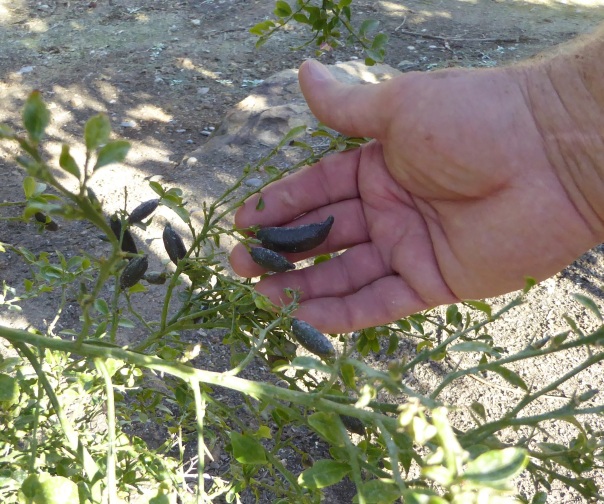
The little thing sitting in the place where the palm of Buddha’s hand would be, and still on the plant in Dick’s hand directly above, is an Australian Finger Lime, Citrus australasica. When we were standing next to the tree Dick picked one and slit it open with his knife — there were the tiny translucent pearls of juice popping out, ready to sp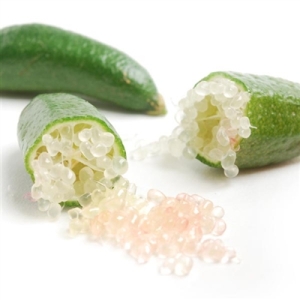 rinkle on one’s tongue or bowl of ice cream — I wished we had brought a scoop at least down from the house. And then I wished that I had put him on Pause so as to snap that photo, with his scuffed leather work gloves as the backdrop. The culinary possibilities of finger limes in a world of Food Art are vast, as one can see with a quick search online, where I found my photo. I’m not ready to slice into my own little lime yet.
Some things I don’t have good pictures of are a 20′ tall wisteria shaped like a Christmas Tree, 40 avocado trees of eight varieties, and Sacred Datura, a plant in the nightshade family that is certainly exotic. Datura wrightii is sometimes used as a hallucinogen, but since it is not edible, and all parts are highly poisonous, I personally do not hold it in very high esteem.
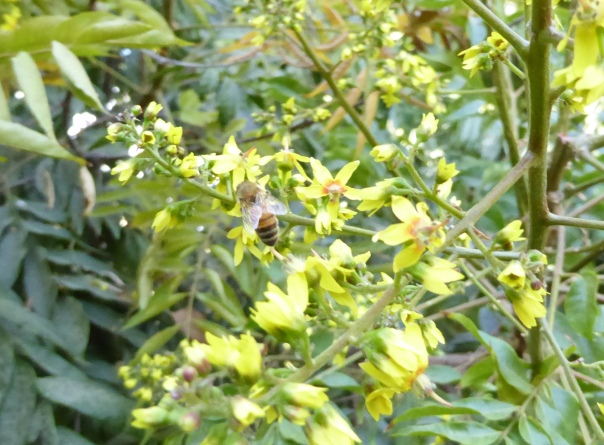
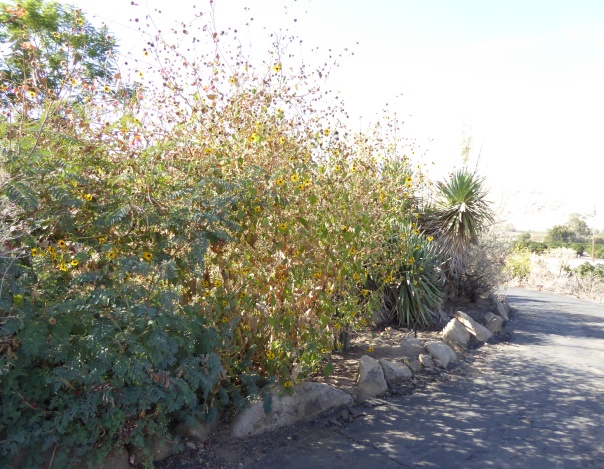
I was amazed at how many shrubs and trees were in bloom in the fall, and at all the bees buzzing on the hill. But then, the nights are still mild in that area, and the daytime high was 80° every day I was there. Delta sunflowers such as I plan to plant in my front yard next spring are blooming enthusiastically – those plants grow without a drop of water all summer long along the highways in the Central Valley, so when they get even a few tablespoons of moisture in the heat they respond beautifully, as can be seen in the second photo above. Dick threw a dead sunflower plant over the wall and next thing you know, he had them growing in the grove below as well. He says that birds planted his original ones.
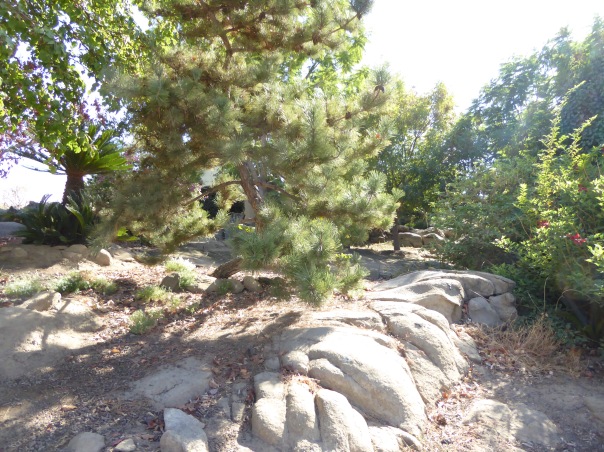
This photo reveals the rock I referred to when I said that the hill is a hunk of granite. The soil around the house is therefore very shallow, but obviously it has been lovingly built up over the last century so that the plants have the benefit of living organic material above and rich minerals below, in which to sink their roots. The kind of dirt found naturally in the area is called San Joaquin Valley Loam, and it is rich in granite but low in organic material.
Soil-building is a project that can never be neglected; even if you have a richer loam naturally, it will in time wear out. Dick raises earthworms whose castings contribute to the health of the system, and he is always adding organic materials of various kinds to his groves and to the gardens. He doesn’t want to be one of the farmers who thinks that “dirt is a place you park your tractor.” I don’t personally know any farmers like that, but he says they are too common.
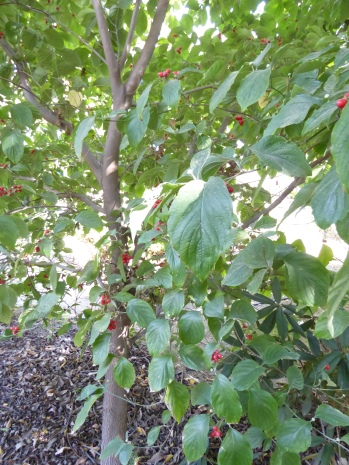
Gardeners like me don’t have to make a living from our land. If we fail at growing something because we were too cheap to amend the soil, or we forgot to irrigate, or were too lazy to dig weeds, it won’t affect our lives much. The farmers who make a living by horticulture and agriculture have to be sure they are giving the plants what they need, and that means caring for the soil and the whole environment, which is not a simple task; but the rewards include a connection to the land and the weather and the changing seasons that so many people never get.
I am inspired by my farming friends and family to be a better gardener, and to pay closer attention to my work and the natural world around me. Then I will be true to the impulses that were bred into me as a child, and my closeness to the earth and also to my fellow farmers will grow.
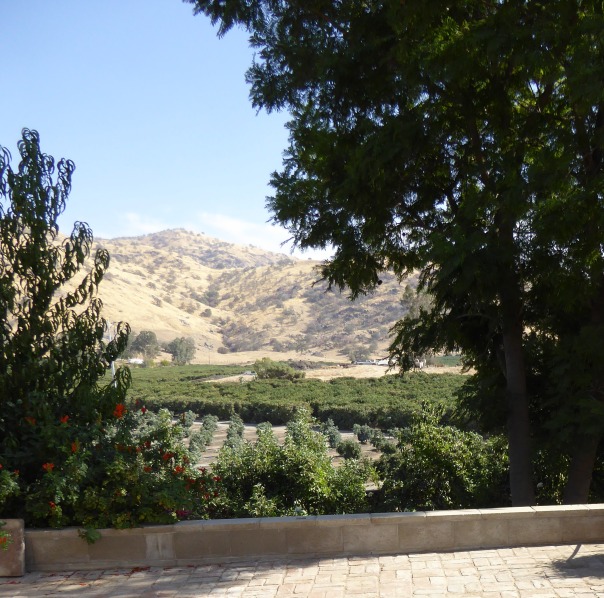
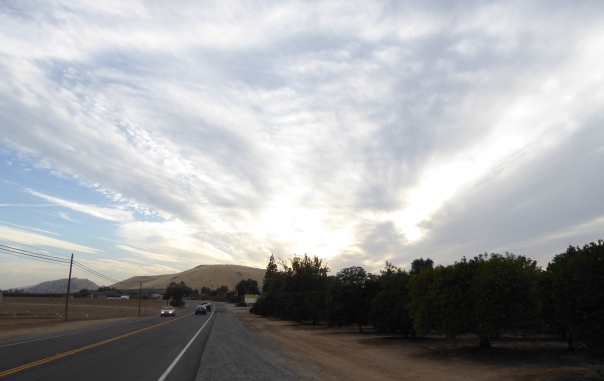
This last picture I took as I was driving back from Dick’s house. I wanted to save the image of that golden hill behind the tiny town, one that we kids used to climb so we could enjoy the view. It doesn’t look very tall, especially from this distance, but it’s to the scale of the orange trees that also aren’t very tall. You can see a lot of sky in this country – Let’s hope and pray that those skies drop some rain on all our fruit trees really soon!


 n the greenhouse!) are very happy with the weather. I’ve been busy battening down the hatches, which includes battling with mice and rats who found my garage a cozy place to set up housekeeping for the winter. I’m thankful for them at this point, because they have forced me to clean the garage from top to bottom. Dear little things – and I’m trying not to be sarcastic – I know they are doing what is normal and right for them.
 At the lower elevations, the northern California forest in September is a dry and dusty place, but it still holds many sights to see and ponder over, if you are lucky enough to be with my daughter Pippin, as I was last week.