Category Archives: nature

Grasshopper Poetry

On the Grasshopper and the Cricket

The poetry of earth is never dead:
When all the birds are faint with the hot sun,
And hide in cooling trees, a voice will run
From hedge to hedge about the new-mown mead;
That is the Grasshopper’s—he takes the lead
In summer luxury,—he has never done
With his delights; for when tired out with fun
He rests at ease beneath some pleasant weed.
The poetry of earth is ceasing never:
On a lone winter evening, when the frost
Has wrought a silence, from the stove there shrills
The Cricket’s song, in warmth increasing ever,
And seems to one in drowsiness half lost,
The Grasshopper’s among some grassy hills.

-John Keats

I am home again from visiting my children. I can relate to the grasshopper a little, as I rest at ease in the pleasant warmth of my town.  Normally I complain about the lack of summery evenings here, but at least most of the days I can bake a little in my garden without wearing a jacket.

At noon today when I crossed the Golden Gate Bridge the water itself was not to be seen below, the fog was so thick on San Francisco Bay. But this evening at Vespers everyone was dressed all summery, and several neighbors have parties in their back yards tonight, and the voices coming over the fences are telling of fun.

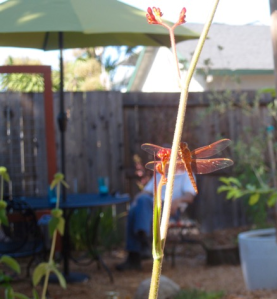
Here is a grasshopper making his sound.

I hope you also are not done with your seasonal delights. Chirp on!

Maps, juice, and puzzles.

  • 2016-07-05 17.30.57I’m improving my mind this week, as I play with the two grandboys whose own minds are soaking up knowledge about their world at a fast rate. I brought their family two large Lauri puzzles that our family of 15 years ago must have acquired too late for them to be of much interest to our own children. In any case, I hadn’t been called upon before to help assemble them, and I was frankly in trepidation about this Fit-a-State puzzle, because I don’t “know my states” very well.

I had forgotten that behind the unmarked pieces is an outline drawing of all the states with their names. Neither of the boys can read those, though, and they were better than I at some important aspects of jigsaw puzzling, such as having a good sense of spatial relationships.

I have always been on the low end of the scale for that kind of perception, and have noticed that many grandchildren are quicker. Laddie who is only two doesn’t even seem to be looking very hard at the spaces to be filled, or at the piece he is holding, but he quickly takes in the view and without hesitating places the piece in the right place.

detail map puzzle

The detail on this map is amazing. Every state is its own piece. Yes, even Rhode Island. You know we haven’t assembled the puzzle many times because neither Connecticut nor Rhode Island has been lost!

I think I’ve probably learned a bit more United States geography through this exercise. I like doing puzzles with the boys because although they are often rambunctious as you would expect healthy boys to be, they both are able to concentrate for long periods on detail work such as coloring and puzzles.

target puzzle

Yesterday I did some grocery shopping for the family and I  brought back something from Target’s $1 aisles for each of the older boys. Liam got a puzzle consisting of sticks to be laid side by side in alphabetical order. I knew it would be easy for him because he knows the A-B-C song perfectly. He soon wanted to make words with the lettered sticks, or to sing the song with the alphabet mixed up but the notes in perfect order. We did that together for a while to gales of laughter. And today we made some of our own “sticks” with extra letters so we can now form words.

ourpuzzle


Yes, we mix up lower case and capitals. Liam prefers the latter. I hadn’t thought of adding pictures to the new strips but he thought that essential. So I took courage and tried to draw a quail and a glue stick, which were the pictures he suggested.

Soldier and Brodie 7-5-16

Little Brodie is here, of course, lending his newborn sweetness to the atmosphere. At four weeks he’s healthy and growing fast, though he hasn’t yet reached his due date. He is a pretty “easy” baby at this point. Does it seem that third-borns are often like this? I think they like having all the noises of the other children in the house.

Perhaps the loudest commotion happens  when a fire truck leaves the station house a block away and turns on its siren. The boys drop whatever they are doing and run to the nearest window screaming like banshees, in hopes of seeing the truck wailing past.

I’m enjoying the neighborhood walks, and I’ve taken the boys up and down different residential streets every day. Every day I see something I don’t know, and/or a plant that I saw years ago when visiting this area. Soldier and Joy and our good friends Mr. and Mrs. Bread lived very close to each other back then.

For example, this plant that I think is an aloe of some kind…? Mrs. Bread probably told me before what it is. Every specimen I have seen is gigantic, and at first I called it the spidery plant, which made Liam laugh, but then I changed it to I’ve taken to the Octopus Plant. It looks to me like a good place for rats and spiders to breed.

2016-07-05 11.55.46Along the sidewalks where I push Laddie in the stroller and Liam walks, if flowers or foliage hang over the sidewalk we will take a sample to sniff. With the help of the Internet I identified a butterfly bush in Soldier apurple flowernd Joy’s back yard. They have a great yard for having a passel of boys — all the ornamentals are of the sort that can’t be destroyed.

A large flock of Canada geese hangs out at one park we have frequented. We have studied their herd movements and don’t understand them at all. Below you can see part of the group nibbling near the swings where Liam is pushing his little brother.

2016-07-05 11.24.21

So much hands-on learning is happening around here all day long. I brought bags of oranges from our family’s groves in the Central Valley, and my juicer, and one of the boys’ favorite things is to make the juicer go, and the juice to flow, by bearing down hard on the cut orange. While they are doing such real and necessary work they behave in a very grown-up manner and don’t squabble at all.

I brought a big basket from home full of some of my favorite children’s books, including Down Down the Mountain and The Maggie B. As I was typing this blog post last night I could hear Soldier in the boys’ bedroom reading The Clock by Esphyr Slobodkina, a book that I read to him in ages past.

Sleepy People by M.B. Goffstein has been loved. It puts even the reader in a somnolent mood with its brief but evocative tale of a family who “are always sleepy.”  Several line drawings depict parents carrying limp children in their arms, and descriptions of people whose eyes are closing as they eat their bedtime milk and cookies.One evening I was asked to read this book as we all clustered around Liam and Laddie’s beds, and we all smiled as our own yawns involuntarily happened, and before long our whole household was on the way to dreamland and restoration and energizing, for the explorations and challenges of another busy day in Monterey.

Summer whites and lesser colors.

gl 6 chamomilegerman.jpg 6-16I got confused about my chamomile. All I could remember was that one is perennial and the other annual. When I noticed that they are both starting to bloom now, I had to try to figure out which was which again. This is what I’ve found.

<< The annual German or Hungarian chamomile is the taller of the two, to 24″. From what I read it often self-sows, and I hope it will do that in my yard.

German: Chamomilla recutita syn Matricaria chamomilla 

gl 6 redpoppies

It’s growing near the red California poppy that I planted from a nursery pot, and whose flowers just opened this week. The white variety of this plant that I put in at the same time bloomed a couple of months ago, much less enthusiastically.

That makes me think about something I read in the Summer book I mentioned last week, a quote from Chesterton, from “A Piece of Chalk,” in which he gives an account of how he reluctantly tore himself away “from the task of doing nothing in particular,” and set off into “the great downs” of England with his brown paper and his brightly colored chalks, all on a summer’s day.

To his dismay he had neglected to bring any white chalk — and he begins to hold forth on how the color white, in art and in morals, is essential:

One of the wise and awful truths which this brown-paper art reveals is this, that white is a colour….a shining and affirmative thing, as fierce as red, as definite as black. When, so to speak, your pencil grows red-hot, it draws roses; when it grows white-hot, it draws stars….Virtue is not the absence of vices or the avoidance of moral dangers; virtue is a vivid and separate thing, like pain or a particular smell. Mercy does not mean not being cruel or sparing people revenge or punishment; it means a plain and positive thing like the sun, which one has either seen or not seen.

Perhaps my spindly white wildflowers, just starting out and blooming faintly without any other color around them to contrast with (even their foliage was already faded when the buds opened), do not provide a fitting metaphor to match this principle, but it did seem like a good place to tuck in that quote about something I do believe in.

93e53-yellowcapoppy4-11So far I haven’t sown any seed for the standard orange color of our state flower because I am a little afraid of them taking over. The other colors are not as vigorous, but some of them are really special in their rarity and subtlety, and when I have had one re-seed itself or, more often, go dormant and hidden for the winter only to surprise me the next spring, I am thrilled. This pale yellow one did just that for several years in my old garden, but could not be saved.                                                                                                           >>

The red ones are my first variety that are both rare and bright. I hope they self-sow — but much of the garden is experimental. I’ll see over the next months what likes growing in this environment, and not fuss over the things that aren’t thriving.

Back to the chamomile… Just in case the Germans don’t bear children next year, I planted a perennial type, the Roman or Nobile. It grows half as tall and is sometimes used as a walkable ground cover, or part of an herbal lawn mix.

gl 6 Roman 1

<< Roman: Chamaemelum nobile syn Anthemis nobilis

An hour after I took this picture, I strolled past again and noticed that ten more buds had swelled enough to be noticeable. History in the making!

I had a house guest for two nights and a day – we spent a nourishing and relaxing time, even though we did no artwork or gardening or poetry-reading. We did eat and shop and update our family birthday lists. But now I have lots of garden work that needs to be done, before I go to see brand-new Baby Brodie next week. Here’s a yarrow bloom for you to look at while I am out tending to my beds.

gl 6 yarrow 6-16

Looking at snakes.

Having two boys of my own, and eleven grandsons, I have done my share of reading to them books about snakes, a topic on which I probably would never have read one word if left to myself. I’m so accommodating. Last week I even read many pages of a giant book about dinosaurs.

That book mysteriously appeared in my house a year or more ago and I didn’t pay much attention to it until Scout asked me to read it last week. It may have been the most boring read-aloud I have ever agreed to, and finally I said I’d had enough. After he went to bed I threw it in the trash.

Snakes are more interesting, I admitfree-green-snake-wallpaper-hd-wallpaper, because they live on the earth with us and can be observed as they really are. But still….

I sat with the grandchildren twice last week to read the snake book that is in our home library, and I re-learned several things about the reptiles. Doubtless I will re-forget most of the facts we read, too, as I always have done, even when my brain was younger and more flexible. I have read stuff like this for so many years: “Would you believe that a python can swallow a whole goat?…The snake doesn’t chew or swallow the way we do. It simply moves its body forward with its jaws wide open and ‘walks’ the animal down its throat.”

When I imagine this scene, or look at pictures of it, I think about how the snake itself is consumed by the task of consuming. Even the egg-eater, who takes only 15 minutes to finish the job and spit out the shell, can’t go anywhere or sleep or drink water, for the duration. The beautiful green flying snake can’t sense a hawk threat and take off like a spring to escape.

After Scout had gone home I came across a poem about the way a snake eats, and I started reading it with the idea of someday sharing it with him. But when I got to the last stanzas I realized that it was for me, much more than for a snake-fascinated boy. Through this poem’s impact, what I learned of snakes I won’t be forgetting. It might take a python a few hours to eat a goat. My portion is of a different calibration and I only know that I’ll be at it a while.

SLOWLY

I watched a snake once, swallow a rabbit.
Fourth grade, the reptile zoo
the rabbit stiff, nose in, bits of litter stuck to its fur,

its head clenched in the wide
jaws of the snake, the snake
sucking it down its long throat.

All throat that snake—I couldn’t tell
where the throat ended, the body
began. I remember the glass

case, the way that snake
took its time (all the girls, groaning, shrieking
but weren’t we amazed, fascinated,

saying we couldn’t look, but looking, weren’t we
held there, weren’t we
imagining—what were we imagining?)

Mrs. Peterson urged us to move on girls,
but we couldn’t move. It was like
watching a fern unfurl, a minute

hand move across a clock. I didn’t know why
the snake didn’t choke, the rabbit never
moved, how the jaws kept opening

wider, sucking it down, just so
I am taking this in, slowly,
taking it into my body:

this grief. How slow
the body is to realize.
You are never coming back.

–Donna Masini, from Turning to Fiction