
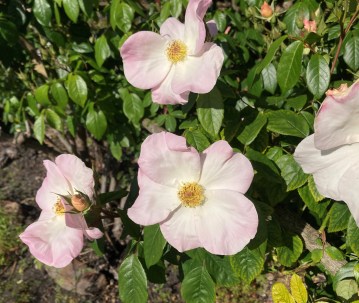
It has been years since I visited what I call The Rose House, though it probably takes less than fifteen minutes for me to walk there. What I found when I saw it last week was that the whole rose garden in front has been cleaned up, and all the bushes pruned. On the corner opposite, a man was standing in his vast flower garden; I didn’t see him at first, as I paused to admire a giant cistus in bloom, until he said, “It’s a beauty, isn’t it?” After a brief chat I said I had come that way to check out the roses across the street; he told me that the owner lives there himself, and has for a long time. So the reason for the previous unkemptness remains a mystery.

When I set out on my walk I debated taking my phone with me, because I have joined a Digital Detox group for the month of May; those in the group are taking up the challenge to detach as much as possible from our devices, according to the needs of our unique circumstances. Because my phone is my only camera at the ready, I decided to take it with me, though I have been trying to take fewer pictures as well. Since my destination was a particular beauty-soaked spot, I wanted to be equipped.
On this walk I was restrained with my camera. It seems that after having accumulated six or seven years’ worth of photos by means of my phone, the thrill of accumulating them is wearing off. Since 2020, when various forces began trying to separate me from other embodied humans, I’ve been extra aware of how easy it is to substitute indirect for direct experiences; for example, looking at pictures of roses instead of walking down the street to smell a real rose.
Our women’s book group is reading Heidi currently, and I’ve been reveling in the images of the child running all over the mountain and hugging the goats. It’s easy for me to have comparable experiences, now that spring is here and I can feel myself melting into the landscape under the sun’s rays. It is a holistic experience of beauty, in which all of my senses relay to me the many impressions that add up to a Beauty that is greater than all the parts of the moment; and I am certainly in a heavenly realm, compared to what you would see if I sent you a two-dimensional photo of me bending over the flower beds.
In The Master and His Emissary, another book I am dipping into, Iain McGilchrist discusses the different modes of being in the world that the right and left hemispheres of the brain offer. As it relates to beauty, this basic aspect of the left hemisphere is critical:
 “The left-hemisphere view is designed to aid you in grabbing stuff. Its purpose is utility and its evolutionary adaptation lies in the service of grasping and amassing ‘things.’”
McGilchrist says that on the other hand, our relationship with the beautiful “is more like longing, or love, a betweenness, a reverberative process between the beautiful and our selves, which has no ulterior purpose, no aim in view, and is non-acquisitive.” This is something the right brain intuitively and holistically understands.
We don’t go through our days aware of the interactions between the hemispheres of our brain, but a big point of the author’s thesis is that “as a society, we are becoming more like individuals with right hemisphere deficits.”
Just a few hours before I took my Rose Walk, I had been reading the book, and this passage jumped out at me:
“As Alain Corbin has argued, we have become more cerebral, and retreated more and more from the senses – especially from smell, touch and taste – as if repelled by the body; and sight, the coolest of the senses, and the one most capable of detachment, has come to dominate all.”
Because it is so easy for us to capture and share visual images by means of our digital technologies, we are flooded with them. As I made my way over to the Rose House I kept thinking about how rich was my experience outdoors, full of bird song, the sound of children’s voices at the creek, the particular feel of the early evening air in May, and the scents — the rose scents most of all. And in my pictures, the only thing I would be able to pass on to you would be a record of what my relatively “detached” sense conveyed to me.
“The coolest of the senses.” That statement about our visual sense startled me, and made me want to push back against the image-focused culture that I have embraced, and against my habit of orienting my explorations toward what my camera can do something with. Since the roses themselves are often so heavy with scent, it was not hard to appreciate them in a multi-sensory way.
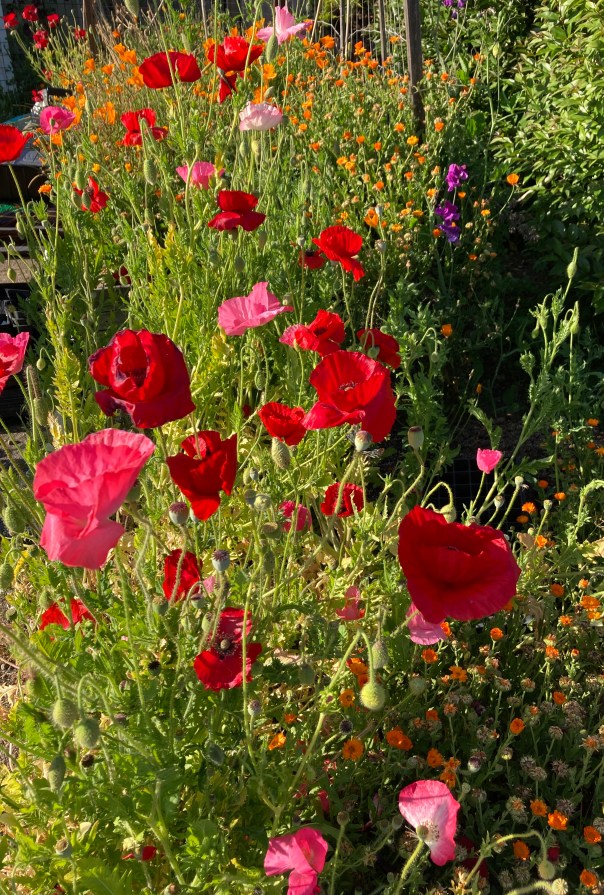
But then — on my way back home I passed by a house with an extravagant poppy display. Oh my, but it was hard to think that my sensing of them was cool. They were swaying in the breeze, and laying themselves down as an offering on the sidewalk. Their colors were warm…. no, hot!
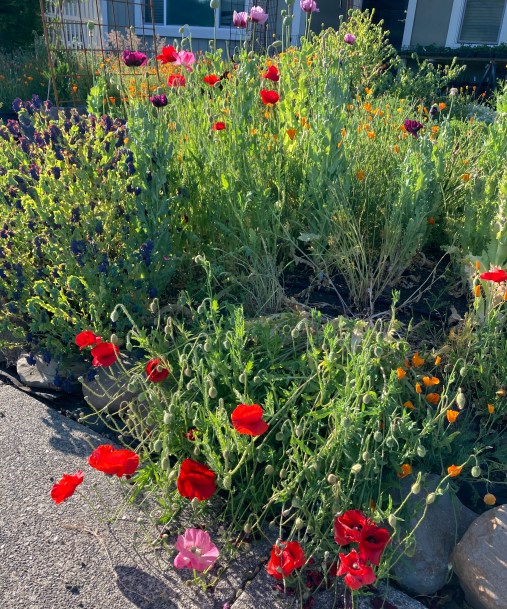
Nearby, dozens of carpenter bees were making a racket in their wild excitement over the largest patch of cerinthe I’ve ever seen, and bright orange California poppies mixed in with the giant red and pink and purple ones. Truly, I experienced the longing that C.S. Lewis describes:
“We do not want merely to see beauty… We want something else which can hardly be put into words – to be united with the beauty we see, to pass into it, to receive it into ourselves, to bathe in it, to become part of it.”
After living in this neighborhood for more than 30 years, and responding to an incredible amount of beauty that presents itself to me day after day, season by season, concentrated in this tiny part of the world, I think by now I must have received at least a smidgen of it into myself.
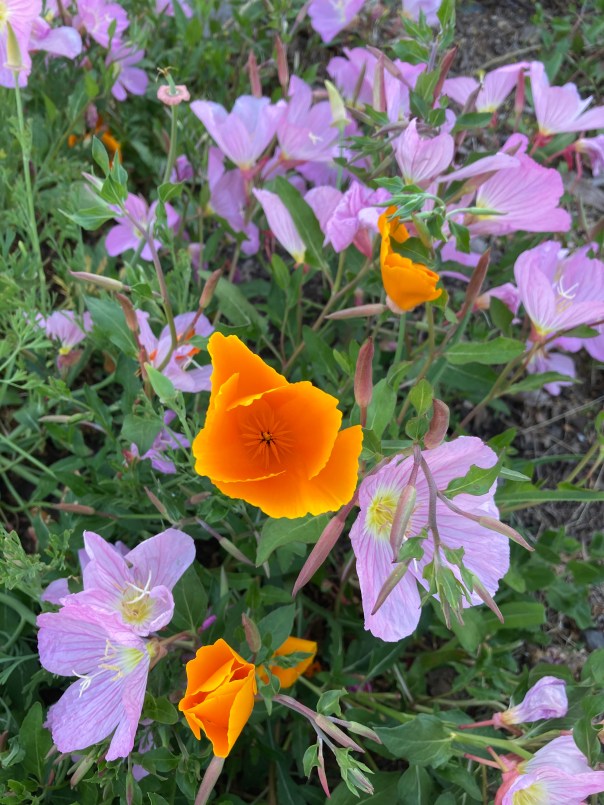
At the corner of my cracked driveway, there my own dear flowers greeted me: the Mexican Evening Primroses, and the California poppies that have only recently added themselves to that display. So I snapped one more picture to detach from the whole landscape and atmosphere to put here flat on the screen. I’m glad you all have enough right brain function to appreciate them such as they are; along with them, I send you my love.

 together a puzzle of the world, played with trains, and made some progress on a large Lego project that is a bit too hard for their ages. Two Lego workers had only one tiny walkie-talkie between them, which didn’t bother the toys, but caused the boys to fight over it. I slipped it into my pocket to make peace.





 Gladsome Lights