Category Archives: quotes

What the women forgot.

The second Sunday after Pascha we remember the Myrrhbearers who came to the tomb to anoint the body of Christ. And my saint, Joanna, was among them. 🙂

And they said among themselves: “Who shall roll away the stone from the door of the sepulchre?” This was the subject of the Myrrh-bearing Women’s conversation as they climbed up to Golgotha, looking for nothing unexpected. The women’s weak hands were not strong enough to roll the stone away from the tomb’s entrance, for it was very great.

Those poor women! They did not remember that the labour to perform which they were hastening so zealously to the tomb had already been performed during the Lord’s earthly life. At Bethany, at supper in the house of Simon the Leper, a woman had poured precious spikenard over Christ’s head. The omniscient Lord said at the time about this woman: “In that she hath poured this ointment on My body, she did it for My burial” (Matthew 26:12). He had a clear foreknowledge that His body would, in death, receive no other anointing.

You may ask: then why did Providence allow these devout women to be so bitterly disappointed? To buy precious myrrh, to come fearfully through the dark and sleepless night to the tomb and not to perform that loving act for which they had sacrificed so much? But did Providence not reward their efforts in an incomparably richer way, in giving – in place of the dead body – the living Lord?

–St. Nikolai Velimirovich , Homilies

Myrrhbearing women at the tomb

Dirt, milk, communion.

“The Armenian writer Teotig tells a story about the genocide of the Armenians during World War I. Father Ashod Avedian was a priest of a village near the city of Ezeroum in eastern Turkey. During the deportations, 4,000 Armenian men of that village were separated from their families and driven on a forced march into desolate regions. On their march to death, when food supplies had given out, Father Ashod instructed the men to pray in unison, ‘Lord have mercy,’ then led them in taking the ‘cursed’ soil and swallowing it as communion. The ancient Armenian catechism called the Teaching of St. Gregory says that ‘this dry earth is our habitation, and all assistance and nourishment for our lives [comes] from it and grows on it, and food for our growth, like milk from a mother, comes to us from it.’

“Teotig’s story is a reminder that we belong to the earth and that our redemption includes the earth from which we and all the creatures have come, by which we are sustained, and through which God continues to act for our salvation. If water is the blood of creation, then earth is its flesh and air is its breath, and all things are purified by the fiery love of God.

“For the earth to bring forth fruit there must be water and air and light and heat of the sun. Every gardener knows this, and so recognizes that the right combination of these elements lies beyond the control of science or contrivance. That is the wisdom and agony of gardening.”

–Vigen Guroian, in Inheriting Paradise: Meditations on Gardening

Books that keep me happily reading.

My project of reading “easy” books continues, as I find a certain satisfaction that comes from the process of reading itself, and not from digesting new (or even old) and difficult ideas. Trashy books, however you interpret that term, will not do. They have to have content I can grasp, and/or be reasonably well-written, if they are to keep me going past the first few pages, and to satisfy me.

I stopped listing “Books I Am Currently Reading” on my blog sidebar when I gave myself permission to pick up and put down titles in quick succession if necessary. At my stage in life I don’t want to bother with an annoying writer or boring content.

I have re-read some from years ago, and that is a happy activity; I’m often surprised at how much of the content seems completely new. I am not the same person who read the book back then, so my relationship with the author and the work is bound to be different.

I feel a review of one such recent engagement shaping up in my mind, but while it’s slowly forming, I thought I’d share this funny list, taken from a book I haven’t read, and don’t think it likely I will ever read. Have any of you read it? Unfortunately, for me most books in the world, including Calvino’s, must fall into his fifth category below.

To be honest, I rarely shop in brick-and-mortar bookstores. I feel guilty about this. But the last few times I did shop in the old-fashioned way, I brought home books I didn’t ever crack open once I got them home. What was that about? And I had spent hours wandering, wasting time I might actually have been reading one of the venerable favorites at home on my shelves. Calvino’s categories apply nonetheless.

SECTIONS in the BOOKSTORE

– Books You Haven’t Read
– Books You Needn’t Read
– Books Made for Purposes Other Than Reading
– Books Read Even Before You Open Them Since They Belong to the Category of Books Read Before Being Written
– Books That If You Had More Than One Life You Would Certainly Also Read But Unfortunately Your Days Are Numbered
– Books You Mean to Read But There Are Others You Must Read First
– Books Too Expensive Now and You’ll Wait ‘Til They’re Remaindered
– Books ditto When They Come Out in Paperback
– Books You Can Borrow from Somebody
– Books That Everybody’s Read So It’s As If You Had Read Them, Too
– Books You’ve Been Planning to Read for Ages
– Books You’ve Been Hunting for Years Without Success
– Books Dealing with Something You’re Working on at the Moment
– Books You Want to Own So They’ll Be Handy Just in Case
– Books You Could Put Aside Maybe to Read This Summer
– Books You Need to Go with Other Books on Your Shelves
– Books That Fill You with Sudden, Inexplicable Curiosity, Not Easily Justified
– Books Read Long Ago Which It’s Now Time to Re-read
– Books You’ve Always Pretended to Have Read and Now It’s Time to Sit Down and Really Read Them

― Italo Calvino, If on a Winter’s Night a Traveler

Painting above by Tavik Simon – “Vilma reading on a Sofa”

Holy Friday and our own holy bodies.

On Holy (“Good”) Friday we Orthodox keep vigil next to the “shroud” icon of Christ all night through, until noon on Saturday, remembering our Lord in the tomb.  From the time of His death until His Resurrection on Sunday, we don’t go about our “usual business.” In my parish, parishioners take turns reading or chanting Psalms at a small lectern, with the aid of a candle during the hours of darkness.
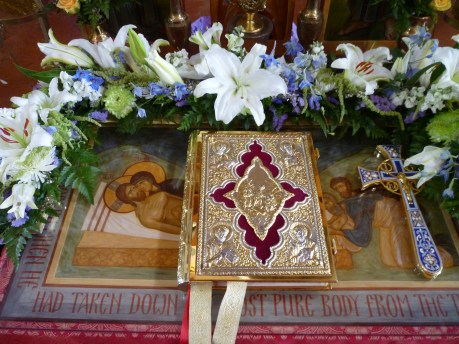
This vigil is something we also try to do, if at all possible, for any mere human from whom the spirit has departed, as each one bears the image of Christ. And as He blessed Creation and the material world by becoming part of it in His Incarnation, so each body of flesh is holy and precious.

(I don’t know if I wrote here previously about how we were able to honor my husband this way two years ago, between the time of his death and his burial, as his coffin remained in our house until the day of his funeral, and many people came to pray the Psalms nearby over the course of three days.)
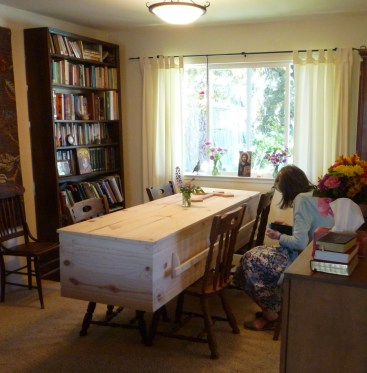
Even if you are not a Christian, or a worshiper of any kind, the body is that aspect of your person with which you have exerted your will to live and love — to stand up, to feed yourself, and even better, to embrace those you love and to express thanks and kindness. All these actions and behaviors build a heritage and a history attached to your physical self, a unique life given by God. It’s not a “shell” or a thing to be discarded as unimportant. You are honorable, every part of you, because of Who made you, and because of His love.

Christians have the added motive to honor the body, that we want to follow the example of our Savior in every way that we can. As His body was lovingly prepared for burial, so we want to do when it is in our power.

I was gratified to read the following explanation of some of these things that was included in a funeral program last summer, when we were saying goodbye to one of our parishioners and laying his body to rest:

“…we believe the body to be an honorable and even a holy thing. For us the body is not something which is dishonorable or defiled, or to be hidden away or hurriedly disposed of. It is less than the soul, and we know that, deprived of the soul, it will dissolve into its elements, but we believe also that on the last day, whether the deceased were a Christian or not, it will be raised up again. We believe that it was part of that person who has died and is therefore to be treated with reverence….

“The body of an Orthodox Christian is a holy thing. It is that body which was washed in Holy Baptism, anointed with holy Chrism, which partook of the Body and Blood of Christ in the Eucharist, which was anointed with holy oil, which received the tonsure at Baptism, at Ordination or at monastic profession, which was crowned in marriage, which made the sign of the Cross, which looked at and kissed the holy icons, which reverenced and touched the sacred relics, which stood in prayer, which made prostrations, which listened to the chants and readings, which read the Scriptures and prayers, which smelled the incense and fragrances, which went on pilgrimage, wept, suffered illnesses and pains, suffered in child-birth, which struggled against the passions, which gave alms, which fasted, restrained itself, tried to keep itself pure, indeed which participated in the true worship of the True God.”

Know ye not that your body is the temple of the Holy Spirit? (I Cor: 6:19)

More on this subject is in the article online from which these paragraphs were taken.