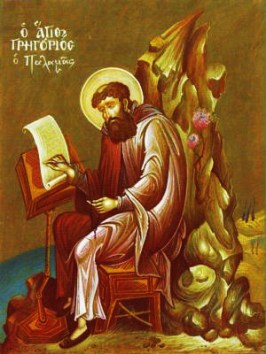
To the brief passage below, taken from The Theology of Illness by Jean-Claude Larchet, the author attaches four footnotes, in which he references St. John Chrysostom, St. Maximus the Confessor, St. Gregory Palamas, Vladimir Lossky and the Book of Job. He is a patristics scholar for sure! And he manages to incorporate many quotes from church fathers and Scripture in the main text as well, without making it hard to read. In fact, it is pure pleasure to follow Larchet’s explanations as he gathers from great minds of the church and reveals the unity of their thought and faith.
“God, who envisions the salvation of man and through man of the entire universe, does not allow the forces of evil to submerge and destroy His creation. Man and nature remain partially protected by His Providence, which imposes certain limits on the negative activity of the Devil and his demons. Thereby God stabilizes the cosmos in its slide toward nothingness, establishing a certain order in the very heart of disorder. Even if man has lost the ‘likeness’ of God which he began to acquire, he 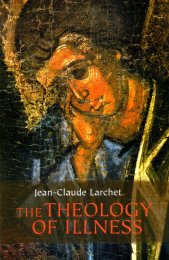 nevertheless remains bearer of the divine ‘image,’ even if that image is veiled, obscured, and deformed.
“Thus man is not totally deprived of grace. Even in his weakness he retains sufficient spiritual power to be able, if he wishes, to turn again toward God and to obey the commandments which he continues to receive from Him (Dt 30:11-19). And thereby he is able to maintain, according to God’s own promise, a certain mastery over nature (cf. Gen 9:1-2).
“Nonetheless, this new balance remains fragile. Man and nature have become a battleground where evil and good, death and life, wage a permanent, merciless combat against each other. This combat is made evident by sickness, infirmity and suffering; and until the Incarnation of Christ, its outcome was uncertain.”
-Jean-Claude Larchet, The Theology of Illness
 Jean-Claude Larchet is a contemporary French patristics scholar and theologian who has written on diverse subjects such as the Theology of Illness, life after death, and mental disorders. (I’m currently reading his The New Media Epidemic.) Several years ago our parish did a study of his book, Theology of the Body, and last week when I was thinking on that topic I was glad to find it still on my shelf.
 Two of those “folds” are 1)
 Gladsome Lights