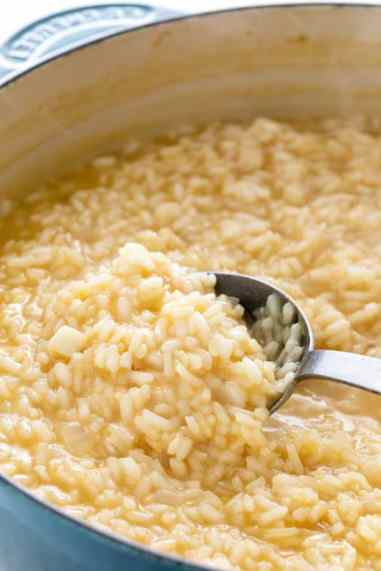
Because the most difficult part about making something, also the best, Is existing in the middle, Sustaining an act of radical imagination, I simmered a broth: onion, lemon, a big handful of mint.
The phone rang. So with my left Hand I answered it, Sautéing the rice, then adding the broth Slowly, one ladle at a time, with my right. What’s up?
The miracle of risotto, it’s easy to miss, is the moment when the husks dissolve, Each grain of rice releasing its tiny explosion of starch.
If you take it off the heat just then, let it sit While you shave the parmesan into paper-thin curls, It will be perfectly creamy, But will still have a bite.
There will be dishes to do, The moon will rise, And everyone you love will be safe.
“Then do not grasp at the stars, but do life’s plain, common work as it comes, certain that daily duties and daily bread are the sweetest things in life.”
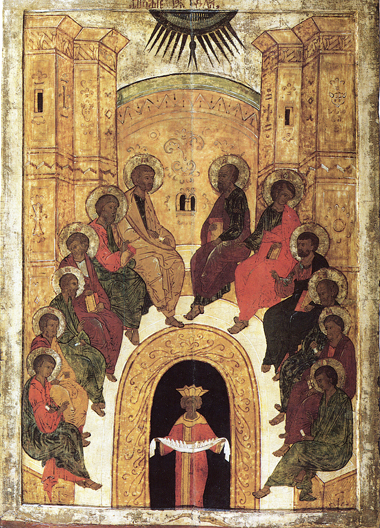
When the most High came down and confused the tongues, He divided the nations; but when he distributed the tongues of fire He called all to unity. Therefore, with one voice, we glorify the All-holy Spirit!
“When the day of Pentecost came, they were all together in one place.Suddenly a sound like the blowing of a violent wind came from heaven and filled the whole house where they were sitting.They saw what seemed to be tongues of fire that separated and came to rest on each of them.All of them were filled with the Holy Spirit and began to speak in other tongues as the Spirit enabled them.”
It seemed like most of May was overcast and cold… Oh, I know there were a few sunny hours in there, but I had to turn on the furnace again, and I felt my mood sink. Many days, in the evening just before dusk the clouds would open up and let a few rays through, as the damp marine breeze was blowing in. But at the very end of the month: the sun! the sun! I guess I am a central California girl in my bones.
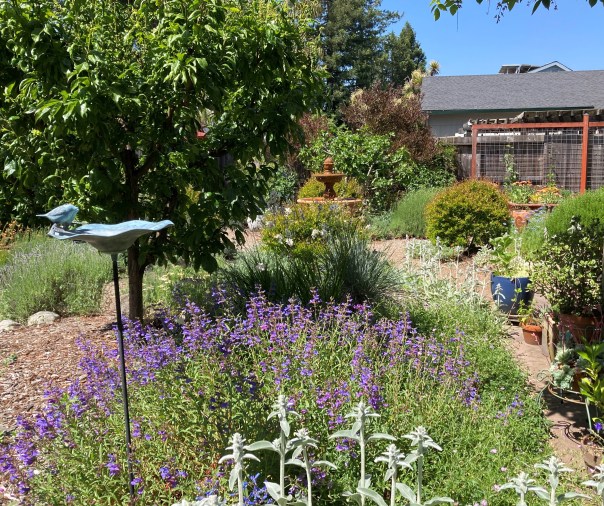
The penstemon bloomed while the weather was still gray; as soon as there was enough sunlight, I took its picture, from north, south, east and west. Things are really crowded right now by the patio, and the blue-eyed grass is barely peeking out from under that penstemon. I guess the Santa Barbara daisies (erigeron) are not exactly blue, but their lavender tone made me think of this group as layers of blue blossoms:
On the other side of the garden, nigella, salvia and borage definitely make a blue bouquet:
The plum trees got some kind of icky leaf curl on their new growth, from the wet spring I guess. Also, because of the constant rain, we were able to apply a dormant spray only once during the winter. Alejandro came today and cut off all those branches, which were going to get lopped anyway in a couple of weeks, at the solstice.
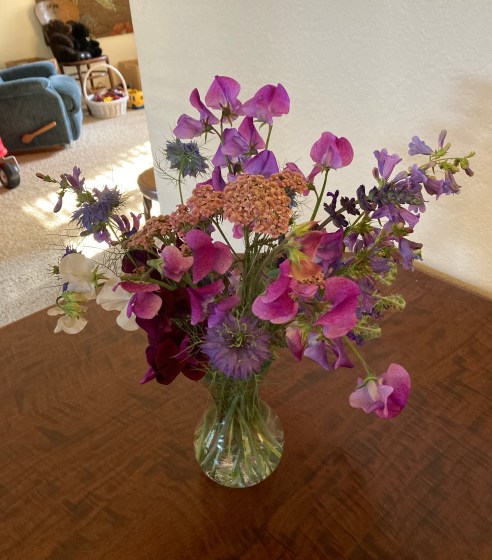
While he was working, I wandered about like an enchanted queen considering her domain, picking flowers here and there. Though the blues definitely make a splash in the garden right now, they didn’t steal the show from the sweet peas and yarrow in my bouquet. Any day that ends with fresh flowers in the house I count as a success. Garden happiness!