
“Christmas is built upon a beautiful and intentional paradox;
that the birth of the homeless should be celebrated in every home.”
-G.K. Chesterton
“Christmas is built upon a beautiful and intentional paradox;
that the birth of the homeless should be celebrated in every home.”
-G.K. Chesterton

This year is extra full for me, during the festal season, because a LOT of family are coming to my house, a bunch of them for nine blessed nights, from all over the country and from outside the country. They are expected to arrive a few days before Christmas, which is very soon, and I still have much preparation to do. Twelve or fifteen extra people will sleep under my roof; it will be a Christmas slumber party! And a few more will be with us for celebratory cooking and eating.
I’ve been grocery shopping (repeatedly) in six different stores, and clearing out “work” rooms for sleeping, and wrapping presents and …. well, you know. But I haven’t baked one cookie, in spite of looking daily at the soft butter sitting on the counter, waiting. If I hadn’t finally dusted the living room blinds this morning I wouldn’t be calm enough to sit down here for a few minutes.
But — I’m so grateful that there is a Prefeast Vespers service this evening for me to attend, to help me focus, and where I can pray with verses such as these:
O ye people, let us celebrate the forefeast of the nativity of Christ, and elevating our mind to Bethlehem, let us soar aloft in thought and behold the great mystery in the cave; for Eden was opened when God issued forth from the pure Virgin, being perfect in both divinity and manhood. Wherefore, let us cry aloud: O holy God, Thou unoriginate Father! O Holy and Mighty One, Thou Son Who becamest incarnate! O holy Immortal One, Thou comforting Spirit! O Holy Trinity, glory be to Thee!
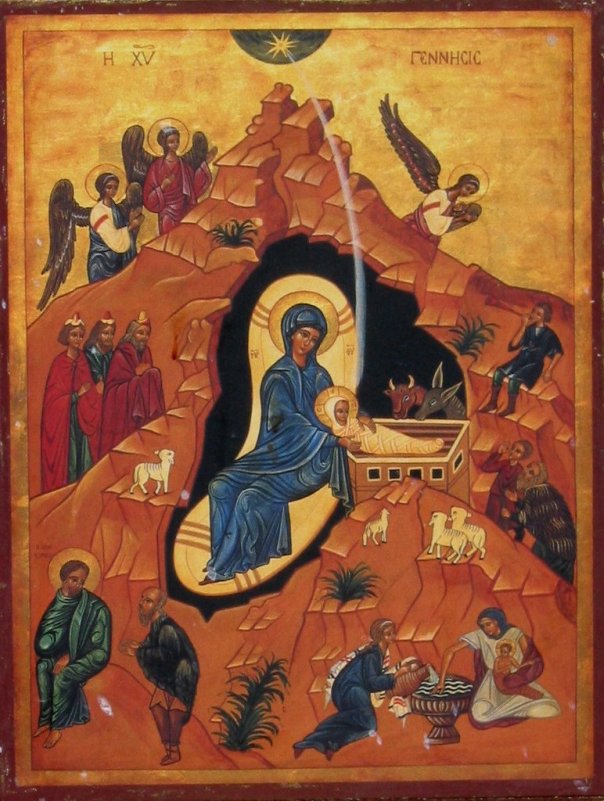
Prepare thyself, O Bethlehem!
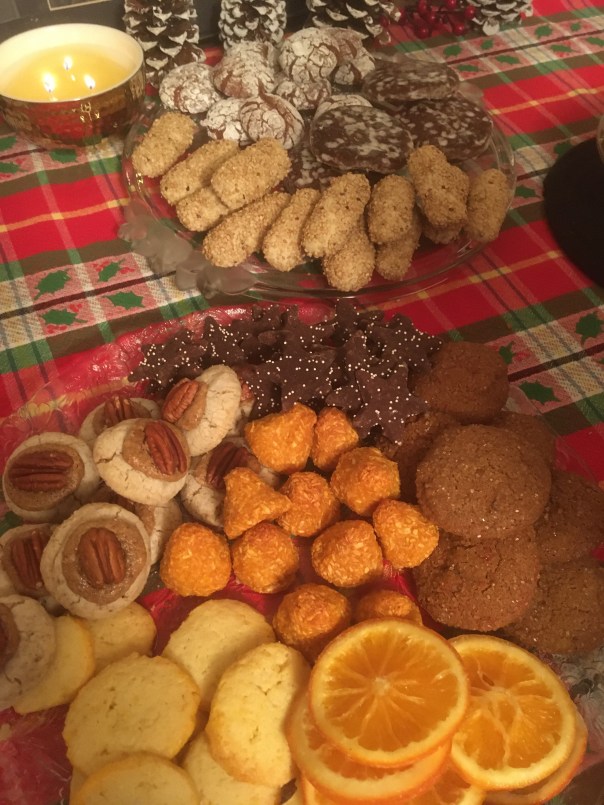
I’ve been sharing pictures and mentions of this cookie for several years now, and last year I promised to post the recipe after Christmas. I see that I failed in that. They are the cone-shaped cookies in the middle of the closer platter above. It’s nice to have a cookie that is fruity and flourless to complement the richer offerings in such abundance, so here is the recipe as I received it, with my notes added in italics:
APRICOT MACAROONS
From Master Chefs Cook Kosher by Judy Zeidler
1/2 cup tightly packed dried apricots, quartered (I use ¾ – 1 cup for more apricot flavor, and decrease coconut slightly; also, I always use Blenheim apricots for their rich flavor- GJ)
1/2 cup water
3/4 cup plus 1 tablespoon sugar
4 egg whites (or 1/2 cup)
4 1/2 cups unsweetened coconut (see note)
Preheat oven to 350 degrees. Line baking sheets with parchment paper.
Combine apricots, 1/2 cup water and 1 tablespoon of sugar in a saucepan over
medium heat. Poach until tender and only about 1 tablespoon of water
remains, about 10 minutes. Cool.
Transfer to a food processor and add remaining 3/4 cup sugar, egg whites and
1/2 cup coconut. Begin with pulsing, then process until apricots are pureed.
Transfer to a mixer fitted with the paddle or beaters and add remaining
coconut. On medium speed, beat until coconut is well blended. When ready,
mixture should hold together when pinched.
Divide dough into 24 equal portions. With moistened fingers, shape each
first into a round and then into a cone. Arrange on baking sheets, 1 inch
apart. Bake 15 to 20 minutes, or until tops are well browned. Cool on a rack
and store in an airtight container. Makes two dozen.
Note: Sweetened coconut may be substituted; reduce sugar by 1/4 cup.

 Most people, even Christians, don’t care whether the date of December 25th derives from a pagan solstice festival, but historians are interested in many aspects of this story; one of these aspects is the way in which earthly powers try to control or use popular religion to further their aims. Williaim J. Tighe is a historian and a Christian whose article “Calculating Christmas” explains how this impulse led one emperor to establish a completely new pagan festival. The last time I posted this “public service announcement” concerning the date of Christmas, I highlighted the historical evidence that Tighe cites for the early church having chosen their date before that pagan festival was ever established.
But there is the other question we might have: How did the Christians choose their date? It seems that Christ’s mother was not of a mind to be keeping a journal, but rather, Luke tells us, “Mary kept all these things and pondered them in her heart.” The author tells us in detail how the dating of Christmas is tied to the effort to figure out when it was that Christ died. It’s not easy to calculate that, either, it turns out:
“There is a seeming contradiction between the date of the Lord’s death as given in the synoptic Gospels and in John’s Gospel. The synoptics would appear to place it on Passover Day (after the Lord had celebrated the Passover Meal on the preceding evening), and John on the Eve of Passover, just when the Passover lambs were being slaughtered in the Jerusalem Temple for the feast that was to ensue after sunset on 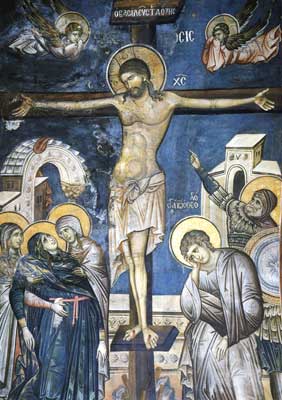 that day.
“Solving this problem involves answering the question of whether the Lord’s Last Supper was a Passover Meal, or a meal celebrated a day earlier, which we cannot enter into here. Suffice it to say that the early Church followed John rather than the synoptics, and thus believed that Christ’s death would have taken place on 14 Nisan, according to the Jewish lunar calendar. (Modern scholars agree, by the way, that the death of Christ could have taken place only in A.D. 30 or 33, as those two are the only years of that time when the eve of Passover could have fallen on a Friday, the possibilities being either 7 April 30 or 3 April 33.)
“However, as the early Church was forcibly separated from Judaism, it entered into a world with different calendars, and had to devise its own time to celebrate the Lord’s Passion, not least so as to be independent of the rabbinic calculations of the date of Passover.”
“…there is evidence from both the Greek East and the Latin West that Christians attempted to figure out the date of Christ’s birth long before they began to celebrate it liturgically, even in the second and third centuries. The evidence indicates, in fact, that the attribution of the date of December 25th was a by-product of attempts to determine when to celebrate his death and resurrection.”
I’ll leave you to decide if you want to get the rest of the story by reading the article itself. Last time I shared it, more than one of my readers said the date was not important to them, and one said this information was important. Many years ago I was briefly influenced against enjoying certain Christian festivals because of things written against them by the uninformed, so I very much appreciate those true historians who love to dig deep. Tighe points us to a longer work on the subject for those who want more details (I haven’t gone further myself). Here’s his own fairly brief summary: “Calculating Christmas.”

 Gladsome Lights