A mind like snow.

This lighthearted (or sardonic – see the comments below) poem by Philip Larkin reminds me of a short conversation I had with a Christian friend about the possibility of my developing dementia in my old age, to the point where I would forget God. She gently rebuked me for not remembering that it is in my spirit, my nous, that I know God most truly, and I would never forget him, no matter what happened to my fragile intellect.

One aspect of the mind that I notice in the poem is its coldness, as it’s likened to snow. By contrast, we might think of those whose hearts are warmed by the love of God. If you have people like that around, radiating into your life, it doesn’t really matter what facts they have forgotten.

THE WINTER PALACE

Most people know more as they get older:
I give all that the cold shoulder.

I spent my second quarter-century
Losing what I had learnt at university.

And refusing to take in what had happened since.
Now I know none of the names in the public prints,

And am starting to give offence by forgetting faces
And swearing I’ve never been in certain places.

It will be worth it, if in the end I manage
To blank out whatever it is that is doing the damage.

Then there will be nothing I know.
My mind will fold into itself, like fields, like snow.

-Philip Larkin


He was a divinely good person.

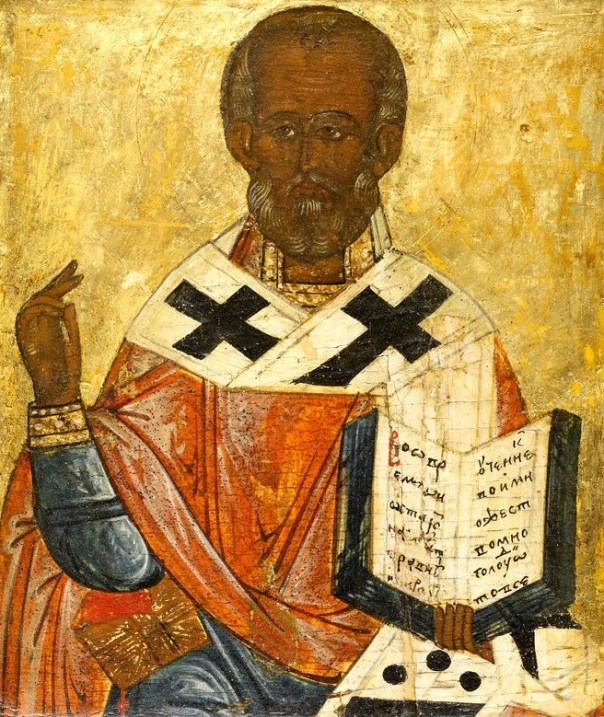
On the Feast of Saint Nicholas, I give you once more the words of Fr. Thomas Hopko from The Winter Pascha:

“The extraordinary thing about the image of St. Nicholas in the Church is that he is not known for anything extraordinary. He was not a theologian and never wrote a word, yet he is famous in the memory of believers as a zealot for orthodoxy, allegedly accosting the heretic Arius at the first ecumenical council in Nicaea for denying the divinity of God’s son. He was not an ascetic and did no outstanding feats of fasting and vigils, yet he is praised for his possession of the “fruit of the Holy Spirit…love, joy, peace, patience, kindness, goodness, faithfulness, gentleness, self-control” (Gal. 5:22-23). He was not a mystic in our present meaning of the term but he lived daily with the Lord and was godly in all his words and deeds. He was not a prophet in the technical sense, yet he proclaimed the Word of God, exposed the sins of the wicked, defended the rights of the oppressed and afflicted, and battled against every form of injustice with supernatural compassion and mercy. In a word, he was a good pastor, father, and bishop to his flock, known especially for his love and care for the poor. Most simply put, he was a divinely good person.”

Happy Saint Nicholas Day!

St. Nicholas Orthodox Church in San Anselmo, California

Reading a Wife

READING A WIFE

A wife is not composed of words, so
Unlike a novel that takes till dawn
To devour she cannot be read
through in a night

Repeating the uneasy lines of a poem
Over and over, rereading again and again
would be different, too (though it probably looks the same)

Yesterday, while driving the car
In a break in the din
I heard for a moment the beat of a bird’s wings
Ah, I thought

That ‘Ah’ was just for one moment, but
It would need an eternity to comprehend, never mind
My wife, who is before me sleeping or awake

Is it arrogant to even want to read a person?
Not her expressions or gestures
But to want to read that person, my wife
Unable to be satisfied with just living together?

My wife speaking to me from across the table
My wife wordlessly tossing and turning in bed
The one there that seems like
Loyal ladies-in-waiting serving a wife I can’t see

In the breath inscribed in each sentence
Punctuated by daily reality
Its draft turns the pages of my wife

I wish to grasp not the look but the way of the words
In a quiet place far from both my wife and myself
And like a twig that smells the approach of snow in the air
I want to read my wife

-Yotsumoto Yasuhiro

Bedouin Woman by César Gemayel

Bearing that secret, ancient flame.

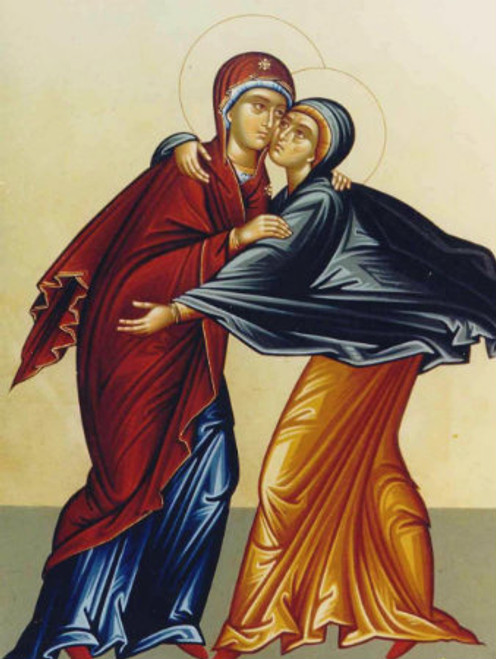
ELIZABETH TO HER COUSIN

After Jacob of Serug

Blessed are you, O Maiden; blest
The fruit which dwells within your womb,
Beloved in that holy rest
Whose secret comes to sacred bloom.
And blessed is this virgin birth
Which shall uproot sin from the earth.

Who grants this favor to me now,
That you should come, O Blessed One,
Bearing the great who is made low?
By his own will this thing is done.
The mother of a king, and yet,
It’s at my wooden door we’ve met.

Let every mouth speak out your praise,
And all the seraphim stand shaken.
Your womb contains the brilliant rays
That from a living flame shall waken
This world, whose sleep in sin-black night
Gives way before new life and light.

The gardener who clears the thorns;
A lion’s cub whose jaws shall roar
Louder than all of Joshua’s horns,
And drive all craven wolves before:
Such is the sun that all shall see
Arise from you as from the sea.

But who am I that you should come
Bearing the one who made the world,
Who is its savior and its sum,
And yet within you now lies curled?
I am unfit, Ancient of Days,
To welcome you or speak your praise.

But, Lady blest and full of grace,
I see your beauty and rejoice;
The radiant flush upon your face,
A living water in your voice,
Disclosing what alone you know,
That light and word within you grow.

No angel spoke this truth to me,
But he who grows within me stirred
The moment that my eyes could see
You, still far off, and my ears heard
Your call, as down the hill you came,
Bearing that secret, ancient flame.

-James Matthew Wilson