Tag Archives: Bright Week

The Bright side.

GL rose geranium 4-18-16
rose geranium

Son Pathfinder drove down from Oregon for his job, so he stopped also to see me at the beginning of this Bright Week, and helped quite a bit by mowing the lawn that hasn’t quite died, doing a pool maintenance task with me, and listening/talking for a while about his father and how our lives have changed. My children are my favorite people to talk to these days.

He brought some mail, including a card from Granddaughter Annie with a gift tucked inside, this bit of seeded paper Iris paper 2she had “made at Bible study to represent spreading God’s love.” She also wrote to invite me to drive north to their house next month to see the exhibit that includes some photography from a class she is taking. I am not making firm commitments that far ahead, but I feel the love pulling me.

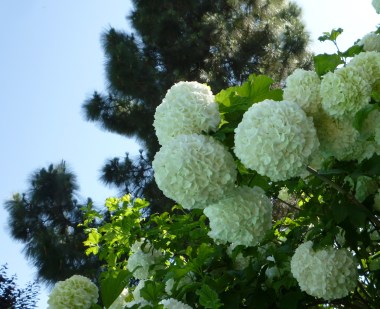
The snowball bush is hanging over the pool, the wisteria over the patio arbor. It was all warm and welcoming when our old friend Ken came by this week – also in town for work – and we sat out there for a visit. He said he hadn’t been in our back yard since he was baptized in our pool….we didn’t tryGL snowballs crp 4-18-15 to figure out how long ago that was! I told him about how I am planning to have the pool removed, and he looked over the equipment and discussed the job I need to get bids for. He owns a pool himself so he is a good person to talk to.
In addition to family and friends who are ready with long hugs and all kinds of practical assistance, I’ve appreciated the writings of Father Alexis Trader, who recently posted a series on grief. His descriptions of the feelings of grief are true to my own experience, as he empathizes with those who suddenly find ourselves in “this disorienting new universe that no longer feels like home.”

GL aloe saponaria close 4-18-16
aloe saponaria

Here is an example of how that is playing out here: I don’t feel like gardening. In my whole life I have only gardened as a partner with my husband, and it’s as though I don’t yet know how to do it as the person I am now. I haven’t planted a seed or a tomato start, and I’m just not thrilled about any of that. It’s a good thing that so much of the garden will keep going on its own and feed me with its beauty. All these photos are from this afternoon – I guess I still know how to take pictures on my own!

GL bells wisteria crp 4-18-15


About the process of grief Fr. Alexis says, “…one thing is consistent: grief is a journey that if it is successful is resolved in acceptance. The fathers also use the metaphor of a journey referring to a longer, spiritual journey in which the briefer journey of grief can be situated.”

GL aloe sap w red valerian & snowball 4-18-15


This image of a journey helps me to keep going. I know I am not at the end of my life’s journey, and I may be on the road for many more years. This short trail called Grief which I am facing now, though, is the steepest hike I’ve ever encountered. I wish I didn’t have to go this way, but it’s on the route my Father has laid out for me, so “best get on with it.” No doubt the trick will be the same old strategy: One foot in front of the other. More from Father Alexis:

Grief indeed is a journey but the holy fathers demonstrate that if we can learn to open our spiritual eyes, we will see that it need not be a solitary journey filled solely with darkness and pain, but it can also be a passage of transformation from death to life. After all, for the fathers, “death is not death, but only a kind of emigration and translation from the worse to the better, from earth to heaven, from men to angels, archangels, and the One who is the Lord of angels and archangels” (Saint John Chrysostom, Letter to a Widow).

Somehow the stages of grief, whatever they may be or in whatever order they may occur, need to be situated within the greater journey from earth to heaven, the journey that the departed in Christ have already completed. We are all “strangers and pilgrims on the earth” (Hebrews 11:13). The experience of grief brings this truth home. When we accept it fully, we can look to “a better country, that is heavenly” (Hebrews 11:16), to “a city which hath foundations, whose builder and maker is God” (Hebrews 11:10), to that Jerusalem on high that has “no need of the sun, neither of the moon, to shine in it: for the glory of God did lighten it, and the Lamb is the light thereof” (Revelations 21:23). That is the place where stages and phases are past, where acceptance is complete, and where we are truly at home with those who are departed, there where “Christ is all and in all” (Colossians 3:11).
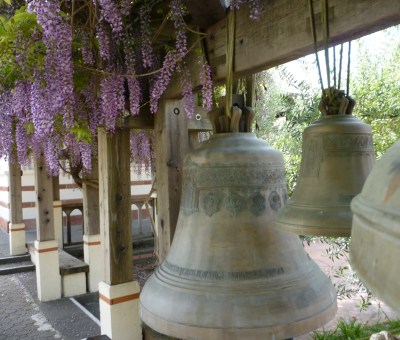
bells 2+ wisteria 4-18-15This morning I attended Bright Saturday Liturgy and was freshly struck by some of the prayers that I have prayed every week for almost a decade now. Like the prayer that we might “complete the remaining time of our life in peace and repentance.” Yes, that is the journey I am on. One thing is needful.

As I went out the door afterward, Ambrose, who is a drummer as well as a bell-ringer, began to ring the Paschal bells with gusto, and their brilliance filled the air of the quiet neighborhood to remind all the humans and animals that it’s not just another humdrum day, because Christ is risen!
Beautiful Artos

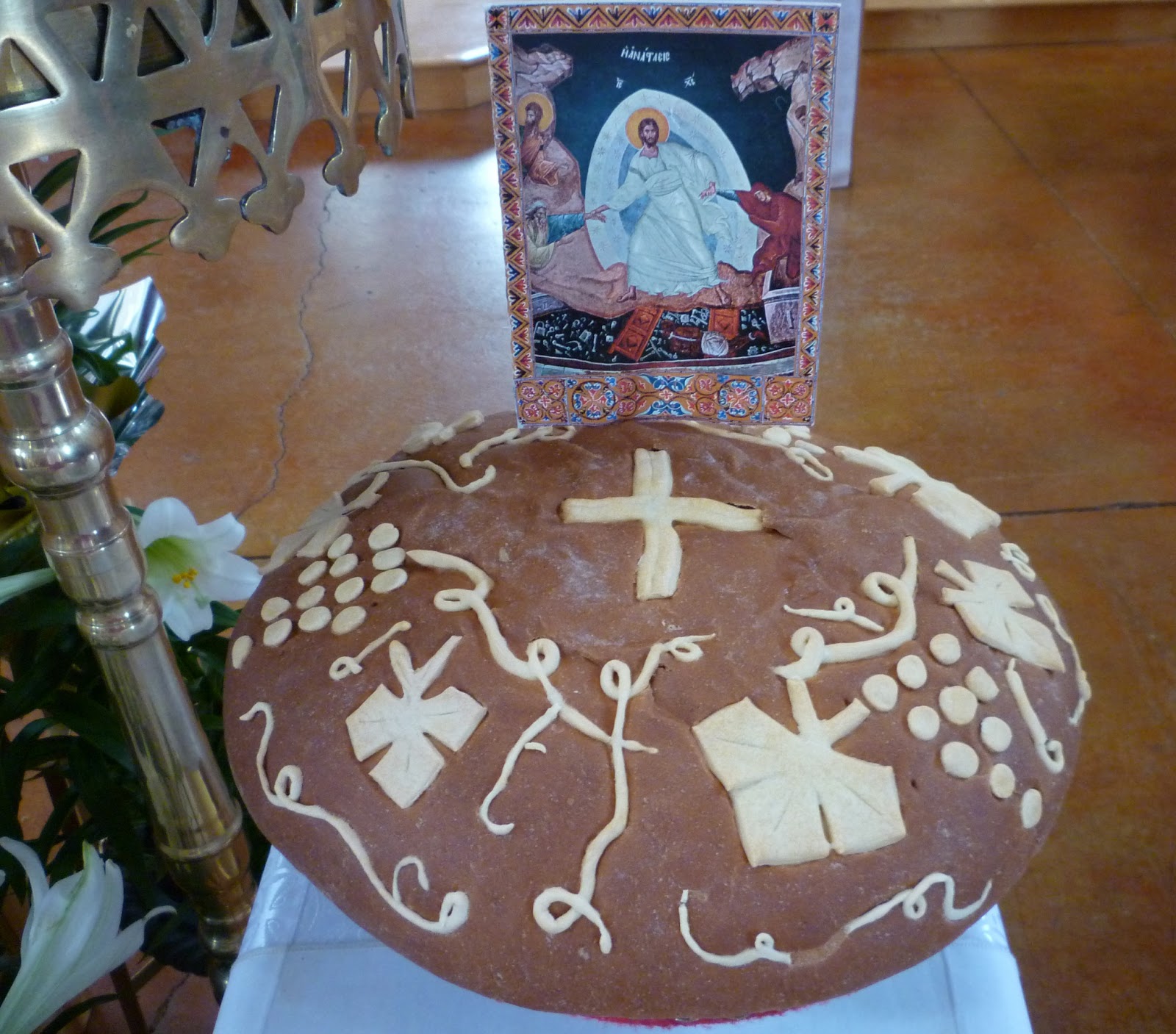
artos 15 crpHere is this year’s Artos, the blessed bread that remains in the church all during Bright Week, one more reminder of the Resurrection and of how our Lord is The Bread of Life.

I’ve been looking at other photos of loaves of Artos and truly I think our parish has the most gorgeous! In a few days we will all get a piece to eat. I happened to go into the church kitchen last week while the dough was being kneaded, so I know it has olive oil and orange zest in it, but other than the wheat itself I don’t know what other flavors it holds.

The Gospel reading at the Bright Tuesday Liturgy told the story of the disciples meeting the risen Christ on the Road to Emmaus, and I was very moved by it. I seemed to feel as never before how their world had collapsed when Jesus was crucified and dead. How heartbroken they must have been, to be suddenly without the One who meant everything to them, who was their very life. And then to hear how He, not recognized, spoke to them, and “beginning at Moses and all the Prophets, He expounded to them in all the Scriptures the things concerning Himself.” (Luke 24) The drama of this well-loved story grew in my heart as our priest read the passage.

When they convinced Him to stay with them that evening, their eyes were opened as they broke bread and ate together, and they knew Him. Then He vanished from their sight, and they realized that even though they hadn’t at the time realized why, their hearts had “burned within them” as they had listened to Him on the road.

My heart was joyful, and I got chills thinking about the unspeakable gift of breaking bread with God, partaking of the Holy Mysteries and by that sacrament receiving a kind of knowledge that can only come by His grace.

And we are only halfway through Bright Week! Christ is risen! He is risen indeed!

artos 15

(This is my 900th blog post!!)

Every tongue and flower.

first sweet pea Pascha 14

My first sweet pea opened on Pascha. At church the roses are abundant, and I’m grateful to be in a temperate area of the Northern Hemisphere where we can be extravagant with our flowers.

Here at home our snowball bush is going all-out for Easter. When he was a boy, Mr. Glad and his sister often had their Easter Sunday photo taken in front of a snowball bush; today I brought some of the blooms in to put on the dining table.

snowball etc Apr 21 2014

Of course, if we lacked flowers, we would still have eggs to color, and white/bright clothes to wear with our smiles and beaming faces.

I surprised myself with a desire to color eggs this year, but time ran Paschal_Egg_ Bolton Ontario Canadaout, and I displayed our small collection of pysanky for the holiday. This red egg is not one of them – I found its picture on the Web.

P1090657

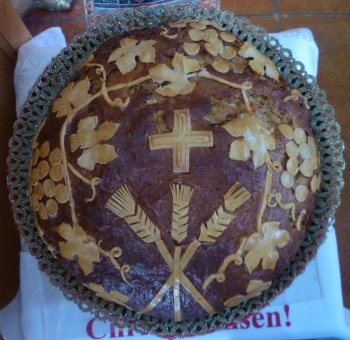
Another tactile and tasty symbol associated with this week is the loaf of bread called the Artos, about which I wrote last year when I was for some reason blessed to carry it in the Bright Monday procession.

Artos Bright Monday 14
Today’s Artos

But this morning what most impressed me was the sounds of worship, because our parish had many guests from two other Orthodox parishes in the area, from the Antiochian and Bulgarian patriarchates. Our Orthodox Church in America made the third. Historical events and migrations of peoples have led to the development, over centuries, of these ethnic distinctions between parishes, and we look forward to the day when the situation can be rectified.

In the meantime, we have the opportunity locally to demonstrate our unity and the glorious historicity of our common liturgy by gathering on this brilliant and shining day to pray, and to sing “Christ is risen!” in more languages than I could identify or count, not just in the Arabic, Bulgarian and English of the clergy, but others including Russian, Spanish, German, and of course Greek. Not only the words, but the tones of the hymns and the styles of chant vary quite a bit, and maybe just because it is more exotic, to my ear the Arab-style chant is especially soul-stirring.

This 10-minute YouTube sampler of many styles of Orthodox Easter hymns includes some in English, some with the lyrics displayed on the screen with the icons, and quite a few are of the sort we might typically sing in our parish, but it doesn’t include anything like what I have heard in the Arab churches near here. This one comes the closest to the deep baritone voice and style of the cantor who has often led us in worship as he did this morning. But for today’s congregation of a majority of American-born converts, I was thankful that he sang most of the hymns assigned to him in English.

Truly the Kingdom of Heaven comes to us in the Divine Liturgy, and at Pascha, as is described in the scriptures:

After this I beheld, and, lo, a great multitude, which no man could number, of all nations, and kindreds, and people, and tongues, stood before the throne, and before the Lamb, clothed with white robes, and palms in their hands; And cried with a loud voice, saying, ‘Salvation to our God which sitteth upon the throne, and unto the Lamb.’

 Christ is risen! Indeed He is risen!

P1090660

It’s a joyful day, whatever day it is.

Pascha goes on and on! So we have Paschal Bright Week services, Monday, Tuesday, Wednesday….

Christ rose on the first day of the week, Sunday. The Church has always considered this to be be the eighth day as well, the beginning of a new order of things. I don’t really understand this. But our bishop mentioned it this morning, Bright Monday, when he talked about the grace that extends throughout the week hinting at the newness of life given us in Christ’s Resurrection.

We all are feeling the newness. Today we lived in the joy of Christ’s presence and celebrated it in many ways, including a loaf of bread. This year it was baked by a young girl with the help of a more experienced baker. It must weigh over five pounds — I know, because I was honored to carry it in the procession around the church, and then standing on the porch as the gospel for the day was read.

This bread is called the Artos and “symbolizes the physical presence of the resurrected Christ among the disciples.” It will remain in the church all week and be carried in procession after Divine Liturgy those days; on Saturday it will be cut into pieces and distributed to the parishioners.

Below is a photo I found online of a Bright Week procession elsewhere.  It seems it might be the only photo available — maybe everyone wants to actively participate in these blessed processions and not stand apart to be a photographer.

On Pascha night I remembered that I have a piece of last year’s Artos in my refrigerator. I’m sure I was saving it for a time when I was ill or afflicted, and I must never have thought that I was terribly bad off at any time during the year. Praise God for that. So I’ll have to eat it for joy this week and put a new portion in reserve for any upcoming needs. Having been exposed to the air for a whole week it becomes dry and keeps very well!

The day of our Lord’s Resurrection is another case, it seems, of how we live in the present life and at the same time we live in the reality and anticipation of God’s coming Kingdom. St. Gregory Palamas wrote in a sermon “On the Sabbath & The Lord’s Day”:

Whatever is said in praise of the 7th day applies even more to the 8th, for the latter fulfills the former. It was Moses who unwittingly ascribed honor to the 8th day, the Lord’s Day. The Jubilee year (Leviticus 25:8ff), which Moses regarded as a year of forgiveness and named accordingly, was not counted among the ‘weeks of years’ under the law , but came after them all, and was an eighth year proclaimed after the last of these 7 year periods. Moses did the same with regards to periods of 7 weeks.

However, the lawgiver did not only introduce in this hidden way the dignity of the 8th day, which we call the Lord’s Day because it is dedicated to the Lord’s resurrection, but also on the feast called “Trumpets” referred to the 8th day as ‘the final solemn assembly’ (cf. Lev.23:36 LXX, Numbers 29:35) meaning the completion and fulfillment of all the feasts. At that point he clearly said that the 8th day would be holy for us, proclaiming in advance how divine, glorious, & august Sunday was to be after everything pertaining to the law had passed away.

But I see that Metropolitan Anthony in a passage I quoted just last week tells us that we are living this present life in the Seventh Day:

…the seventh day will be seen as all the span of time that extends from the last act of creation on the part of God to the last day, the eighth day, the coming of the Lord, when all things will be fulfilled, all things will come to an end, reach their goal, and blossom out in glory. It is within this seventh day, which is the whole span of history, that the creativeness of man is to find its scope and its place.

In this whole span of history we have much work to do, including our bread-baking and flower-arranging to celebrate Christ’s rising from the dead. St. Isaac of Syria tells a bit about how the fullness of our Eighth Day is yet to come, and seems to see things somewhat differently from Met. Anthony:

The Lord’s Day is a mystery of the knowledge of the truth that is not received by flesh and blood, and it transcends speculations. In this age there is no eighth day, nor is there a true Sabbath. For he who said that ‘God rested on the seventh day,’ signified the rest [of our nature] from the course of this life, since the grave is also of a bodily nature and belongs to this world. Six days are accomplished in the husbandry of life by means of keeping the commandments; the seventh is spent entirely in the grave; and the eighth is the departure from it.

It certainly is a mystery to my small mind, but I am always comforted by these realities of the faith that show how great is our God, and His plans for us, so high as the heavens are above the earth, that they are hard to grasp with our minds. And I’m full of that joy that is not received by flesh and blood, of the glorious risen Savior Christ. He is here every day.