I am no more than a secretary of the invisible thing
That is dictated to me and a few others.
Secretaries, mutually unknown, we walk the earth
Without much comprehension. Beginning a phrase in the middle
Or ending it with a comma. And how it looks when completed
Is not up to us to inquire, we won’t read it anyway.
-Czeslaw Milosz
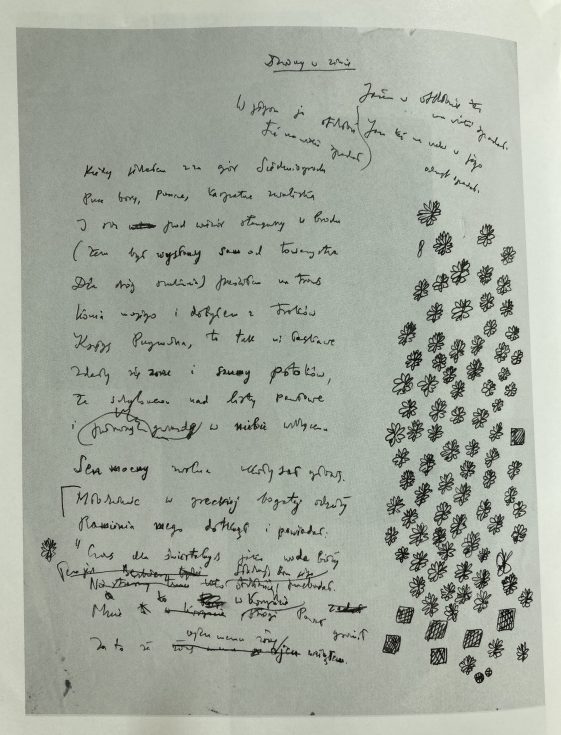
A Milosz poem in the original Polish. I like the doodlings that resemble my own “secretarial” scribblings, though I feel I am not as good at taking dictation.
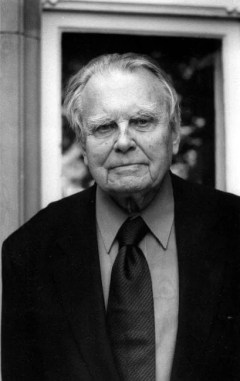
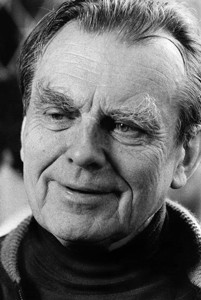
Czesław Miłosz defected from Poland to the West in 1951. In 1960 he began teaching at the University of California at Berkeley, where he lived most of the time until 2000, when he moved back to Krakow; he died in 2004.
There are many reasons why I have recently wanted to read from the writings of Milosz in several genres. After I had already started on A Book of Luminous Things: An International Anthology of Poetry, which he compiled in his 80’s and which is essentially a gift to modern readers, I discovered that this kind and generous man had been teaching at Berkeley during the years when I was deciding where to go to college. Berkeley was one of my top three choices back then. In the Now, my mind wandered into the land of “What if?” What if I had attended Berkeley and had known Professor Miłosz as a poetry teacher?
Ah, but he didn’t teach poetry. He taught Slavic literature, and many of his colleagues didn’t even know he was a poet, until he won the Nobel Prize in Literature in 1980. So if I had attended “Cal,” I would probably not have known of his existence until now anyway, and that would have made me a little sad.
As it is, the fact that he lived in the Berkeley hills (where my grandmother spent most of her life) for 40 years, and wrote many poems during that time about his experience in and of California and its landscape, draws me to him powerfully. One more thing that links us: his father and my grandfather were both born in Riga, Latvia, probably about the same time. Here is a poem that builds a bridge in his heart from a church in Berkeley back to his homeland and to his dear mother.
WITH HER
Those poor, arthritically swollen knees Of my mother in an absent country. I think of them on my seventy-fourth birthday As I attend early Mass at St. Mary Magdalen in Berkeley. A reading this Sunday from the Book of Wisdom About how God has not made death And does not rejoice in the annihilation of the living. A reading from the Gospel according to Mark About a little girl to whom he said: “Talitha, cumi!” This is for me. To make me rise from the dead And repeat the hope of those who lived before me, In a village near Danzig, in a dark November, When both the mournful Germans, old men and women, And the evacuees from Lithuania would fall ill with typhus. Be with me, I say to her, my time has been short. Your words are now mine, deep inside me: “It all seems now to have been a dream.”
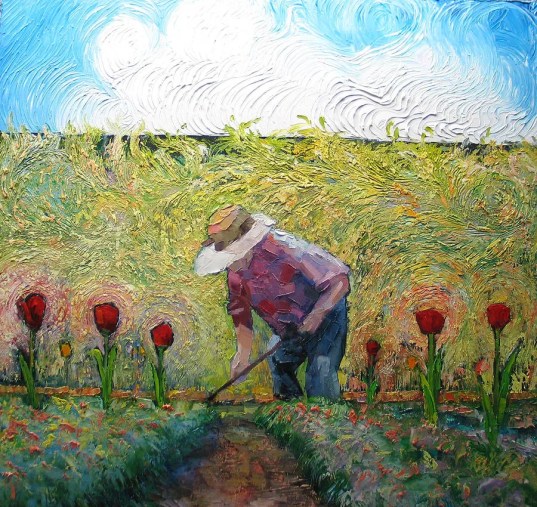
A day so happy. Fog lifted early, I worked in the garden. Hummingbirds were stopping over honeysuckle flowers. There was no thing on earth I wanted to possess. I knew no one worth my envying him. Whatever evil I had suffered, I forgot. To think that once I was the same man did not embarrass me. In my body I felt no pain. When straightening up, I saw the blue sea and sails.
I can’t help analyzing this poem a bit….. I am a book-lover, and if I didn’t know that the dead will be resurrected in glory, I might have liked to write this poem:
AND YET THE BOOKS
And yet the books will be there on the shelves, separate beings,
That appeared once, still wet
As shining chestnuts under a tree in autumn,
And, touched, coddled, began to live
In spite of fires on the horizon, castles blown up,
Tribes on the march, planets in motion.
“We are,” they said, even as their pages
Were being torn out, or a buzzing flame
Licked away their letters. So much more durable
Than we are, whose frail warmth
Cools down with memory, disperses, perishes. I imagine the earth when I am no more: Nothing happens, no loss, it’s still a strange pageant,
Women’s dresses, dewy lilacs, a song in the valley.
Yet the books will be there on the shelves, well born,
Derived from people, but also from radiance, heights.
 There are many reasons why I have recently wanted to read from the writings of Milosz in several genres. After I had already started on A Book of Luminous Things: An International Anthology of Poetry, which he compiled in his 80’s and which is essentially a gift to modern readers, I discovered that this kind and generous man had been teaching at Berkeley during the years when I was deciding where to go to college. Berkeley was one of my top three choices back then. In the Now, my mind wandered into the land of “What if?” What if I had attended Berkeley and had known Professor
 Gladsome Lights