 My primary motivation for creating this loaf was to use a big bag of prunes that was taking up space in the fridge. Plus I wanted to make some kind of bread I could keep eating when (Orthodox) Lent arrives, which is soon. When I saw a recipe for a prune bread using buckwheat flour, I saw another opportunity, to incorporate some of the many kinds of flours and grains I have stored up and haven’t been using.
I took ideas from that recipe I saw online and made my own version. The name Prunia comes from joining prune with chia (seeds), another item I had on hand and that figures prominently in the bread, as do walnuts. I love walnuts, especially when they have been toasted, and their flavor may be the most dominant one here.
The picture of honey at the top puts the brightest ingredient forward, color-wise. We have many jars of honey around here lately, the most wonderful being the quart of golden sweetness from Kit’s own bees, whom she had to leave in Oregon on The Farm, when she came here. I often buy honey from the nearby monastery, or receive it as gifts from friends… it all adds up to our being a household rich in honey.
Unfortunately, the other ingredients that the beautiful honey gets mixed into are very drab. Buckwheat flour is gray, gray, gray, and chia seeds and prunes are pretty much black. Walnuts are brown… When I look at a loaf like this:
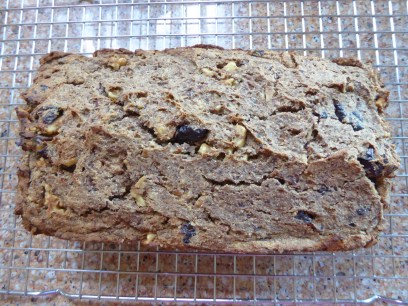
…it makes me remember a Garrison Keillor spoof on health food in which the high-fiber cereal being put forward as so essential for regularity was called “Raw Bits.” My loaf does look rough on the outside. It is fairly high-fiber, too, as well as being gluten-free and vegan — with what I consider just the right amount of sweetness.
Prunia Nut Bread 
1 ½ cups buckwheat flour
½ cup coconut flour
3 cups walnuts, divided
¼ teaspoon salt
2 teaspoons baking powder
1 teaspoon allspice
1 teaspoon nutmeg
½ teaspoon cardamom
1/3 cup chia seeds soaked in 1 cup water
30 large pitted prunes, divided
¼ cup coconut oil
½ cup honey
2 teaspoons vanilla
1 ½ cups plant-based milk
First toast the walnuts, 300° for 40 minutes, stirring once.
While they are toasting, put 10 prunes in a small bowl and pour on boiling water to cover.
Mix the chia seeds with the water in a small bowl.
Chop the remaining 20 prunes, sprinkling a little of the flour over them as you do, to keep them from clumping up again.
Into a medium-large bowl sift the flours, salt, baking powder and spices together.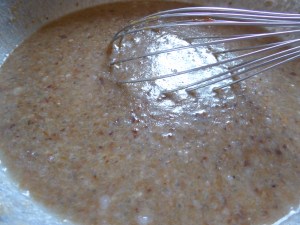
When the walnuts are toasted and cooled, chop 2 cups coarsely and set aside.
Grind the remaining 1 cup of walnuts in a food processor. Add these to the dry ingredients – but don’t wash the processor bowl yet.
Put the prunes and water in the bowl of the processor and purée.
In a medium bowl melt the coconut oil with the honey, then add the milk, the chia seeds and the prune purée.

Combine the wet and dry ingredients, mixing in the chopped prunes and walnuts.
Put into oiled medium-sized loaf pans – or one very large – and bake for 50-60 minutes at about 350°. Cool on racks.
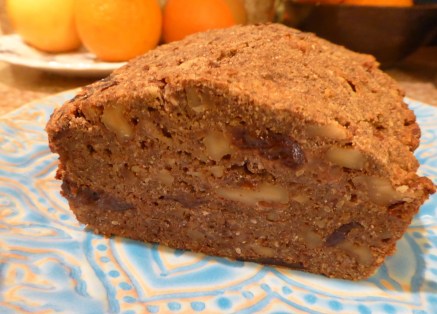
The bread comes out very moist and dense. I’ve made it three times in order to perfect my recipe, but each version was well worth the eating, which tells you that this recipe is still pretty tweakable. You might leave out the bit of coconut oil and I bet it wouldn’t be missed; or you could increase the amount of spice if you like more intensity. As it is it is a mellow loaf.
If I wanted to spend more time on the project, it would be to figure out how to use fewer cups and bowls in the mixing of the batter, and to do without the food processor altogether. For one thing, that little bit of prune purée is probably dispensable. But for now, for this Lent, I think I have plenty stashed in the freezer; the kitchen has been cleaned up, and I have a little more room in the fridge.
If anyone tries the recipe, let me know if you made any changes and how it worked.
Bon appétit!

 Gladsome Lights