 I was a child when poetry was still “taught badly,” according to some people. In fifth grade we had to memorize a poem, choosing from a collection that our teacher had compiled. Before that I remember reading some poems at home, like “Wynken, Blynken, and Nod,” which I came to love. It was in a children’s literature anthology my grandmother had given us.
From the options my teacher presented I chose “The Children’s Hour” by Longfellow. It seems that we had some weeks to learn our poems, and the practicing and reciting of the poet’s metered verse are a very pleasant memory for me. I did enter vicariously into the scene the poem describes, of a father surrounded by his affectionate and beloved daughters. I can still hear the music and feel the happiness even if I can’t remember many of the words past the first line.
Now, when I read about that particular poem on Wikipedia, I find that it serves as an illustration of one aspect of poetry that educators debate about: “More recently, the poem has been called overly-sentimental, as have many of Longfellow’s works. Scholar Richard Ruland, for example, warns that modern readers might find it ‘not only simple and straightforward, but perhaps saccharine and overly emotional,’ though he concludes it is a successful poem. Scholar Matthew Gartner, however, uses the poem as an example of how Longfellow invited his readers into his private home life in New England to refine them and teach them lessons in virtue.”
I have been lightly musing over these questions since reading a recent article by California’s Poet Laureate Dana Gioia, who has for as long as I’ve known him been intensely interested in education, and how to restore among the populace the love for poetry that used to be commonplace.
 In the article “Poetry as Enchantment” the poet discusses the huge changes that have taken place in the world of poetry over the last few generations. I can see how my own experience reflects some of the losses that occurred. After the one poem that I memorized (not counting lyrics of hymns and folk songs) there was to be no more reading aloud in school, or memorization. In high school I know we analyzed some poems, but nothing grabbed me. Despite this, our small rural high school retained vestiges of the past in the form of a literary magazine in which students might publish poems or stories that the student editors selected.
I tried writing some poems, of which I was of course ashamed soon after they were published in the magazine. Maybe the magazine was not actually a leftover from a previous era but a “progressive” thing, packed with material from untaught writers, screened by writers just as unqualified. And likely it was an attempt to hold on to a fuller experience of poetry than we were getting in the classroom. Gioia says that textual criticism and analysis is all well and good and can be very helpful — he does quite a bit of it himself — but that we require an encounter with poetry that engages more than our intellect. We amateurs should not be underestimated as readers of poetry:
Amateurs have not learned to shut off parts of their consciousness to focus on only the appropriate elements of a literary text. They respond to poems in the sloppy fullness of their humanity. Their emotions and memories emerge entangled with half-formed thoughts and physical sensations. As any thinking person can see, such subjectivity is an intellectual mess of the highest order. But aren’t average readers simply approaching poetry more or less the way human beings experience the world itself?
Life is experienced holistically with sensations pouring in through every physical and mental organ of perception. Art exists embodied in physical elements—especially meticulously calibrated aspects of sight and sound—which scholarly explication can illuminate but never fully replace. However conceptually incoherent and subjectively emotional, the amateur response to poetry comes closer to the larger human purposes of the art—which is to awaken, amplify, and refine the sense of being alive—than does critical commentary. The scholarly response may be accurate and insightful. The culture is enriched by specialized discourse about literary texts and traditions. But critical analysis remains deliberately outside the full experience of the poem, which is physical, emotional, subjective, and intuitive as well as intellectual.

Less than ten years out of high school, I was teaching poetry to my children. That was when I fully fell in love with many a good poem. Maybe all the analytical skills my high school and college teachers had tried to teach me came back and helped me appreciate the art, but I think much of the good effect came from starting from the ground up:
-Teaching toddlers the fun of a sing-song nursery rhyme;
-reading A Child’s Garden of Verses to older children so many times that we couldn’t help but learn several by heart (skipping a few that didn’t seem to be teaching “a lesson in virtue,” to use the words of Matthew Gartner above);
-working the copying and memorization and reciting of poems into our homeschool curriculum; reciting/memorizing Frost’s “The Figure in the Doorway” as a family in the car while on a camping trip.
We didn’t try to analyze or figure out hidden meanings, but I think we often intuited deep things. Probably many times we missed the primary intent of the poem, but we still were enriched in our humanity and our connection to the poet, and the world.
“Genuine poetry can communicate before it is understood.”
-T.S. Eliot, as quoted by Dana Gioia
More from the article:
Poetry offers a way of understanding and expressing existence that is fundamentally different from conceptual thought. As Jacques Maritain observed, ‘poetry is not philosophy for the feeble-minded.’ It is a different mode of knowing and communicating the world. There are many truths about existence that we can only express authentically as a song or a story.
Conceptual language, which is the necessary medium of the critic and scholar, primarily addresses the intellect. It is analytical, which is to say, it takes things apart, as the Greek root of the word ana-lyein, to unloosen, suggests. Conceptual discourse abstracts language from the particular to the general.
Poetic language, however, is holistic and experiential. Poetry simultaneously addresses our intellect and our physical senses, our emotions, imagination, intuition, and memory without asking us to divide them. The text may be frozen on the page for easy visual inspection and analysis, but the poetic experience itself is temporal, individual, and mostly invisible. As Wallace Stevens wrote, ‘Poetry is a pheasant disappearing in the brush.’
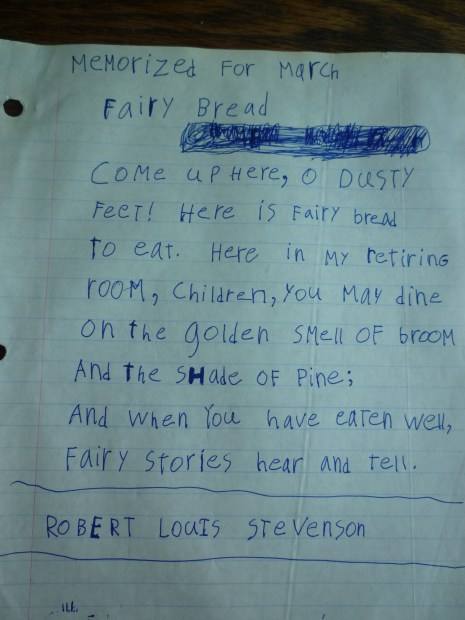
In the passion of 20-yr-old pride I tossed out my copies of the high school magazine, but I can remember the first line of one verse I wrote: “Must we tear apart the thing, and analyze and criticize?” Even then I had no leanings toward being a literary scholar. But I am still in the process of getting a literary education.
“The purpose of literary education is not to produce more professors;
its goal is to develop capable and complete human beings.”
-Dana Gioia
Against much resistance, when he was chairman of the National Endowment for the Arts, Gioia managed to implement a program he designed to restore some of the practices that encouraged a love of poetry in bygone years. Many of you are probably familiar with Poetry Out Loud, but I only learned about it in this article. High school students are having fun learning poems and reciting them in competitions, and this has been going on for ten years now! I’m hoping to attend the recitations in my area this coming January. It will do my heart good.
Get the fuller story of Gioia’s thesis and suggestions, and of the Poetry Out Loud events, by reading the entire article here.

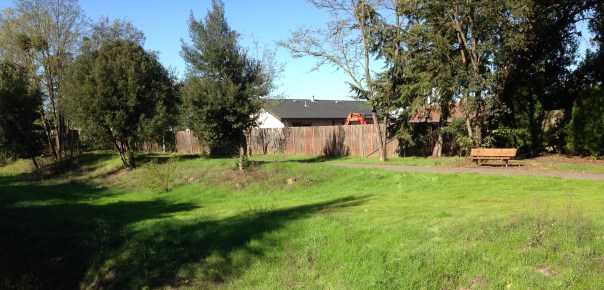
 The cold mornings hit this week, but the fog always lifts in time for a walk under blue skies. On one of those days, I was only warm for the hour when I was walking down the path with the sun on my back.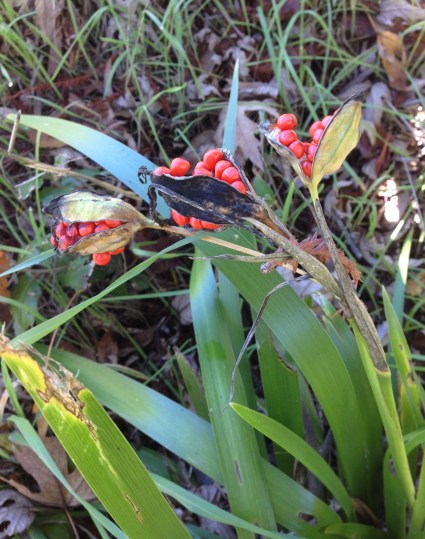




 Gladsome Lights