“And the Word became flesh!…in order to make us earthly beings into heavenly ones, in order to make sinners into saints; in order to raise us up from corruption into incorruption, from earth to heaven; from enslavement to sin and the devil – into the glorious freedom of children of God; from death – into immortality, in order to make us sons of God and to seat us together with Him upon the Throne as His royal children. O, boundless compassion of God! O, inexpressible wisdom of God! O, great wonder, astounding not only the human mind, but the angelic as well!”
+ St. John of Kronstadt, Sermon on the Nativity of Jesus Christ
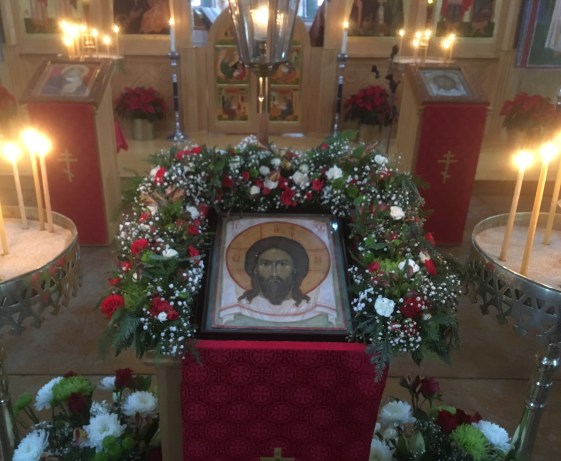
“In Christ we see something which could be revealed by God but which could not even be dreamed of by man: the fullness of Divinity in human flesh. Here is the crux of holiness. It is accessible to us because of the fact of the Incarnation. This does not lessen the mystery of God: a purely transcendent God is easier to understand or imagine than the God of the Incarnation.
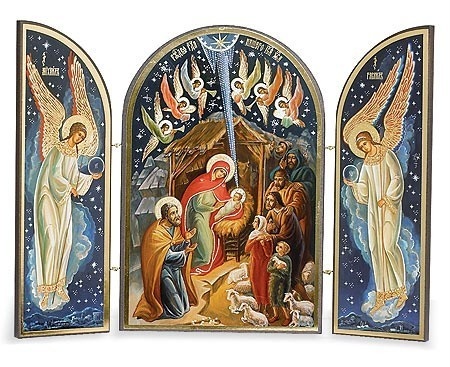
“And when we see the crèche of the Nativity in our imagination, or in plastic representations, and can take the Child-God in our hands, we are confronted with a greater mystery than that of the imperceptible God. How can we understand that the full depth of infinity and eternity lies here, hidden and at the same time revealed by a frail human body that is fragile and transparent to the presence of God?”
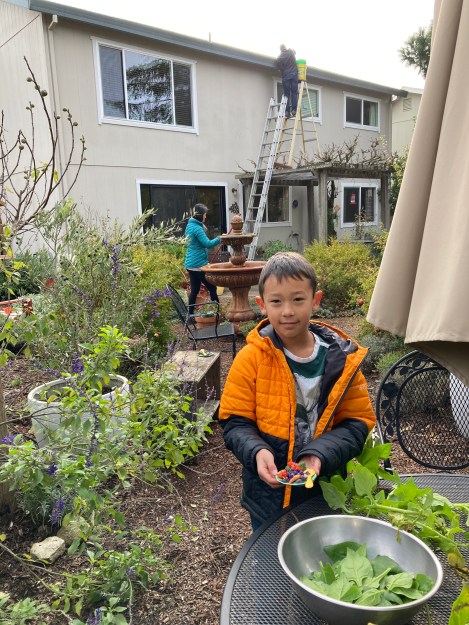
The children and I had a good time scavenging in my garden for any remaining edibles. My New Zealand Spinach, known down under as warrigal, I think, popped up and was immediately lush after recent rains, so I picked a gallon of leaves to make Creamy Green Soup with.
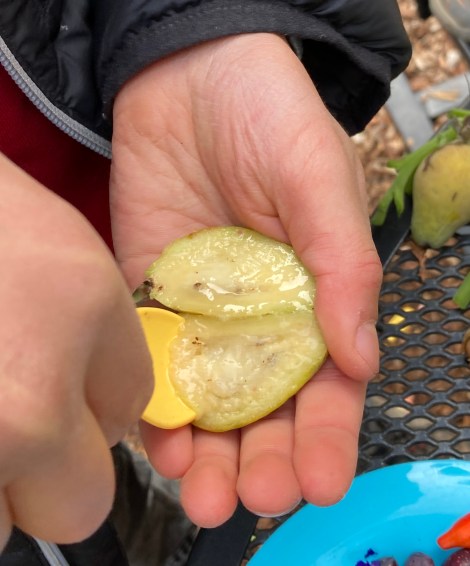
The boys used a few of the leaves as a foundation for multiple gorgeous culinary creations, several of which were proudly presented as “fully edible.” I did eat one whole plateful, and we all nibbled on pineapple guavas that we found on the ground at the back of the bush, and almost-ripe pomegranate seeds. We found a few sweet tomatillos here and there, but there were only two fruits on the strawberry tree. Olives and salvia flowers and pomegranate flowers all contributed to extravagant visual displays.
Skeleton of a tomatillo husk. It contained seeds and a fly.
Meanwhile, Soldier cleaned my rain gutters
and Joy raked the paths of pine and redwood needles.
Liquidambar gumballs
On our drizzly walks we’ve admired liquidambar trees with deep red leaves yet to drop, and collected cotoneaster berries for the next phase of Christmas decorating. My grandson Pat and his new bride are joining us for Christmas Eve!
Here are the remaining “Baby Jesuses” that we made from salt dough about thirty years ago, re-wrapped in their twill tape swaddling clothes and set under my second little Christmas tree, given by my neighbor and decorated by the children just tonight.
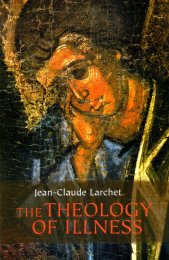
To the brief passage below, taken from The Theology of Illness by Jean-Claude Larchet, the author attaches four footnotes, in which he references St. John Chrysostom, St. Maximus the Confessor, St. Gregory Palamas, Vladimir Lossky and the Book of Job. He is a patristics scholar for sure! And he manages to incorporate many quotes from church fathers and Scripture in the main text as well, without making it hard to read. In fact, it is pure pleasure to follow Larchet’s explanations as he gathers from great minds of the church and reveals the unity of their thought and faith.
“God, who envisions the salvation of man and through man of the entire universe, does not allow the forces of evil to submerge and destroy His creation. Man and nature remain partially protected by His Providence, which imposes certain limits on the negative activity of the Devil and his demons. Thereby God stabilizes the cosmos in its slide toward nothingness, establishing a certain order in the very heart of disorder. Even if man has lost the ‘likeness’ of God which he began to acquire, he nevertheless remains bearer of the divine ‘image,’ even if that image is veiled, obscured, and deformed.
“Thus man is not totally deprived of grace. Even in his weakness he retains sufficient spiritual power to be able, if he wishes, to turn again toward God and to obey the commandments which he continues to receive from Him (Dt 30:11-19). And thereby he is able to maintain, according to God’s own promise, a certain mastery over nature (cf. Gen 9:1-2).
“Nonetheless, this new balance remains fragile. Man and nature have become a battleground where evil and good, death and life, wage a permanent, merciless combat against each other. This combat is made evident by sickness, infirmity and suffering; and until the Incarnation of Christ, its outcome was uncertain.”
 The children and I had a good time scavenging in my garden for any remaining edibles. My New Zealand Spinach, known down under as warrigal, I think, popped up and was immediately lush after recent rains, so I picked a gallon of leaves to make Creamy Green Soup with.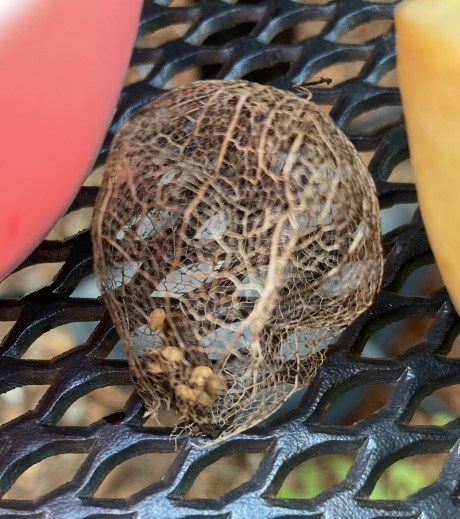




 Gladsome Lights