
Back in 2016 I removed my two olive trees from their pots, trimmed their roots, and installed them in larger, matching white (and lightweight) fiberglass pots. I seem to have never written about the process here or posted photos; I wish I had, because I couldn’t remember the specifics, and had to consult YouTube when yesterday I decided to tackle the root-trimming job again.
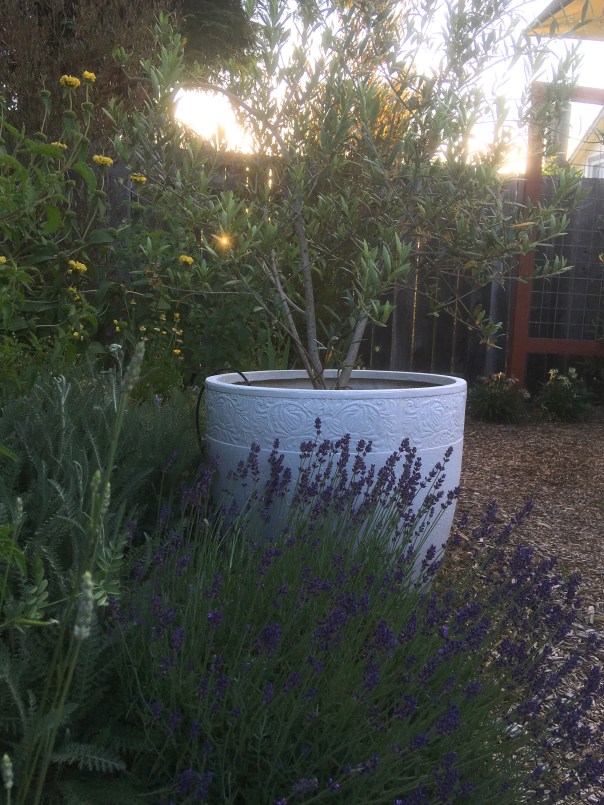
The landscape designer who advised me back then not to plant an olive tree in the ground, because it would grow out of scale and become overbearing in my little garden, suggested I keep the ones I already had and just put them in larger containers; she added that I would need to trim the roots every couple of years to keep them healthy in the confined space.
That was eight years ago this month, and one of the trees by its yellowing leaves has been signalling me that my procrastinating was costing it its health. The task had become more daunting with every year added to my age. Those pots may be easy to move around when they are empty, but with all that moist dirt and biomass in them, I could barely tip one over on to a tarp.

When I did, I found a couple dozen salamanders of all sizes under there. They weren’t happy to feel the sun on their cool and moist bodies, and they writhed and slithered away into the mulch.

Getting the root ball out of the pot was the hardest part of the whole job. My back didn’t suffer any lasting effects, but my arm muscles are complaining. We were stuck in the situation pictured above no matter how I yanked and rolled things around; I really could have used a helper (with long arms) at this point just to pull on the pot while I pulled on the tree. But inch by slow inch — and it was finally out.

After I loosened the snarled roots, and shook off the old soil, it dawned on me that I didn’t have enough new soil to replace it, so I covered the root ball against the sun and took a half hour to go to the store for a few bags of potting soil.

After trimming the roots I put the pot back in place and leveled it using two flat stones from the mountains, then put the tree back in, with the new dirt, and a little fruit tree food. I trimmed the branches a bit, too. I think this tree, whom I’ll call “Olive Junior,” will be happier now.
What about the other one? It seems pretty healthy, so I’m putting off dealing with it for now. The two trees have different history. Olive Senior was given to me as a birthday present by my son “Pathfinder” and his family more than ten years ago. I kept it in a roomy pot but didn’t water it very much; its form was lacking but it didn’t occur to me to try to improve on it.
A few years later I saw little olive saplings at the grocery store half-off, that is, $7.50. They were very healthy and more shapely than my olive tree, and I brought one home. I began to shape Olive Senior with my pruners. When it came time to put them in matching pots, O.S.’s roots weren’t crowded in the pot and there wasn’t much to trim off. Olive Junior’s roots were extensive and needed a lot of trimming, even though it was much younger. So… I’m guessing each is still following its pattern, and I can wait a bit, and tackle Olive Senior with a little more forethought, and with a helper.
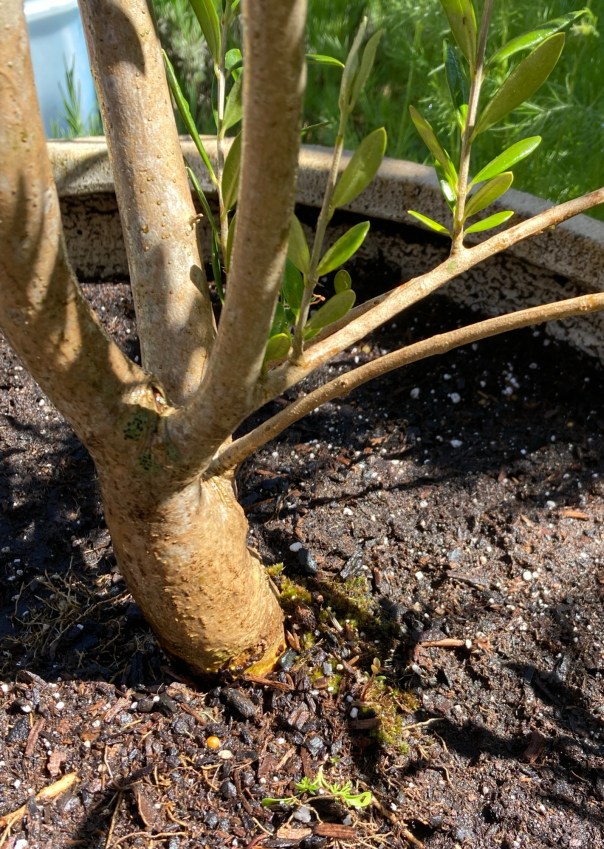
It’s a great blessing to own not just one, but two olive trees, even if I do have to give them the bonsai treatment. They like the Mediterranean climate. I will close my olive report with this Bible verse that I took many years ago as a poem-prayer expressing my heart’s vision:
But as for me,
I am like a fruitful olive tree
in the house of the Lord;
I have hoped in the mercy of God
for ever, and unto the ages of ages.
Psalm 51:8
 Gladsome Lights
You are an inspirational gardener!
LikeLiked by 1 person
Thank you for the beautiful glimpse into your gardening. It’s delightful to see what flourishes in a climate so different from mine in northeast New Jersey!
LikeLiked by 1 person
Substitute Hawaiian schefflera for olive, and you’ve perfectly described my last process of dealing with a too-long in the same pot plant. From the yellowing leaves, to rolling a too-heavy pot around on the ground, to discovering the need for a trip to the soil store, my process was exactly the same as yours. Trying to get that schefflera out of its pot was like trying to pry a recalcitrant toddlers hands off the ‘whatever’ that it wants.
In fact, you’ve reminded me that I still need one more bag of soil. The repotted plant’s been pruned and is putting on new growth, but I think it might appreciate a bit more soil to hang on to!
LikeLiked by 1 person
Your olive tree story is fascinating to me! I have a beloved meyer lemon tree, myself, and can only grow it in a large pot because our climate includes extended periods of extreme cold in the winters. It *has* to be able to be moved indoors for those times, although it clearly thrives much more happily outdoors. It has grown too big for its pot, yet I cannot manage a larger pot or a heavier tree.. It is as big as it can be and still be manageable. I prune it and add extra soil and fertilizer to the top, but I am definitely afraid of doing what you managed to do – getting it out of that pot and giving it a complete overhaul! May your beautiful trees live long and prosper 🙂
LikeLiked by 1 person
I’m curious — do the olive trees bear fruit? Black or green? Perhaps when your children visit you can get some help with the other tree. It seems like a smart idea to wait till you have some strong help!
LikeLiked by 1 person
Olive Senior has many black olives on it right now.
LikeLike
Good for you for tackling this heavy job. Love that verse!
LikeLiked by 1 person
That was quite a big project you undertook. I’m amazed that you could do it without any help. I was also wondering if either tree produced fruit and was glad you answered that question.
I hope your arm muscles don’t bother you for long.
LikeLiked by 1 person
Wow, what a job! I’m impressed that you were able to manage the tug of war on your own. Wonder if this is the same procedure needed for other trees like citrus in containers…
Yes, such a beautiful verse to accompany your olive tree refreshing.
LikeLiked by 1 person