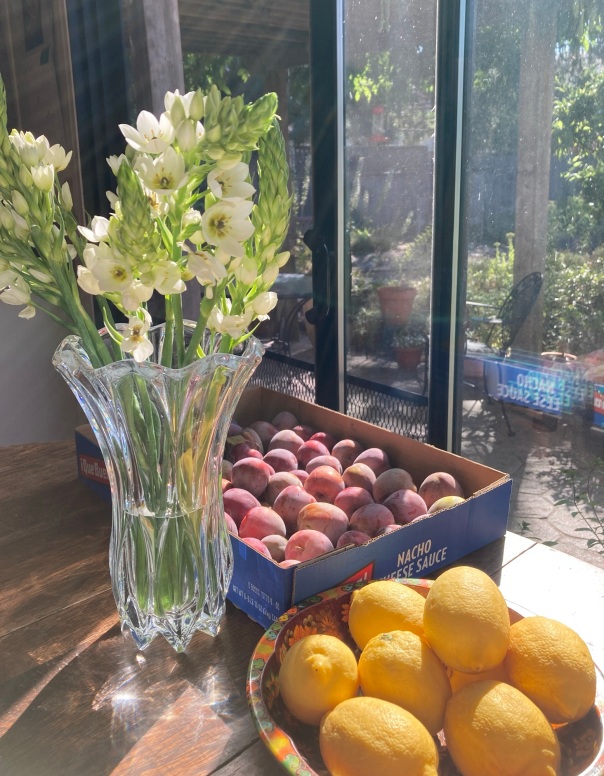
I’ve been home from my travels more than two weeks already, and before any more trips loom on the horizon, I have eight more weeks of homebody bliss remaining. It’s still high summer, when the days –or at least, the afternoons — are of the warm sort that energize and call me to the garden. This is the greatest good fortune. Glory to God, that I have a garden. Glory to God!

Other things besides the garden have helped to fill my days, and are filling my calendar into the near future. When I am home, I can be a host, and have guests! My house is happy when extra people are enjoying its spaces, and feeling the breezes blow through. That’s happened twice already in the last two weeks, and I’m expecting it to happen more.
When guests come in the summertime, they can stroll about the garden and pick a plum, and younger guests can play in the playhouse. The last one who did that made a soup entirely of tarragon and fountain water, and then dumped it into the fountain. Speaking of the fountain, when I am home I can keep it running, and keep it clean. It’s not very cheery to have a fountain turned off.

The birds are enjoying the summer. I hadn’t noticed the goldfinches much in the last couple of years, but this week they have been frolicking around the fountain; they seem to have plenty of time to play, probably because they’re not burning so many calories to keep warm. Today the house finches came along to drink and bathe as well. And one goldfinch made a side trip to the arbor, to perch on a long wisteria runner that was reaching out horizontally. He made short and quick jumps down toward the tip, which dropped a couple of inches in elevation with each jump, pecking at the buds, or maybe at insects, until he was at some critical point, after which I suppose he’d have found himself upside down if he’d held on — so he flew away.
It was a wet spring here, and the early summer was cool, but now everything not in watered gardens is crisping up. I took my friend to one of my favorite parks for an easy hike, but it was so dry that the trail in many places had deep and wide cracks that made walking difficult, even in my boots. I guess I’d never been there at this time of year before? It did smell good out there, I must admit, and amid the crackling grasses we saw lots of wildflowers — first, masses of Yellow Star-Thistle, Centaurea solstitialis, an invasive plant that is in bloom now.

Star-Thistle is one of the many invasives that one can learn about on the website of the California Invasive Plants Council website, which I only just discovered. I think I’ll like to return there. The website of Yosemite National Park also features articles about such plants locally, and one of them tells about the great lengths different agencies go to, to control what is in California considered a weed. A Wikipedia article is unclear about whether the star-thistle is considered noxious in six or in 23 of the U.S. states where it is present. Are you my U.S. readers familiar with it? Evidently the purple star thistle is essentially the same thing, except for the color.

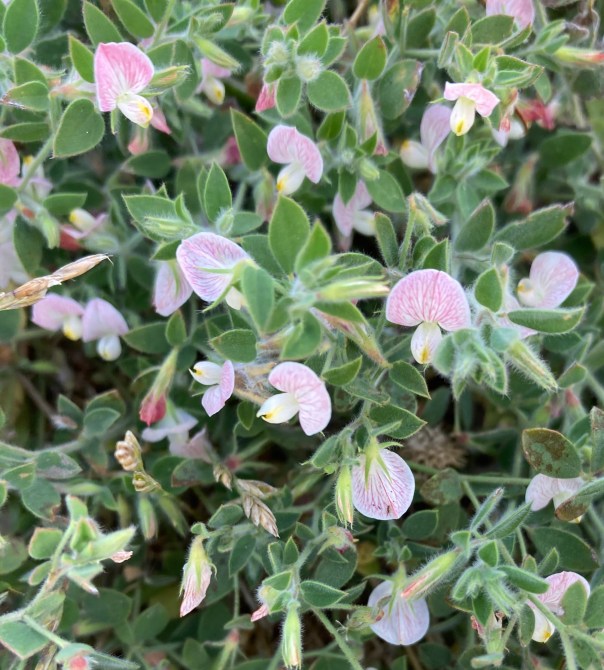
The pennyroyal that amazed me at Tomales Bay also grew along the path in less spectacular displays; and Spanish Clover, and Stinking Chamomile (Anthemis cotula), photo above. That chamomile was new to me; Gwen sniffed it and said that indeed it did not smell good.
Domesticated and not-stinky chamomile is growing in my planter box, just one specimen that sprouted from the old seeds I threw in there before I went to Greece. I should plant it every year, it is so cheery.

Last week we celebrated the Procession of the Cross, and the festal cross stayed in the middle of the temple until the Forefeast of Transfiguration. Now we will celebrate Transfiguration for about a week until the Leavetaking of Transfiguration which is the day before we celebrate Dormition (Assumption) of the Theotokos in the middle of the month. I love the way the calendar anchors me to the church, and reveals the abundance of saints and events who fill the year with the glory of God.

As usual we brought baskets of fruit, and after Liturgy processed through the vineyard singing. It wasn’t as prickly as the trail I walked on last week, but it required careful stepping around grape prunings and blackberry brambles.

I pruned the lavender this week, and set it aside to take to a friend so she can add it to the straw in her chicken coop, to sweeten up the atmosphere:

A different friend came for lunch, and we were able to eat outside on the patio, after a leisurely tour of the garden. It was just warm enough to thoroughly relax, but not to wilt.  I added snips of my parsley and tarragon to the salad we made together. I could have put a few calendula petals in as well, but I didn’t think of that.
This has been a pretty unfocused ramble, I’m afraid, so rambling that I don’t know how to sign off. So, let’s just pretend we were talking together next to my planter boxes, and looking at the zinnias, and then I went into the house and didn’t come back.
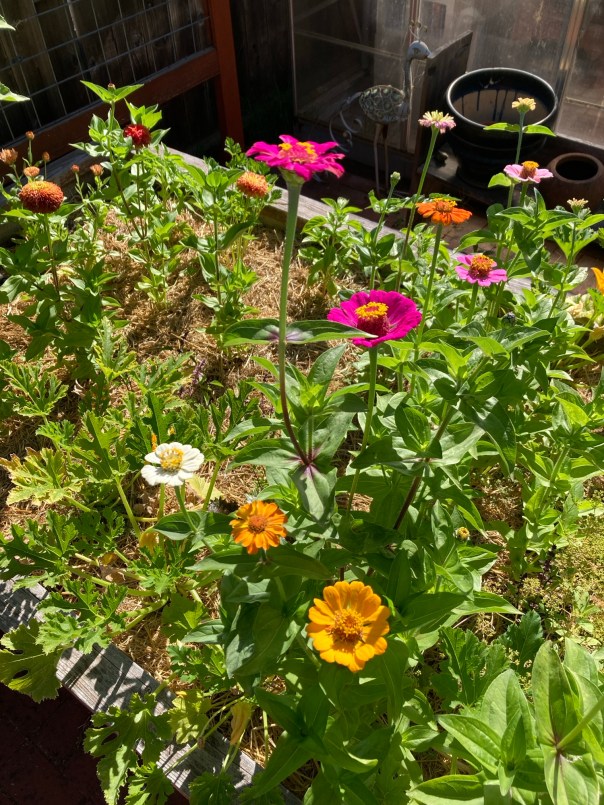
But I will return eventually!
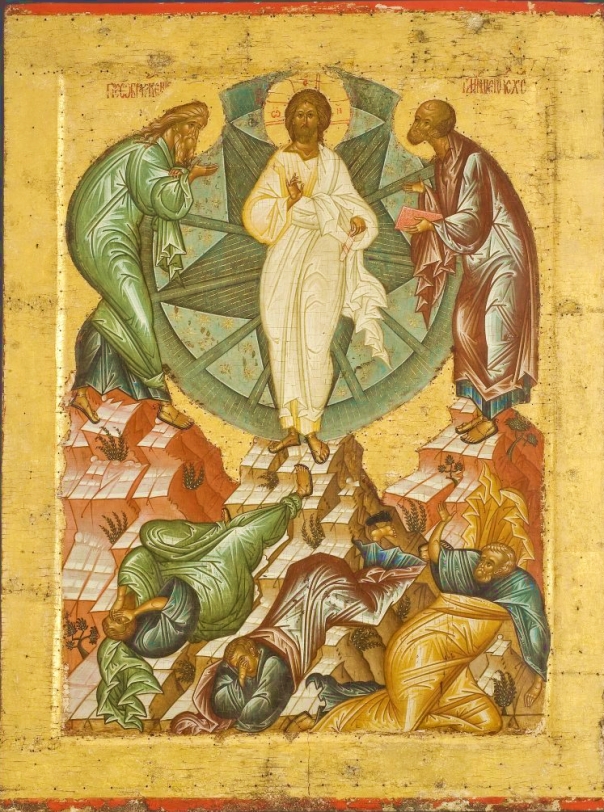


 Gladsome Lights