Category Archives: children’s books

Swan Lake stories


I really got into the Swan Lake story last Spring. It all started with an Amazon.com recommendation, from which I learned that Mark Helprin had written a book-length adaptation of the tale that was most famously told by Tchaikovsky’s ballet. There were surprisingly few reader reviews of his book given that they were nearly all gushingly positive, some saying it was the best book they had ever read.

I’ve long been curious about Helprin and the many books he’s written. Some of my family and friends have read his novels, stories, and non-fiction pieces. I had a feeling that I should appreciate him more than I did, and I planned to try again to read his fiction. I was sure his Swan Lake would be good, and I nearly ordered it without previewing it. But then I saw that it was first of a trilogy, and people were less thrilled with the sequels, so I got it from the library instead to see for myself before investing on behalf of a grandchild.

While I was at it, I borrowed three other juvenile versions of the story, so I would have something to compare with. On the first day of Lent I read all four of the books — I know, it was an odd thing to do that day — and scratched out some thoughts. After returning the books to the library in the interest of focusing on more appropriate matters, I forgot all about the subject, until today, when I decided I should gather everything up finally.

Helprin’s version (©1989) would have to be counted my least favorite of the four. It’s the length of a short novel, and his story is fleshed out with several characters who don’t appear in the more common tellings. It’s the most changed, interesting and complex story, but maybe too complicated. The story’s flow is interrupted with goofy details and sidetracks that detract from the moral weight. The narrator’s voice is not that of a believable old man, not that of the man who has enough wits about him to accomplish what he does. Yet he’s supposedly a sage.

I also did not like the loose morals of the characters, who literally “shack up” together and have a child, who figures in the politics of the realm in the sequels, as I understand. The prince never does behave in a very noble fashion that I can see. And what’s the good of a fairy tale if the prince is at best only a foolish boy?

I’m really not competent to even know what it is about Helprin’s fictional style that puts me off. Probably it’s only a personal preference or lack of foundation that makes it hard for me to enjoy him. But I think that I’m through trying.

My next-least favorite of the bunch of Swan Lake tales that I read was Swan Lake, retold by Anthea Bell, illustrated by Chihiro Iwasaki (©1984). I liked the watercolors, but there weren’t enough pictures of swans for my taste. And the story line was thin.

Swan Lake, adapted and illustrated by Donna Diamond (©1980) was second-best of my stack. It was thorough story-telling, including more motives and complications, with nice black and white, dreamy paintings.

My favorite was Swan Lake, retold and illustrated by Lisbeth Zwerger (©2002). The illustrations were pleasing to me, and after mentioning several versions of the ending, the author makes it into a happily-ever-after story.

After all my literary wanderings, I’m left wondering if perhaps this tale is best told through a ballet performance. I know that even in that form there have been widely divergent versions of the story, but I can’t help thinking that the rich visual and musical elements would make the whole experience more satisfying than did any of these books.

The Hungry Soul – Struggle to Stand

The charming children we get to know in the recent documentary “Babies” are, at the end of the film, struggling to become toddlers, persons enjoying the upright posture that is a mark of homo erectus. They don’t even think about it, because it seems to be a given that children want very much to stand up and walk.

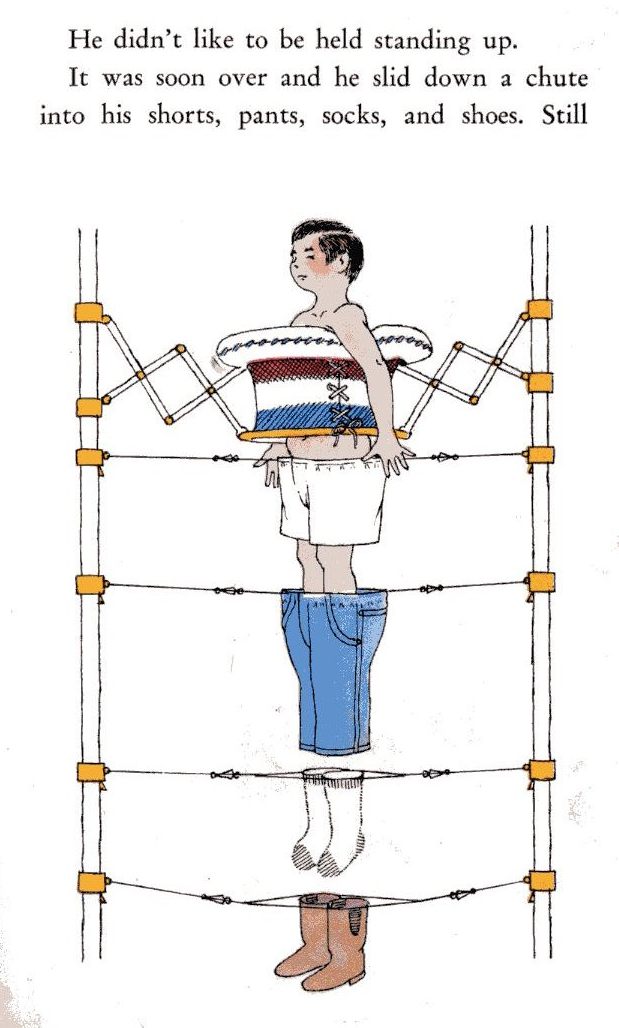
That is, unless you are Lazy Tommy Pumpkinhead, who lives in an electric house that does everything for him; Tommy can’t bring himself to get out of bed or even stand up without assistance. But his story is meant to teach any self-respecting child to be self-respecting, to be human, and not lazy. He is the hero of a children’s book I liked to read to our children.
In the chapter on “The Human Form,” in his book The Hungry Soul: Eating and the Perfecting of our Nature, Leon Kass examines how the erect and forward-facing posture that distinguishes us from most of the animal world contributes to our outlook and coordinates with our calling to be lords of creation, as it were. He takes many of his foundational ideas on this subject from the neurologist-psychologist Erwin Straus, and from his essay titled “The Upright Posture.”

In my reviews I’m skipping around in the book, but I should explain that the first chapters make a case for the primacy of form. That is, all living beings are more than a collection of the same kinds of particles. Even though absolutely all our material is replaced during our lifetime, we retain the same recognizable form. And as this is a book about the human soul, the subject is next narrowed to the human form. From there the author goes on to discuss what humans do with these bodies.

The uprightness of our form is what I am trying to stick to in this post. I think of this a lot now, when I wake up in the mornings and am lying in bed for at least a few seconds. Rarely do I have to get up with an alarm clock, for which I am grateful. And at this time of my life no baby is demanding that I get up to feed her and no child will be late for school if I linger a bit. This morning when I woke I realized that God had answered my prayer to be wakened in time to go to Bridegroom Matins, so I hopped out of bed.

But it isn’t always so easy. Wouldn’t it be lovely if we could keep that verve that children have, that makes them get up, or cry to be let out of their cribs, as soon as they wake up? It seems that God gives us a special grace, when we are new to the world, to work hard at standing before we know what work is.

Though upright posture characterizes the human species, each of us must struggle to attain it. Our birthright includes standing, but we cannot stand at birth. Feral children who have survived in the wild were not found upright but were able to become so. As with other distinctively human traits (speech, for example), human beings must work to make themselves do or become what nature prepares them to be or do. Upright posture is a human, and humanizing, accomplishment.

Kass quotes Straus:

Before reflection or self-reflection start, but as if they were a prelude to it, work makes its appearance within the realm of the elemental biological functions of man. In getting up, in reaching the upright posture, man must oppose the forces of gravity. It seems to be his nature to oppose nature in its impersonal, fundamental aspects with natural means. However, gravity is never fully overcome; upright posture always maintains its character of counteraction.

And Kass elaborates:

Effort does not cease with rising up; it is required to maintain our uprightness. Automatic regulation does not suffice; staying up takes continuous attention and activity, as well it should, inasmuch as our very existence is at stake. Awakeness is necessary for uprightness; uprightness is necessary for survival. Yet our standing in the world is always precarious; we are always in danger of falling. Our natural stance is, therefore, one of ‘resistance,’ of “withstanding,’ of becoming constant, stable.

It doesn’t get any easier, does it? As we get older and weaker, the temptation is to sit down more often. I notice that tendency in church, where in my tradition we stand during the services, which means for one or two hours at a time we stand. What better attitude could we take toward The Holy Con-substantial Life-Creating Trinity?

Yes, we can prostrate ourselves, and I know people who do that when their ailing backs prevent their standing in prayer. But I notice in the Bible that after people fall on their faces before messengers of God, they are told to stand up. The Psalms speak of standing in His presence, and in the New Testament we are told, “…having done all, to stand.”

Stand firm, stand in the gap, stand still and see the salvation of the Lord…The posture is both a metaphor for and a support to our efforts, the whole Christian life being a struggle against laziness, even to the point of, “Let us labor therefore to enter into that rest.” (Hebrews 4) Perhaps if I stand a little longer than is comfortable in church, or work a few more minutes at my household chores before sitting down, it will make me call out to God and ask for help to be the kind of person He wants.

And if I doubt my ability, let me remind myself, “You’ve been doing this your whole life, resisting gravity, walking this precarious walk against natural forces that want to pull you down. You can keep doing it, you can!” I will call to mind the words of T.S. Eliot: “Only those who will risk going too far can possibly find out how far one can go.” And not forgetting the difference between the metaphor and the reality, I’m only too aware that some people who are no longer able to stand with their bodies are standing in the gap for me.

As to lying in bed, for most of us it is a near necessity, though the saints’ lives testify that some of them avoided it like the plague. One wants to avoid the condition described in Proverbs 26, “As a door turns on its hinges, so a sluggard turns on his bed.” I haven’t yet figured out how exactly it fits in without spoiling my thesis, but I have to mention my dear G.K. Chesterton’s delightful essay, “On Lying in Bed,” in which he cautions tongue-in-cheek against legalism and hypocrisy, mostly about how early one rises:

A man can get used to getting up at five o’clock in the morning. A man cannot very well get used to being burnt for his opinions; the first experiment is commonly fatal. Let us pay a little more attention to these possibilities of the heroic and the unexpected. I dare say that when I get out of this bed I shall do some deed of an almost terrible virtue.

This drawing of Lazy Tommy illustrates what happens after he is all dressed and fed, and the long afternoon stretches ahead of him with nothing to do but propel himself up the stairs — not walking, but crawling, it should be noted — but his bed is the attraction that gives him that much energy.

I like this picture, only because it shows that even Tommy is capable of struggling. Maybe we could think of him as a late bloomer, crawling when he should have learned to walk — but at least he is showing some spunk. At the end of the book he experiences enough discomfort resulting from an electrical outage and the failure of technology that he resolves to “turn over a new leaf.”

As I finish this post we are in Holy Week. All through Lent I wanted to write something about the wonderful midweek services that we have (and at which I hope to worship tonight), but it seemed to be beyond my ability to capture even a bit of the sweetness in words. One thing I love about them is that all the Psalms that are called Songs of Ascent are read at each service. And the last of those, Psalm 134, provides a fitting picture of our souls’ posture before our God.

Behold, bless ye the LORD,
all ye servants of the LORD,
which by night stand
in the house of the LORD.
Lift up your hands in the sanctuary,
and bless the LORD.
The LORD that made heaven and earth
bless thee out of Zion.

Other posts on this book: The Hungry Soul — Intro (Why I love this book) and The Hungry Soul – How Science Disappoints

Taught by The Little Match Girl


It’s quite cold today, and my feet are feeling it even though I am indoors; I didn’t turn the heat on before I went to church, so now it will take a long time for the house to get warmed by the wood fire I built. And the computer is in the coldest corner. As I sit here with my cold feet and three layers of wool sweaters, blankets of snow can be seen on the surrounding foothills. Maria has a theme of children on her blog this month, and today she posted a lovely painting of a girl reading.

All of these factors combined to spur me into writing about a story that captivated me as a child and that became a foundational piece of furniture of my mind. When people suggest sharing a list of the books that were formative in our lives, I often think that only God could say what they are. I’m pretty sure that we don’t remember in our intellect everything that our hearts know.

But “The Little Match Girl,” by Hans Christian Andersen, is the one story I know would be on my list. It was in the anthology that provided most of my reading material when I was about 5-10 years old, which my children also read, and which now sits on my shelf in its duct tape bandage.

What did I get from this story, and why did I love reading it over and over? I lived a comfortable life, so it wasn’t empathy with the poor and freezing child that held my attention. It must have been the attractiveness of God Himself, Who I understood was taking the child to be with Him, where she would also be with her grandmother. I learned from this story something about Heaven and death, and that suffering and neglected children aren’t entirely alone. Indeed, they can have spiritual experiences that adults know nothing about and with which no one can interfere.

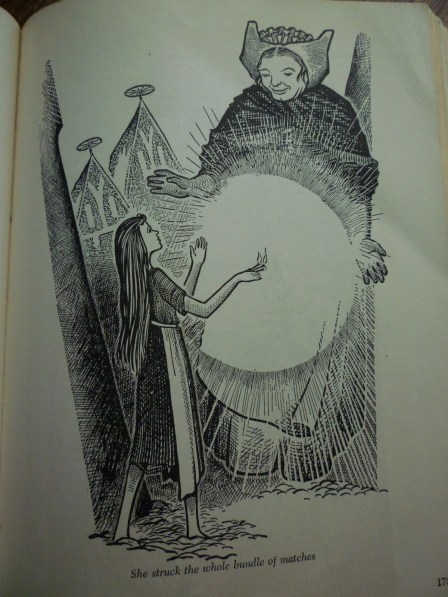
I easily found the text of the story online, in slightly different wording, but I couldn’t find an illustration that seemed right. They all showed a girl of the wrong age, or they were too cute, or irreverent. Finally I took a picture with my camera of the picture in the book, but as I look at it I see that even it doesn’t equal the much richer, if vague, images I retain from reading the words.

Evidently there have been movies telling the story, and perhaps most everyone is familiar with several versions of this tale, but I’ve never gone beyond that first encounter. For anyone wanting to read it once more — or perhaps for the first time! — I post it here.

The Little Match Girl

Most terribly cold it was; it snowed, and was nearly quite dark, and evening– the last evening of the year. In this cold and darkness there went along the street a poor little girl, bareheaded, and with naked feet. When she left home she had slippers on, it is true; but what was the good of that? They were very large slippers, which her mother had hitherto worn; so large were they; and the poor little thing lost them as she scuffled away across the street, because of two carriages that rolled by dreadfully fast.

One slipper was nowhere to be found; the other had been laid hold of by an urchin, and off he ran with it; he thought it would do capitally for a cradle when he some day or other should have children himself. So the little maiden walked on with her tiny naked feet, that were quite red and blue from cold. She carried a quantity of matches in an old apron, and she held a bundle of them in her hand. Nobody had bought anything of her the whole livelong day; no one had given her a single farthing.

She crept along trembling with cold and hunger–a very picture of sorrow, the poor little thing!

The flakes of snow covered her long fair hair, which fell in beautiful curls around her neck; but of that, of course, she never once now thought. From all the windows the candles were gleaming, and it smelt so deliciously of roast goose, for you know it was New Year’s Eve; yes, of that she thought.

In a corner formed by two houses, of which one advanced more than the other, she seated herself down and cowered together. Her little feet she had drawn close up to her, but she grew colder and colder, and to go home she did not venture, for she had not sold any matches and could not bring a farthing of money: from her father she would certainly get blows, and at home it was cold too, for above her she had only the roof, through which the wind whistled, even though the largest cracks were stopped up with straw and rags.

Her little hands were almost numbed with cold. Oh! a match might afford her a world of comfort, if she only dared take a single one out of the bundle, draw it against the wall, and warm her fingers by it. She drew one out. “Rischt!” how it blazed, how it burnt! It was a warm, bright flame, like a candle, as she held her hands over it: it was a wonderful light. It seemed really to the little maiden as though she were sitting before a large iron stove, with burnished brass feet and a brass ornament at top. The fire burned with such blessed influence; it warmed so delightfully. The little girl had already stretched out her feet to warm them too; but–the small flame went out, the stove vanished: she had only the remains of the burnt-out match in her hand.

She rubbed another against the wall: it burned brightly, and where the light fell on the wall, there the wall became transparent like a veil, so that she could see into the room. On the table was spread a snow-white tablecloth; upon it was a splendid porcelain service, and the roast goose was steaming famously with its stuffing of apple and dried plums. And what was still more capital to behold was, the goose hopped down from the dish, reeled about on the floor with knife and fork in its breast, till it came up to the poor little girl; when–the match went out and nothing but the thick, cold, damp wall was left behind. She lighted another match. Now there she was sitting under the most magnificent Christmas tree: it was still larger, and more decorated than the one which she had seen through the glass door in the rich merchant’s house.

Thousands of lights were burning on the green branches, and gaily-colored pictures, such as she had seen in the shop-windows, looked down upon her. The little maiden stretched out her hands towards them when–the match went out. The lights of the Christmas tree rose higher and higher, she saw them now as stars in heaven; one fell down and formed a long trail of fire.

“Someone is just dead!” said the little girl; for her old grandmother, the only person who had loved her, and who was now no more, had told her, that when a star falls, a soul ascends to God.

She drew another match against the wall: it was again light, and in the lustre there stood the old grandmother, so bright and radiant, so mild, and with such an expression of love.

“Grandmother!” cried the little one. “Oh, take me with you! You go away when the match burns out; you vanish like the warm stove, like the delicious roast goose, and like the magnificent Christmas tree!” And she rubbed the whole bundle of matches quickly against the wall, for she wanted to be quite sure of keeping her grandmother near her. And the matches gave such a brilliant light that it was brighter than at noon-day: never formerly had the grandmother been so beautiful and so tall. She took the little maiden, on her arm, and both flew in brightness and in joy so high, so very high, and then above was neither cold, nor hunger, nor anxiety–they were with God.

But in the corner, at the cold hour of dawn, sat the poor girl, with rosy cheeks and with a smiling mouth, leaning against the wall–frozen to death on the last evening of the old year. Stiff and stark sat the child there with her matches, of which one bundle had been burnt. “She wanted to warm herself,” people said. No one had the slightest suspicion of what beautiful things she had seen; no one even dreamed of the splendor in which, with her grandmother she had entered on the joys of a new year.

Cats, Chickens, and Tree Houses

It all started when one of my grandsons was beginning to read “chapter books,” a category of literature I hadn’t known by that name before then. He didn’t start with The Boxcar Children as my children did; what got him excited was a series about talking cats. I wanted to be able to chat with him about his reading so I got my hands on a copy of Warriors, a series by Erin Hunter. I did get pulled in to the politics and magic of wild cat clans made up of individuals with names like Ravenpaw and Bluestar, clans that fight territorial wars and look down on “kittypets,” their derogatory name for tame kitties. Hunter has written 19 books in this series so far, but perhaps Grandson B. grew out of them; he hasn’t gotten around to reading the last story.

Another grandson, in 2nd grade, recommended the Magic Tree House Mysteries by Mary Pope Osborne. 28 have been published at this writing, and he’s keeping up. I let him read several chapters out loud to me a year ago, and then I came home and read one of the series myself. Through time and earth travel that happens when they are in their tree house, the two children enter into historical events great and small all over the globe, in many different eras and cultures. The format is a vehicle for learning lots of social studies and even science trivia.

My most recent exploration of children’s literature came as a result of blogger contacts, where I heard about the books by Frances O’Roark Dowell. The two I’ve seen so far use a conversational first-person style that reminds me of The Sugar Creek Gang books of yore. In Chicken Boy the main character is a 7th-grader from a decidedly dysfunctional family; he spends the latter part of the book in a foster home, even though the reader has become sympathetic to the good hearts and potential of the family members who are neglecting Chicken Boy.

I liked the grandmother, and Boy’s school friend who gets him involved in a science project to prove that chickens have souls. A bit of philosophy hooks me in, especially when added to the fact that Boy gets several chickens to raise at Grandma’s. Grandma and Friend have a discussion on this question of souls, and Grandma concludes, “I’d believe a tree had a soul before I believed a chicken had one.”

Overall Chicken Boy is full of hope. Our 7th-grader gets over some of the major obstacles of entering junior high without a supporting family, by having kind friends and teachers and extended family. Even before Social Services enters the picture, you get the feeling he might make use of limited resources and succeed in life. Instead, the foster family provides a refreshing and not unrealistic option in his case, and it is hopeful as well. At the end of the book we don’t know if and when the original family will come together again.

Why do some children read Warriors and some books about foster children? It is heartening to think that borderline neglected children are finding Chicken Boy in the school library and taking it home to read. It could give them ideas for making the most of adversity, and ease some anxiety about the future. If just one child is uplifted by this book, the author will have accomplished a great blessing.