Category Archives: church

Providence and Photography

Long ago in Fantasyland, I thought my remodeling project might be done before Lent 2019. And again this year I thought so, but I had less hope than last year. 🙂

I hate to take the time to tell you properly why it’s not done, and how it makes me feel. But I will say that at worst, I feel like a homeless woman who for a year has been camping in an increasingly disorganized storage unit, who must still be presentable at 7:30 every morning to welcome visitors who are working on the place, very close to my bed and bathroom.

But I do have the loveliest bed, plenty of food to eat, and I have a bathroom. My wonderful house has windows through which sun often shines. I have hope of my affliction coming to an end. Millions of people in the world would love to experience my problem. Besides, God knows what I need, doesn’t He? He does. The last fifteen months have not gone the way I expected, but I can’t help but see, even with my bad spiritual eyesight, much good coming out of “everything,” and I’m not talking about my closet makeover.

The providence of God was crystal clear this week, when it’s the first week of Lent, and precisely for the first three days of this special week my project stalled; it wasn’t the first occasion when I could appreciate the timeliness of delay. Unlike most truly homeless people I have a car and could drive to church! I love to attend Matins and other services that are at 8:00 a.m. during Lent, and it’s not difficult during this season of my life when I can’t sleep past 5 or 6. And as often happens, when we have said the last “Amen,” I’m not eager to leave.
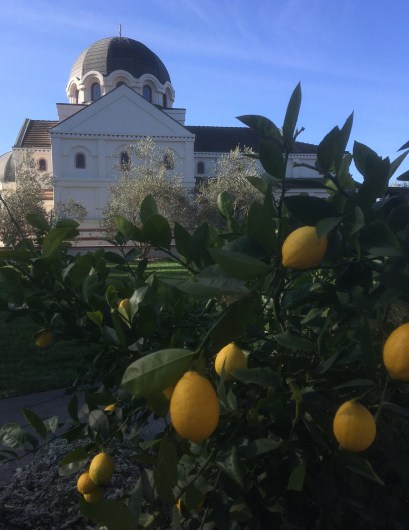
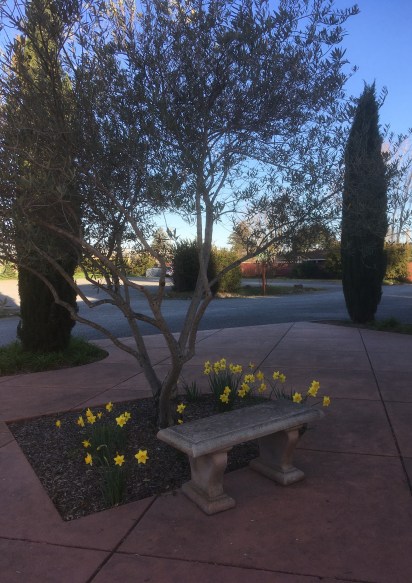
Today I lingered to straighten some of the new purple cloths on the icon stands. On Sunday a dozen of them had been quickly exchanged with the previous cloths of Pre-Lenten color — was it gold? — right in the middle of  Forgiveness Vespers, and a few were a little wonky. Then I went out and wandered in the church garden with my camera. I had already taken a couple of pictures on arrival, when the sun was barely up.
I went into the kitchen where Herman and Maria were just unloading their shopping bags of vegetables and clams and yummy things with which to make soup for tonight. We will have the first Presanctified Liturgy of Lent, and on Wednesday evenings we eat together afterward, a simple soup-salad-bread meal together, which people take turns cooking. I’m planning to prepare one of these midweek soups in April.

Before I could leave the parking lot I got a phone call from the painting contractor saying that they will finish this week, tomorrow and Friday. I had been prepared to wait much longer than that, but this seems perfect. One never knows what a day will bring — that is one way of describing the uncertainty, lack of routine, and waiting that has often been crazy-making in this last year.

But If I don’t have to wait here at the house, and I am physically able to take walks or go to church while I’m waiting, it’s not hard to be content. A thousand flowers decided that March 1st was a good day to bloom; there’s no denying that spring has sprung!

Born into everyone’s business.

Encounters with strangers often leave me feeling deeply connected at the fundamental level of our common humanity. People you don’t know, who may be needy themselves, or may help you in an emergency, or with whom you share a crisis, are often easier to feel close to than your dearest friend or your cousin you’ve loved since you were children. That is because you have nothing but your humanity to connect with. No offenses given or received have been stuffed into your baggage regarding that person.

Like the Indian woman I once sat next to, so very close to, on a plane from Mumbai to Frankfurt. She actually had been seated behind me when we first boarded, but before we were told to fasten our safety belts the man next to me, I guessed he was her son, traded places with her, perhaps so she could sit by a woman. I don’t know, but she and I liked each other, we could tell by our smiles, though we said not a word to each other during eight hours, not knowing the words.

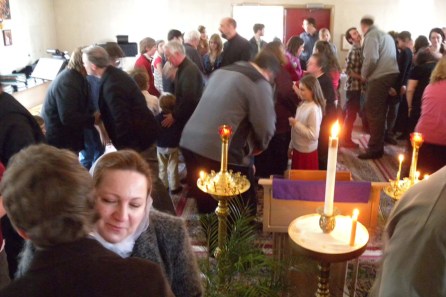
Today in the Orthodox Church we enter Great Lent with the Vespers of Forgiveness, when we also connect with many people we hardly know, on the ground of our fallen humanity. We admit with a bow and a kiss that we have sinned against them, whether we’ve ever spoken to them or have even seen them before. We exchange the words, “Please forgive me!” with each person in the service in turn, and each of us responds, “God forgives!”

Why? Because, as Elder Sophrony said, “Every sin, manifest or secret, committed by each one of us, affects the rest of the universe.”

I’m sure many of us find it difficult to comprehend, but going through this exercise every year will help us learn the truth in our hearts. Father Stephen Freeman helps, too, in passages like this:

The universe as an event of communion, a reality in which we literally participate, is quite foreign to the modern mind. The fiction of our radical individualism is an invention designed to promote the most irresponsible account of human freedom possible. It tells us that our lives “are our own,” and that we can act without consequences for anyone other than ourselves. “It is none of your business!” is the heart-cry of modernity. But this is simply not true.

We are born into everyone’s business and everyone’s business sets the stage and the very parameters of our existence. The language we speak, the thoughts we think, everything in our lives comes to us already burdened with the history and experience of the world around us. The saints treat this reality in the strongest possible sense. “My brother is my life,” St. Silouan says. By this, he does not mean simply that he cares strongly about his brother. He means it in its most literal sense. Not only is my own life not my own, but the life of the other is, in fact, my true life, or my true life certainly has no existence or reality apart from the life of the other.

Read the rest of the article: Why We Forgive

And if you are keeping Lent, I pray that through your efforts and God’s grace you and we all will grow in understanding of this life that we share. God bless you!

Seoul, Korea

*pictures found online

Hovering over the meadow.

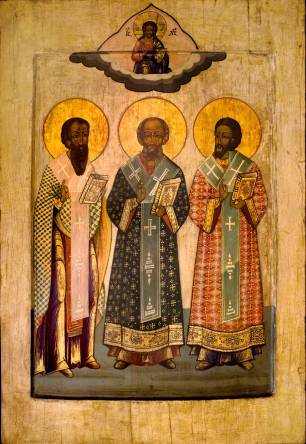
Our Orthodox commemoration of the Three Holy Hierarchs and Ecumenical Teachers was instituted as a result of 11th-century debates about which of them was the greatest. They themselves had to intervene by means of a vision given to St. John Bishop of Euchaita, who chose January 30 for their feast.
These three gifts to the Church are Basil the Great (330-379), Gregory the Theologian (329-389), and John Chrysostom (347-407). Each has his own feast day, but they are held in such esteem that it isn’t too much for us to remember them again together, they who in the words of a hymn, “have enlightened the world with the rays of their divine doctrines. They are sweetly-flowing rivers of wisdom filling all creation with springs of heavenly knowledge.”

A hymn of Matins on their feast day echoes a theme that runs through hagiography generally; it is the sweetness of true theology and and God’s Word imparted to us.

Like bees hovering over the meadow of scriptures,
You embraced the wonderful pollen of their flowers.
Together you have produced for all the faithful
The honey of your teachings for their complete delight.
Therefore as we each enjoy this,
We cry out with gladness:
Blessed ones, even after death,
Be advocates for us who praise you!

The electrician learns of his special day.

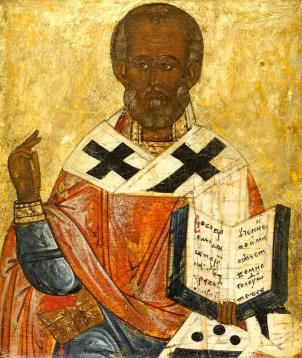
Today the cousins and brothers who are the electricians on my project brought a fourth young man who was introduced as Nico. After they had all been working upstairs and I had been cleaning downstairs all morning, I began to wonder if any of them knew that today was St. Nicholas Day.

Then it occurred to me that “Nico” is probably short for “Nicholas,” so I ran up and waited nearby while he finished installing a fixture in the new hallway, and asked him if he was named for St. Nicholas. He said Nicholas was indeed his “real name,” and I said, “Today is your day! It’s St. Nicholas Day.” He had no idea, poor boy. But now he knows; I told him St. Nicholas is probably praying for him today.

Until that little conversation I hadn’t thought of putting anything pertinent on my blog, but it made me want to take advantage of the calendar to honor St. Nicholas again. I am giving you (for the third time!) a quote from Fr. Thomas Hopko below, in my post re-published from last year. Those of you who have had enough of that might like to go instead to this blog post from on how the memory of St. Nicholas can help us resist the spirit of the age and the “talk about our having ‘the best Christmas ever!’ It is as if Christmas is a rush that brings us perfect happiness.” It is here: “Saint Nicholas and the Meaning of Christmas.”

St. Nicholas is one of the “favoritest” saints in the Orthodox Church. I have read about him many times and don’t usually remember much. I didn’t grow up hearing about him as the real historical not-Santa-Claus person that he is, or knowing that there was such a thing as St. Nicholas Day, and since I became Orthodox I haven’t succeeded in implanting him in my heart in any satisfying way.

But we both live by and in the love of Christ, so he must be in my heart in spite of my neglect. I will pass on to you (again) what blessed me some years ago, from The Winter Pascha:

“The extraordinary thing about the image of St. Nicholas in the Church is that he is not known for anything extraordinary. He was not a theologian and never wrote a word, yet he is famous in the memory of believers as a zealot for orthodoxy, allegedly accosting the heretic Arius at the first ecumenical council in Nicaea for denying the divinity of God’s son.

“He was not an ascetic and did no outstanding feats of fasting and vigils, yet he is praised for his possession of the “fruit of the Holy Spirit…love, joy, peace, patience, kindness, goodness, faithfulness, gentleness, self-control” (Gal. 5:22-23). He was not a mystic in our present meaning of the term but he lived daily with the Lord and was godly in all his words and deeds. He was not a prophet in the technical sense, yet he proclaimed the Word of God, exposed the sins of the wicked, defended the rights of the oppressed and afflicted, and battled against every form of injustice with supernatural compassion and mercy.

“In a word, he was a good pastor, father, and bishop to his flock, known especially for his love and care for the poor. Most simply put, he was a divinely good person.”

-Fr. Thomas Hopko