Today is the beginning of our salvation;
the revelation of the eternal Mystery!
The Son of God becomes the Son of the Virgin
as Gabriel announces the coming of Grace.
Together with him let us cry to the Theotokos:
“Rejoice, O Full of Grace, the Lord is with you!”

I had wanted to continue my ruminations on The Lily of the Field and the Bird of the Air by further considering The Moment that Søren Kierkegaard refers to when, after waiting in silence, “…the silent lily understands that now is the moment, and makes use of it.”
I don’t know what that moment consists of for you, for me, for us as a world community, or in our cities or church communities or families. No doubt there are overlapping times and seasons containing infinite instants, and only by quiet listening can we make any sense of them. But this passage in particular I wanted to pass on, in which the writer discusses what is missed when we fail to make the proper, standing-before-God kind of preparation:
“Even though it is pregnant with rich significance, the moment does not send forth any herald in advance to announce its arrival; it comes too swiftly for that; indeed, there is not a moment’s time beforehand…. But of course everything depends upon ‘the moment.’ And this is surely the misfortune in the lives of many, of far the greater part of humanity: that they never perceived ‘the moment,’ that in their lives the eternal and the temporal were exclusively separated.”
 So many thoughts swirl in my own noisy mind and heart that I could not imagine how I might find a way to share even these few gleanings with you. Then, in God’s providence and the church calendar, appeared someone who is the supreme example for us of being ready for the moment, that time in history and that time in her life, in a particular moment of a day, when the Angel Gabriel appeared to her. Today we remember that event, when Mary listened, and responded, “Behold, I am the handmaid of the Lord; let it be to me according to your word.”
The Word became flesh and came to live with us, taking on all our human experience, its weakness and suffering and death. He defeated death, and opened the gates of Paradise. The Incarnation, the beginning of our salvation, is The Moment of history; our own “Yes” to God, echoing Mary’s willingness, can be the essence of our every prayer as well, as we wait on Him.
Kierkegaard exhorts us, in words that seem especially fitting for this time of uncertainty and change: “Would that in the silence you might forget yourself, forget what you yourself are called, your own name, the famous name, the lowly name, the insignificant name, in order in silence to pray to God, ‘Hallowed be your name!’ Would that in silence you might forget yourself, your plans, the great, all-encompassing plans, or the limited plans concerning your life and its future, in order in silence to pray to God, ‘Your kingdom come!’ Would that you might in silence forget your will, your willfulness, in order in silence to pray to God, ‘Your will be done.'”
We know that God’s will for us is good, now as ever. Our inability to see or understand that is due to our weakness or sin, or His hiding of His works. May He give us grace to wait and to pray, and eventually we will see the full salvation of the LORD.
Oh, the depth of the riches and wisdom and knowledge of God!
How unsearchable are his judgments and how inscrutable his ways!
For who has known the mind of the Lord,
or who has been his counselor?
Or who has given a gift to him that he might be repaid?
For from him and through him and to him are all things.
To him be glory forever. Amen.
Romans 11

 I didn’t know the name for it at the time, but one morning last week I experienced an acute and painful case of Cognitive Overload. It was the day I had been looking forward to for two months, when I would drive up to Pippin’s; the day before that I’d started packing my car with the books and food and even a 50-ft garden hose I was going to take to the family there in far-Northern California.
 “Jonathan Rauch reminded him of the inability of any one human being to bear the cognitive load of decision making that we are called upon to do every day… there is a necessity to offload some of this responsibility to a reliable and healthy community. Each of us individually can’t know what we need to know about every issue; that means we have to trust other people to help guide us and inform us. We just don’t have the cognitive energy to be able to do this…. that triage is impossible for any of us to do on our own. Don’t listen to the people who tell you to think for yourself. It’s not possible to think for yourself… we are always embedded both socially and temporally… That can work for us, if we see to it that we are properly and helpfully embedded.”
 “We are human beings, made of flesh and bones. Flesh and bones can become Chalices of God’s presence in the world, but they can also become ill. As a Christian, my duty is to comfort and to love, to keep myself and my neighbour from harm.”
 ade institution, but the Harbour of Life that is Christ’s Body. We are fed the food not of men but of angels; we are inspired by the truth, not of this world, but of God Himself; and we are ruled, not by worldly fear which grows and begets more fear, but by the peace of Christ which surpasseth all understanding (Philippians 4.7) and brings unfailing comfort, whether in times of peace or peril. In the present moment, therefore, I urge you to be not afraid (Isaiah 43.1) nor let the concerns of the moment shake you from the firm foundation that is unhindered faith in the living God, Who heals the sick and restores the broken-hearted. The present situation may be a cause of great upset in the world around us, but in the Church, and in our Christian lives, we continue unhindered and undeterred in all that God has delivered into our hands for the salvation of our souls.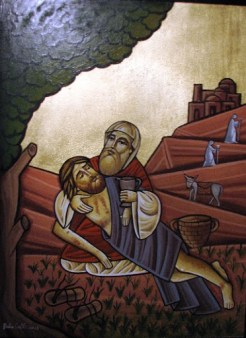
 Mysteries might bring or be the source of sickness or ill-health: by no means! The Mysteries of Christ are the true medicine of our souls and bodies, and bring nothing but life—and life eternal. Any whose hearts are troubled by present matters should pray fervently for an increase of faith so that fear can be cast aside; and the Church will continue her ancient witness to the love that is beyond fear, bringing the Holy Mysteries to the world, and to each of us, in a time when it needs them profoundly. Do not be afraid! As we sing so frequently in these Lenten days, God is with us! And He is merciful and loving, quick to hear and heal and save.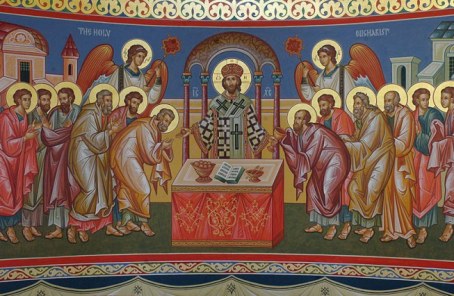
 Long ago in Fantasyland, I thought my remodeling project might be done before Lent 2019. And again this year I thought so, but I had less hope than last year. 🙂
 But I do have the loveliest bed, plenty of food to eat, and I have a bathroom. My wonderful house has windows through which sun often shines. I have hope of my affliction coming to an end. Millions of people in the world would love to experience my problem. Besides, God knows what I need, doesn’t He? He does. The last fifteen months have not gone the way I expected, but I can’t help but see, even with my bad spiritual eyesight, much good coming out of “everything,” and I’m not talking about my closet makeover.
 The providence of God was crystal clear this week, when it’s the first week of Lent, and precisely for the first three days of this special week my project stalled; it wasn’t the first occasion when I could appreciate the timeliness of delay. Unlike most truly homeless people I have a car and could drive to church! I love to attend Matins and other services that are at 8:00 a.m. during Lent, and it’s not difficult during this season of my life when I can’t sleep past 5 or 6. And as often happens, when we have said the last “Amen,” I’m not eager to leave.