Category Archives: current events

Truth in a story of plague.

Only a few days ago I read, hastily as it turns out, a post on Fraise that got my attention because of what Mags wrote about Albert Camus:

Sartre accused Camus of expelling Christ from the front door of the house, only to let him in at the back. I think this sums up Camus’ respect for people of faith. But then Camus just respects all people, all the time, with all love and compassion. He certainly captures all the stages of illness and its accompanying fear that we’re experiencing now.

I don’t think I’d read any Camus since college, and maybe all I’d read was in high school French class, in French, which would mean I’d understood little at any level. But this made me want to read Camus for real. I continued in her post to read about Cyrano, and until this morning forgot that she was mentioning Camus because she had recently re-read his novel The Plague (La Peste – she read it in French.) Mostly what I retained was the phrase “love and compassion.”

Soon afterward I saw on Rod Dreher’s blog that he is hosting a sort of book club to read The Plague! So naturally I hopped on. I’ve been listening to the audio version while I wait for a used paperback to arrive. Dreher hopes to complete his website discussion within two weeks, so I may have to read everyone’s comments on his page later. I know I won’t go that fast. I have to work this book into my other Lenten reading, which is an unusual compendium this year!
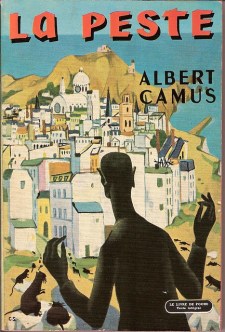
I ran into my dear homeschooling friend Debbie in the store and told her I was starting The Plague; she laughed her delightful laugh and said, “Oh, Gretchen, you are reading that right now??”

Well, why not get some perspective on the current news? It has been very thought-provoking already, not far into the story, to compare the world today to that in which the story’s characters live and move. Camus in the first pages uses the word “modern” several times in describing them, and makes me curious to see how their story develops, and how their response to their epidemic might compare to that of us who are called “post-modern.”

One of the things that occurred to me immediately is something very much from the surface of the story, that our current “plague” is much nicer than the one whose graphically described, horrific symptoms spread through the town of Oran. I was a little worried about listening too close to bedtime, to the account of the rats coming into the streets to die their bloody deaths.

Please comment, if any of you have thought about this novel or have read it recently. (If you  have, you probably want to visit Dreher’s blog to see what goes on there.) I already noticed a few lines that I’d like to muse on when I have the print copy and can look longer at them. But until then, here is an idea I’ve thought about for a long time, but didn’t remember that the quote was from Albert Camus:

“Fiction is the lie through which we tell the truth.”

Fire, smoke and ashes.

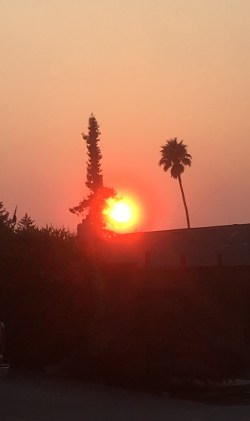
That wonky redwood is the “Dr Suess Tree” as we call it, on the other side of my backyard fence, that towers above my garden from my neighbor’s place. I took the picture from down the street, quickly before the sun set.

We are seeing the setting sun through smoke. It’s been like this since last Thursday, when shortly after wildfires began to destroy the town of Paradise in Butte County, ashes and cinders from that destruction floated three hundred miles to the south, here and beyond here, at least to San Jose. Students and teachers in our schools are on the fifth day of their weekend, what with Veteran’s Day and smoke days.

It’s gloomy. My friend Myriah may have lost her house, though she was mercifully stuck in Texas when the chaos began. Or, her house might still stand, one of the few that weren’t destroyed by the blazes. The prospect of being a householder on an outpost in the middle of a burned-out town, “in the middle of an ash heap,” as Myriah puts it, is bleak. Whatever the condition of her house, her home is gone.

Lately in Liturgy the litany has included prayers for those suffering as a result of shootings, and this week “fires” was added to the phrase, along with the extra remembrance of soldiers slain in wars. Our parish was also commemorating the repose of a beloved priest, and we met at the cemetery Sunday afternoon for a prayer service in his memory. Several parishioners wore masks against the bad air.

It was a sweet gathering and memorial, for a man who was in many ways the heart of our parish — and still is. After the prayers and hymns and aromatic censing of the graves, we sang “Memory Eternal,” and the service ended. A little table had been set up on the grass next to the grave, with a candle and a icon on it, and our priest poured the melted wax from the candle on to the grave marker in the shape of a cross. Then he emptied the charcoal from his censer and remaining bits of incense on top of that.

A couple of the children crouched down to ask what he was doing, and I didn’t hear his answer, but I did hear him say, “I need to you blow on that, gently.” He wanted the incense to go on smoking for a while, so the kids got to provide the supporting wind.

A lawsuit has been filed against the utility company that supplies electricity to Butte County, claiming negligence on their part; it may have been sparks from their wires that started the fires. They had previously talked about the possibility of shutting off power to several counties because of extreme fire danger, and wanting to avoid all possibility of sparks or downed power lines instigating a disaster. I can see how they would at the same time like to avoid depriving their customers of what is a means of life support for many, especially in that mountain community where many retired people are now missing the comfort of winter coats that are turned to ashes.

I have no thesis around which to organize my ramblings, only sightings and impressions and feelings. Myriah is collecting clothing and supplies that match the actual needs of specific people in her hometown, and she will stop by here to get a few things on her way there. That is the most concrete and encouraging thing I have to write today; as was the case last year when the inferno was right here, the stories of sacrifice and true community are heartening.

One friend at church wrote on a chalkboard by his front door, “The love in the air is thicker than the smoke, and depression is a close second.”

The cows are back.

Housekeeper Kareena went out to do the grocery shopping yesterday morning and came back empty-handed. The shops and produce stands were all shut up. It was the latest development in the strife between the Dalits and the Hindu Nationalists.

I can’t really say more than that without revealing my ignorance and no doubt also over-simplifying one of the many complex and interrelated issues troubling this country with so many cultures, languages, and religions clashing and blending and layering over the centuries. I know little about it but now I am living in it for a time. It feels like a lot of excitement for only my first week.

The photo above shows some Dalit demonstrators in our neighborhood, the only thing happening in the emptied streets. Tom took this one, and it is blurry because he didn’t want to get too close to the action.

He and I had been planning to buy lunch out before going to visit Baby Boy and his mom, but all of the  eateries were closed, too, so we ate some leftovers from last week, and then walked back to the hospital.

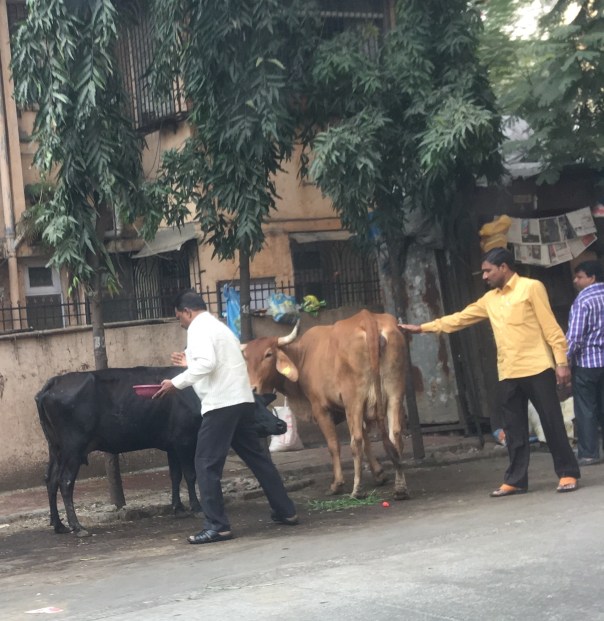
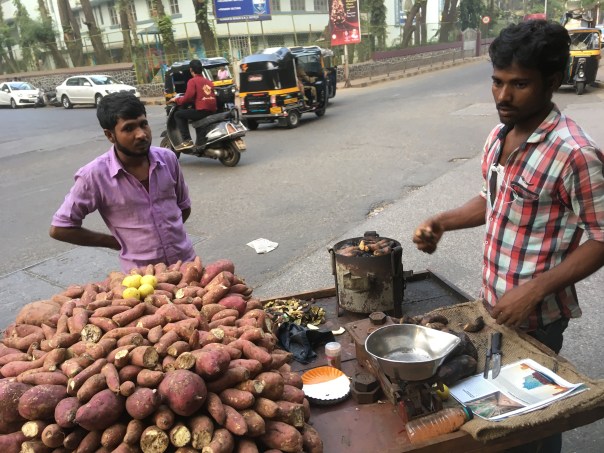
I had become familiar with this intersection from our trips to the hospital over the last couple of days. The same man was constant in roasting sweet potatoes on the corner near our apartment building, and at the side of the road across the street from the hospital, several cows always stood with their keepers in two groups, three cows and two cows.

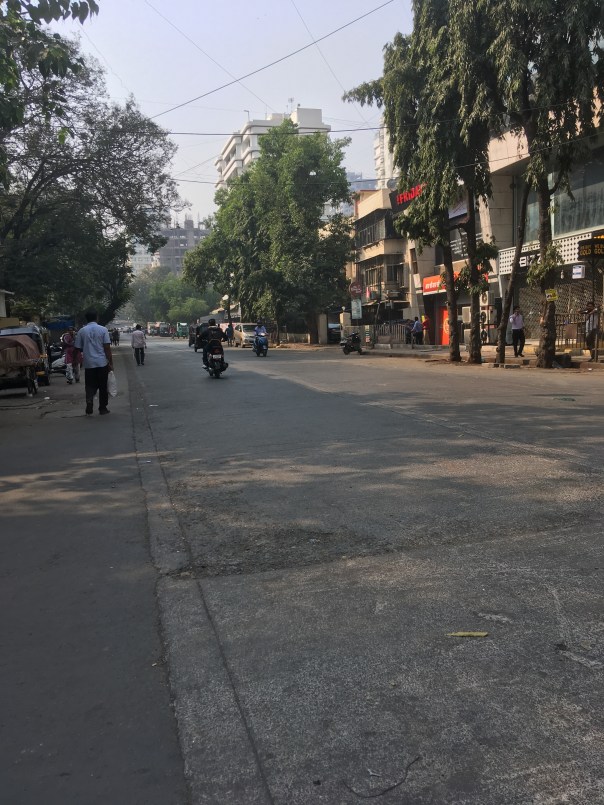
But the sweet potato roaster was not to be seen, and even the cows were gone. Rickshaw drivers slept in their vehicles, shopkeepers slept outside their shops, and for the first time I had to walk around a man sleeping on the sidewalk. The street in the picture below is normally filled with hundreds of cars, rickshaws and pedestrians all flowing around each other in close and chaotic streams.

By the end of the day someone in power had met for talks with the police, and the Dalits called off further protests. I have been too busy holding a baby to read much about the situation (This is the article I am starting with), but we were all glad that last night the shops had opened again, and this morning the shopping got done and we now have spinach paneer and chicken tikka masala in the house, with fresh chapatis. The cows are back in their place.

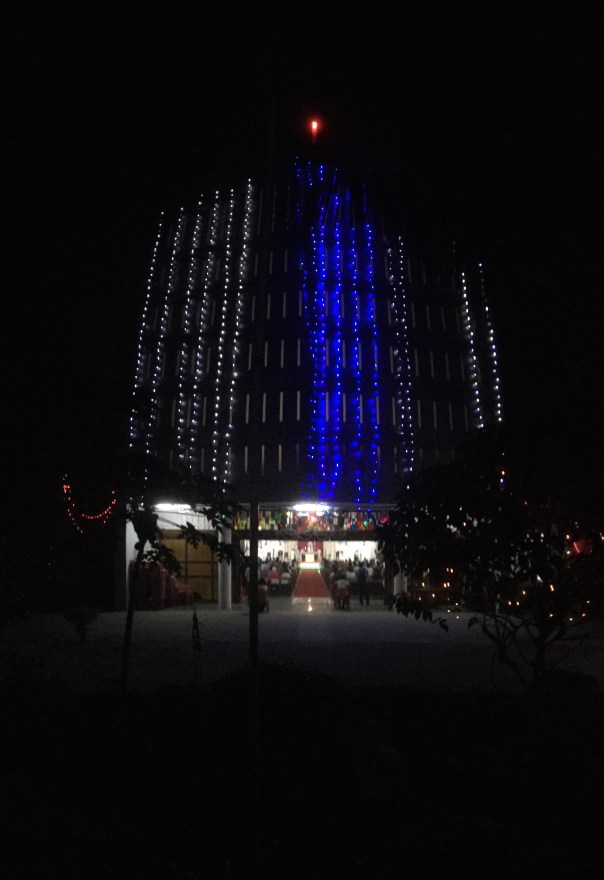
On our walk home from the hospital after dark, the neighborhood church was in the middle of serving food to the poor. Its Light and its lights had not stopped shining for even one day.

ST church lights