Category Archives: death

To spit on a corpse.

“There is a cruelty that lurks in the human heart: to speak ill of the dead. They lie silent, their mouths shut by the grave, unable to repent, unable to defend themselves. And yet our tongue, restless and unbridled, digs into the soil to unearth their sins. Scripture cuts us off: ‘Do not speak ill of one who has died, for we are all to be numbered among the dead’ (Sirach 8:7). To spit on a corpse is to spit on your own grave.”

-Father Charbel Abernethy, “Do Not Speak Ill of the Dead.” 

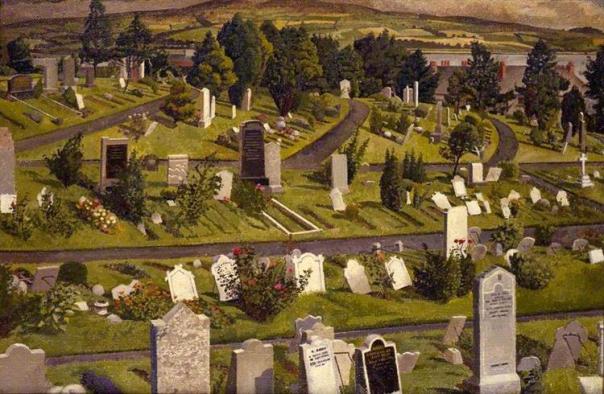
Stanley Spencer, Port Glascow Cemetery

They are not two worlds.

“In the traditional theology of the Eastern Church this world and the ‘next’ are not two worlds. We use the language of place (heaven and earth) for lack of language not for accuracy. There is more to the created order than we see (‘all things visible and invisible’). But that which is not seen is not inherently separate from that which is. Sacrament (mystery in the East) is a way of describing the relationship between what is seen and what is unseen. Everything is sacrament, icon and symbol.”

-Fr. Stephen Freeman in “A Secular Death”

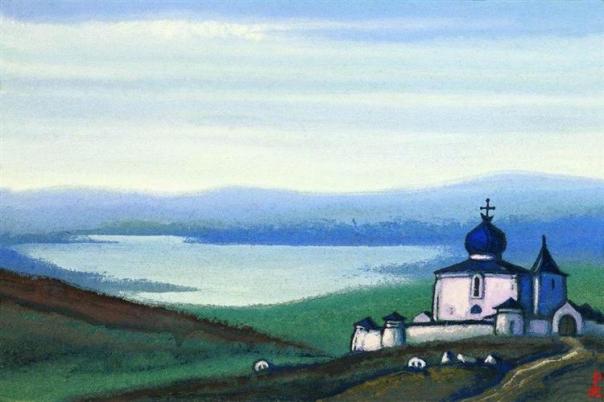
Nicholas Roerich, Novgorod Cemetery

What Athanasius knew.

Psalm 58:8

Thou tellest my wanderings:
put thou my tears into thy bottle:
are they not in thy book?

The more one researches current events, historical accounts, and the tangled web of cultures and civilizations going back to the foundation of the world, the more likely is a fall into worry and even despair. We fear especially for children who have to grow up in a violent era, as many have done. That’s why I take courage from the life of St. Athanasius, and pray that my children, grandchildren, godchildren, and all of us, might learn deep in our souls what he knew. The following is an excerpt from a post I wrote several years ago in a time of sorrow. I have shared the quote from his treatise more recently than that, but I hope you might agree with me that it’s worth rereading:

I learned in the short account of the life of Athanasius at the beginning of his On the Incarnation, that the last and worst persecution of Christians ended in Egypt in 311 A.D., when Athanasius was about fourteen. From the age of five he had lived with the constant threat of death, and with the ever-present reality of persecution of his friends and family. The behavior of the ungodly is irrational and inhuman, and tends to cause great pain and suffering, often unto death, not only of the innocent but also of the most Christ-like. As an adult the scenes and events of his childhood seem to be fresh in his mind when he writes:

“A very strong proof of this destruction of death and its conquest by the cross is supplied by the present fact, namely this. All the disciples of Christ despise death; they take the offensive against it and instead of fearing it, by the sign of the cross and by faith in Christ trample on it as on something dead. Before the divine sojourn of the Saviour, even the holiest of men were afraid of death, and mourned the dead as those who perish. But now that the Saviour has raised his body, death is no longer terrible, but all those who believe in Christ tread it underfoot as nothing, knowing full well that when they die they do not perish, but live indeed, and become incorruptible through the resurrection. But that devil who of old wickedly exulted in death, now that the pains of death are loosed, he alone it is who remains truly dead.”

Thessaloniki – Rubble at Church of the Acheiropoietos

The face was seeing things.

A few years ago I posted a poem by Clive James, the title poem “Sentenced to Life,” from the collection written after he became ill, and he began to consider his life from the perspective of a dying man. When I opened that book again recently I immediately was taken by another reflective poem with similar themes.

Reportedly James maintained confidence to the end that there is no afterlife, but I suspect he was cured of that delusion as he was crossing over. He did realize and admit publicly that he had been a “bad husband” (by long infidelity) and he regretted it. In his poems he compares his years of strength, the exciting years of his life, with the last decade when he was facing death, and he judges the recent, shorter season to be the time during which he was restored to sanity by facing the truth about himself.

LANDFALL

Hard to believe, now, that I once was free
From pills in heaps, blood tests, X-rays and scans.
No pipes or tubes. At perfect liberty,
I stained my diary with travel plans.

The ticket paid for at the other end,
I packed a hold-all and went anywhere
They asked me. One on whom you could depend
To show up, I would cross the world by air

And come down neatly in some crowded hall.
I stood for a full hour to give my spiel.
Here, I might talk back to a nuisance call,
And that’s my flight of eloquence. Unreal:

But those years in the clear, how real were they,
When all the sirens in the signing queue
Who clutched their hearts at what I had to say
Were just dreams, even when the dream came true?

I called it health but never stopped to think
It might have been a kind of weightlessness,
That footloose feeling always on the brink
Of breakdown: the false freedom of excess.

Rarely at home in those days, I’m home now,
Where few will look at me with shining eyes.
Perhaps none ever did, and that was how
The fantasy of young strength that now dies

Expressed itself. The face that smiled at mine
Out of the looking glass was seeing things.
Today I am restored by my decline
And by the harsh awakening it brings.

I was born weak and always have been weak.
I came home and was taken into care.
A cot-case, but at long last I can speak:
I am here now, who was hardly even there.

-Clive James