Malcolm Guite alerted me to the fact that this is the date that the Church of England remembers George Herbert. (As I write, that day has passed for many of you.) He posted his sonnet for the occasion, but I am re-posting from a few years back a poem from Herbert himself. Once my late husband gave me a collection of Herbert’s poetry, and it just occurs to me that I might add that to my stack of Lenten reading, to fill out the poetry genre of the group.
Someone has said that to fast, in the Christian tradition, is to feast with the angels. I think that must be something like the feast Herbert is referring to here:
This very meditative homily on the words of St. Paul, when he wrote about faith, hope and love, I found to be truly rich and encouraging. Father Patrick Reardon points out in his sermon the strange reductions of St. Paul’s teachings that came from various Christians writing many centuries after the apostle’s letters were circulating among the churches.
In fact, it can only be theoretical to separate love from hope and faith, as St. Paul does in I Corinthians 13, for the purpose of making clear that love is preeminent; true love is not manifested without faith and hope. We also learn in this Bible lesson of another fruit of the Spirit that makes up a second triad of virtues, further fleshing out the reality of what it means to live in love. The interrelated meanings of the several words and their contexts lift one’s mind right up to the throne of God where the Three Persons live eternally in Love, a Love in which we are invited to partake.
If you are interested in further contemplation about this Love that originates in the Holy Trinity, and how it contrasts with Faust, or is described by Dante, you will want to listen to the 16-minute talk on the Ancient Faith site here: “The Supremacy of Love,” or by means of the direct MP3 file linked at top.
Saturday being the day of Sabbath rest, we Orthodox often have memorial services this day, and pray for those who rest in death, waiting for the Resurrection. For that reason I thought to share these words spoken at a funeral earlier this year. But also, my parish has seen two of our community fall asleep in death this month, and we are feeling the sorrow right now. Read on to hear what the rabbis say:
“If you have a heavy heart and are grieving, that is OK. We weep for those we love and who have loved us. One hears from time to time: ‘Oh, you should not cry. He is in a better place.’ But Christ God Himself wept at the death of his friend Lazarus. And the rabbis say that God weeps at the death of every human being. So, don’t be afraid to weep.
“You can also hear it said among some Christian groups: ‘Oh, that is not Father Anthony. He is with the Lord! That is just a shell.’ I ask you then who is that there in our midst?! You see, to be a human being is to be a soul enfleshed, that is, a soul wrapped in a physical body. Angels do not have bodies.
“The tragedy of death is that the union of soul and body is torn asunder! That is why Christ died a real human death, and rose from the dead as a real human person, his body and spirit united again. Fr. Anthony’s body is as much Fr. Anthony as is his soul which awaits the last day when it will receive a new body.”
-Archbishop Benjamin at the funeral of Father Anthony Karbo, March 2024
“Have you ever heard of kintsugi? Literally ‘golden joinery,’ kintsugi is ‘the Japanese art of repairing broken pottery by mending the areas of breakage with urushi lacquer dusted or mixed with powdered gold, silver, or platinum … As a philosophy, it treats breakage and repair as part of the history of an object, rather than something to disguise’ (Thanks, Wikipedia!). I won’t presume to discuss the Japanese philosophies related to this art. But there are certainly deeply Christian parallels to be drawn. Three come immediately to mind.
“First are those who valiantly and humbly endure life’s inequities or unjust persecution, such as Job, Patriarch Joseph, Jeremiah, and the beggar Lazarus. Crushed in various ways through no fault of their own, these saints became beautiful not despite the cracks, but because of how they dealt with them. Without such trials, these saints would never have become as great as they are.
“Second are those who sinned greatly but repented deeply, such as King David, Peter, and Paul. Their great sins are there for all to see and the sins remain sinful. Yet, Christ healed their fractured souls with the gold of their repentance and faithfulness.
“Then there is Christ Himself. He didn’t just valiantly and humbly endure unjust persecution: He came to earth for that very purpose – for OUR sake. So, His wounded side and hands remain in eternity as visible signs of the beauty of His victorious self-sacrificial love.
“So, let’s take heart. Are we innocently enduring persecution? Christ can make us beautiful through our trials. Have we fallen into serious sin? We can repent and still become great saints. We can even go past these things to suffer freely for love of Christ and His people. Thus, we shall most deeply resemble Him Whose greatest glory is that He was freely broken for our sake.”


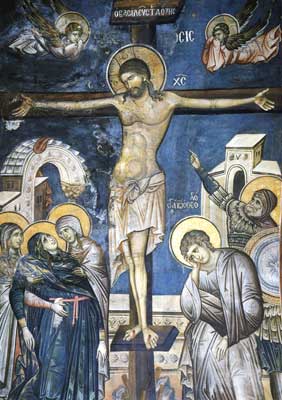 But Christ God Himself wept at the death of his friend Lazarus. And the rabbis say that God weeps at the death of every human being. So, don’t be afraid to weep.

 Gladsome Lights