Category Archives: love

On the Beach at Fontana

ON THE BEACH AT FONTANA

Wind whines and whines the shingle,
The crazy pierstakes groan;
A senile sea numbers each single
Slimesilvered stone.

From whining wind and colder
Grey sea I wrap him warm
And touch his trembling fineboned shoulder
And boyish arm.

Around us fear, descending
Darkness of fear above
And in my heart how deep unending
Ache of love!

-James Joyce

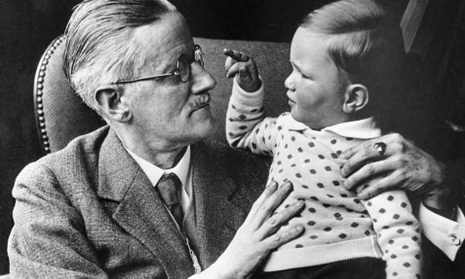
James Joyce and his grandson

Why did the maid weep?

BEHOLD, THE GRAVE OF A WICKED MAN

Behold, the grave of a wicked man,
And near it, a stern spirit.
There came a drooping maid with violets,
But the spirit grasped her arm.
“No flowers for him,” he said.
The maid wept:
“Ah, I loved him.”
But the spirit, grim and frowning:
“No flowers for him.”

Now, this is it —
If the spirit was just,
Why did the maid weep?

-Stephen Crane


Monasteries are not places of refuge.

“The world thinks that when someone becomes a monk in a monastery, he leaves society and becomes wild. They say this because they are unaware that monks are the most sociable of human beings. You should know that no one can become a monk if he is not sociable, that is, if he cannot communicate and deal openly and directly with all the difficulties encountered in a life shared with others. If a man has had difficulties in marrying or establishing a family, chances are he won’t be a good monk. He must feel secure in his life. Monasteries are not places of refuge. Consequently, a monk is someone who may have formerly attained success in such relationships, and loved them, too, and thus he doesn’t reject them, he doesn’t condemn them, he doesn’t despise them, but rather prefers something superior for himself.”

-Elder Aimilianos of Simonopetra, in The Church at Prayer: The Mystical Liturgy of the Heart 

What Goes On.

WHAT GOES ON

After the affair and the moving out,
after the destructive revivifying passion,
we watched her life quiet

into a new one, her lover more and more
on its periphery. She spent many nights
alone, happy for the narcosis
of the television. When she got cancer
she kept it to herself until she couldn’t
keep it from anyone. The chemo debilitated
and saved her, and one day

her husband asked her to come back —
his wife, who after all had only fallen
in love as anyone might
who hadn’t been in love in a while —
and he held her, so different now,
so thin, her hair just partially
grown back. He held her like a new woman

and what she felt
felt almost as good as love had,
and each of them called it love
because precision didn’t matter anymore.
And we who’d been part of it,
often rejoicing with one
and consoling the other,

we who had seen her truly alive
and then merely alive,
what could we do but revise
our phone book, our hearts,
offer a little toast to what goes on.

-Stephen Dunn