Category Archives: other gardens

We bloom and drink, and wait.

In Wisconsin my daughter Pearl has been tending a large house and garden for about eight years. She’s much more artistic and organized than I, about all of the design and execution of beautiful spaces indoors and out. She does all the work herself, even to the point of laying bricks to create a quiet and somewhat hidden corner to sit in, with morning sun and afternoon shade. It’s a wonderful spot winter or summer, and I enjoyed it with Pearl on one of my visits. This time, she had little time for sitting, what with being the wedding planner for Maggie. While she was bustling about, on my first morning after arriving late at night, I made the rounds to see all the flowers that are still blooming everywhere.
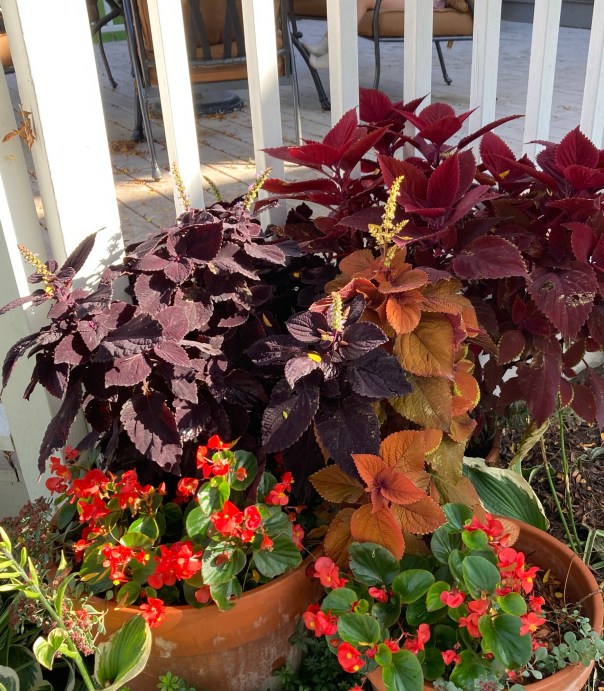
Her hydrangeas are gigantic — and I saw others in the area that are just as impressive. Along the side of her driveway, and in big pots, a multitude of plants all grow thickly and complement each other;  she doesn’t know the names of them all. She showed Izzy and me this Blackberry Lily, iris domestica, displaying its seeds something different!

At the airbnb where some of the wedding party stayed, closer to the venue, I sat on a wide porch where giant trees shaded the lawn and tire swing. Pearl’s house has similar ones, though maybe not as tall, that charm me at any time of year.

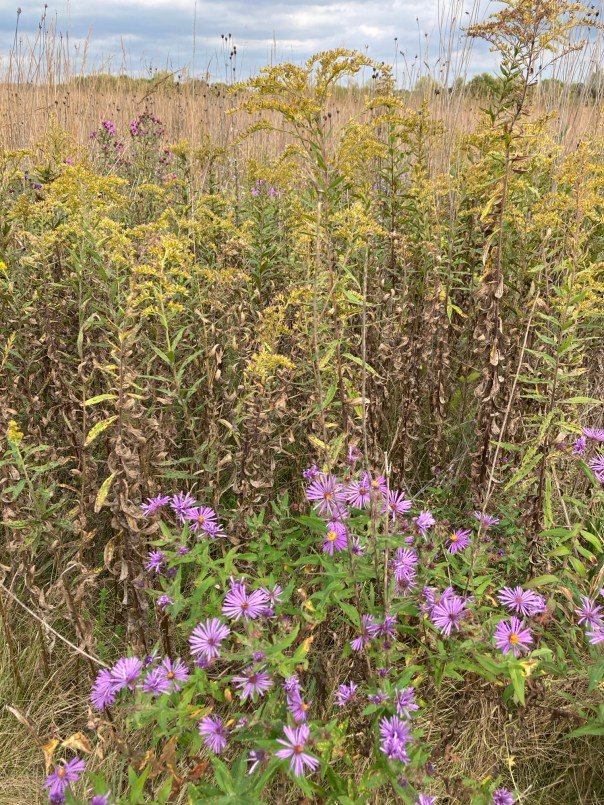
One day Roger and Izzy, Lora, Pearl and I went to a nature preserve in the middle of wide fields that are being restored to wildness from agricultural land. The asters provided the brightest splashes of color in the midst of the various drying grasses and seed heads, and bees were all over the several species of them.

Most of the Gray-headed Coneflowers (Ratibida pinnata) had faded to simply gray heads, but this one was still going strong:

Hairy White Oldfield Aster

The temperature had dropped some, rain was coming in. Everything was delicious.
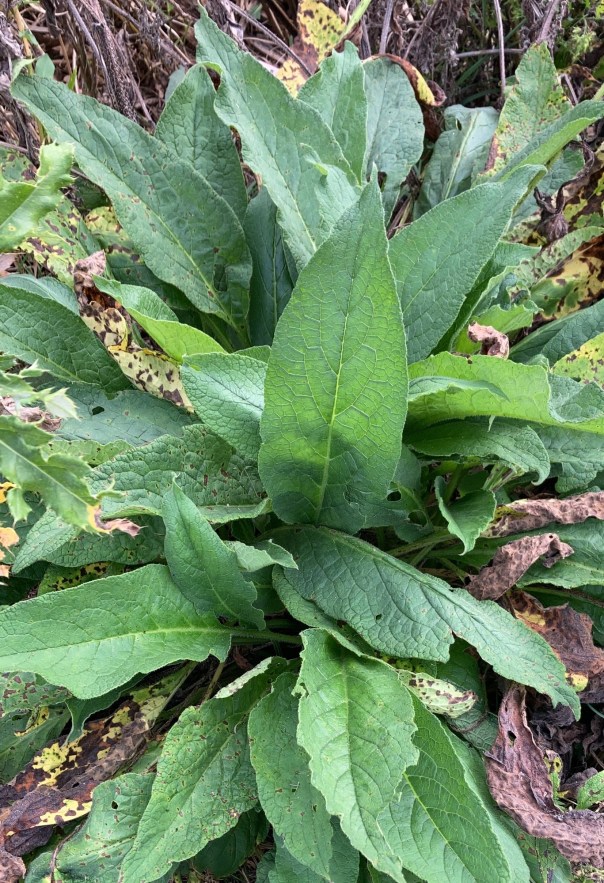
Common Comfrey

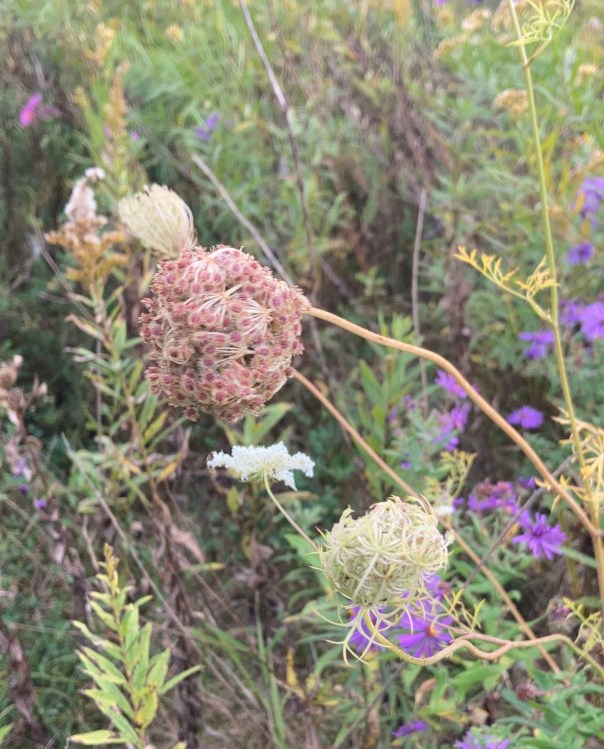
Wild carrot seed heads, here and above.

That encounter with native plants of Wisconsin pretty much filled my Nature cup. When I came home, just as at Pearl’s, this first morning I wandered around and around again to see how my own garden had fared in my absence. In spite of all the unfinished projects waiting for me, I felt warmly welcomed. It’s been a little rainy, and cloudy. For some reason my furnace is not turning on, so I gave in and just opened the door to the coolness, and put on a flannel shirt.
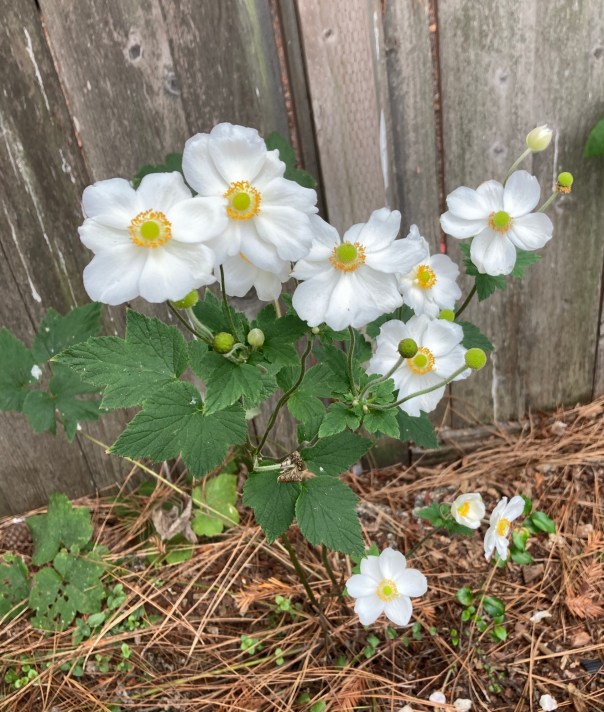
I guess the Japanese anemones heard me saying that I plan to move them to a different spot, and they are putting on a display five times bigger than ever in their ten years of life. I’ll have to reconsider… If nothing else, I will at least wait until they finish blooming before I move them. Other things blooming now are bulbine….

The salvia is producing more blooms since I rather tardily trimmed the old ones.

And always, always, the pomegranate bushes are blooming, from spring until frost! Rosemary is flowering right now, too.

I’m finding it quieting to my spirit to be among the plants as they adjust to the changes of fall. I thought the urgency and too-muchness I was feeling leading up to my time away would be waiting for me when I got home, but it seems not.

This humble native succulent is quietly waiting, not demanding more than a few drops of water from time to time. It appreciates a little shade. When I bought it, there was a sign nearby saying it was not ready for transplanting yet. So it was just the plant for me. We will be ready when we’re ready!

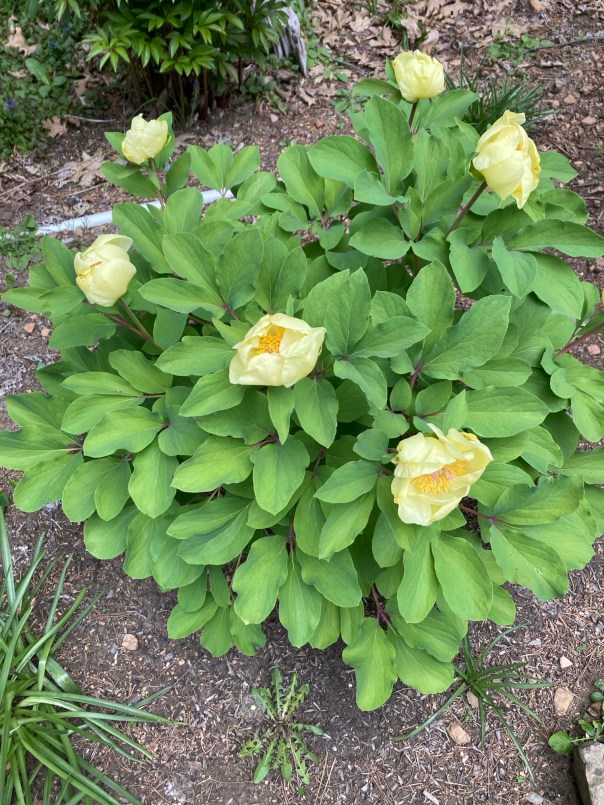
Flowers wild or exotic.

mystery plant

Pippin drove the younger children and me to the same botanical garden we visited two years ago, but several weeks earlier in the spring. Before looking at the plants in the garden itself, we briefly explored an area of the larger park down by the Sacramento River, which is roaring through its narrow channel in the town of Dunsmuir.

On trees growing at the river’s edge, Ivy found dozens of exoskeletons that Seek tells us are of the California Giant Stonefly. They were certainly the giantest fly of any kind I’ve ever seen. Pippin thinks the flies exited these skins last year, because it’s too early in this spring for it to have happened recently.

California Giant Stonefly

We saw poison oak and regular oak, and several wildflowers along the riverside path, including annual honesty, which is in the mustard family. And nearby, last year’s seed pod, now a faded moon.

Lunaria annua – Annual Honesty

Up the hill, rhododendrons!

Blaney’s Blue Rhododendron

Dogwoods layered with Japanese maples and rhododendrons make a beautiful scene.

The big lawn around which the garden is arranged is a setting for recreational events, and there were lots of poles and wires and big boxes of electrical equipment that interfered with our photography, but not with our appreciation of the display of plants, which included various other shrubs native to the Far East, like this Japanese Andromeda (Pieris japonica):

Japanese Andromeda

The other favorite exotic was the Dove Tree, or Handkerchief Tree (Davidia involucrata), native to China:

Behind the dogwoods and smaller trees, tall conifers form a backdrop.

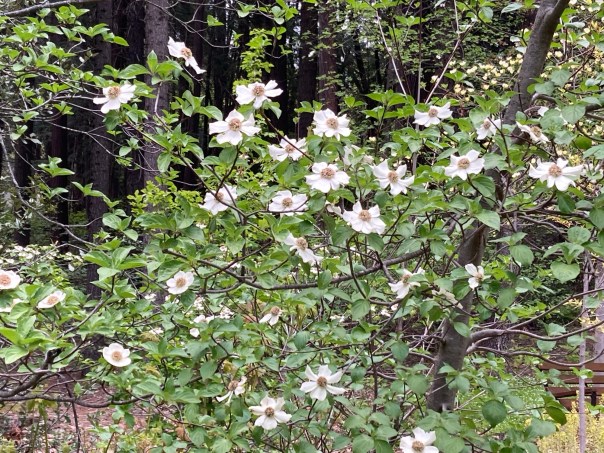
Dogwood

If there had not been a chill breeze blowing up from the river, I might have plopped myself down on that lawn to gaze at dogwood trees for a half hour. I forget about their existence for years at a time, and then am blown away all over again by their beauty. There are at least eight species of dogwoods to enjoy there. From the garden’s website:

Cornus nuttallii, Mountain or Pacific Dogwood, is the emblematic tree of the City of Dunsmuir and the Dunsmuir Botanical Gardens. They are native to the Gardens and the surrounding area. What appear to be flower petals are actually bracts – petal-like modified leaves. The (mostly) inconspicuous true flowers are ringed by four to eight of the showy, white bracts. In fall as the flower ovaries develop and set buds, they turn a bright yellow with red seeds.

Mountain Dogwood

At last, we did have to leave.
And I will say good-bye for now
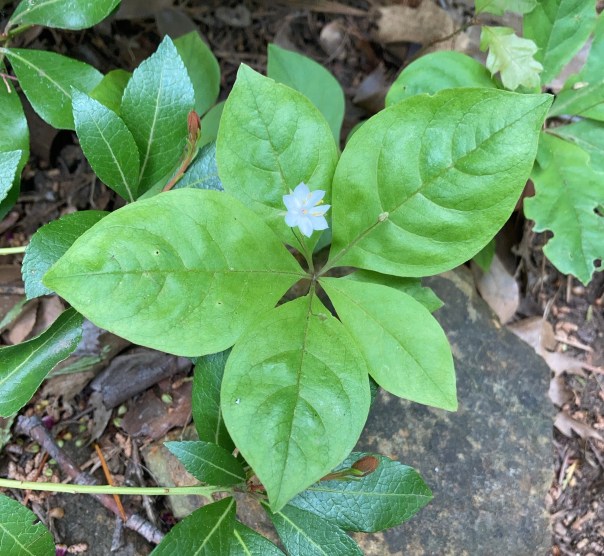
with the simple Western Starflower:

Western Starflower

I’m enchanted by amaranth.

The morning that I was walking home while looking at the clouds, I took a slight detour to see what was going on at my favorite neighborhood gardener’s front yard. I met her briefly once when I was standing gawking, and learned that she grows nursery stock to sell to local stores. She obviously loves to plant all kinds of things for her own enjoyment as well, such as these poppies I wrote about one May; but last week my focus was on the gorgeous amaranth and its relatives.

I believe these are types of Quail Grass, Celosia argentea, which is in the amaranth family. I read that in some places, especially parts of Africa, it is “cultivated as a nutritious leafy green vegetable.” In Nigeria it is known as “soko yokoto,” meaning that it will “make husbands fat and happy.”

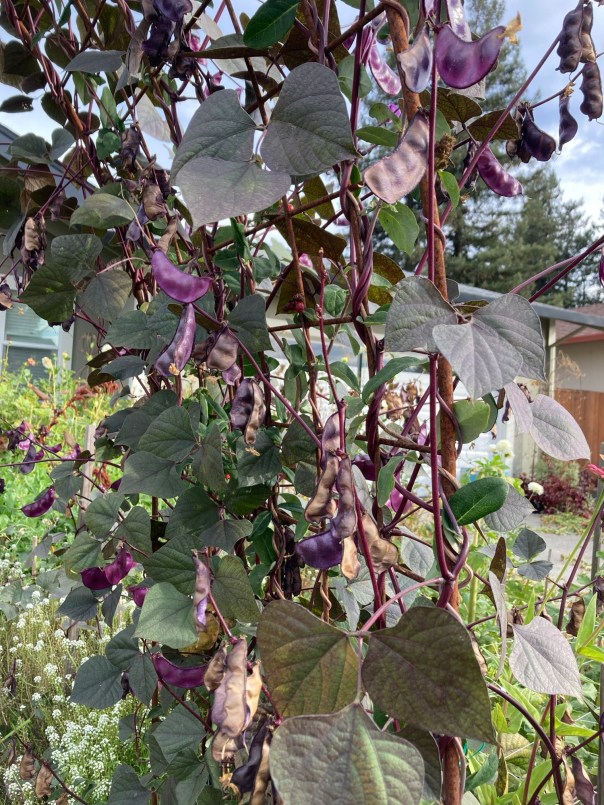
This garden also was lush with perfect dahlias, cosmos blooming extravagantly, and Hyacinth Beans. Do you know about these? The gardener had three arching trellises along the walk going to the front door, each with a different edible plant climbing on it. These are the hyacinth beans, which were on the arbor closest to the sidewalk:

I did manage to sprout amaranth seeds in my planter boxes once, but I think something ate them before they got very big. I wonder if my neighbor collects the seeds to eat? Maybe next year I will experiment by growing the usual amaranth and quail grass, too.

I no longer have a husband to feed, but if I get amaranth growing in my garden, any of you is welcome to come and pick a bunch to try out in your own kitchen and marriage.

Like bread, or the sea.

After I left my car at the mechanic’s shop for its routine service, I set off walking down the road to the bus stop. After only a few steps I stopped to admire plants along my way; I did that a few times. The California Buckeye startled me as it always does, looking like the dead of winter in early fall. The large conker peeking out redeemed the scene.

It was fun, walking for ten minutes through a sort of industrial park, where all the people arriving for work gave their energy to the atmosphere, and lots of pickup trucks lined the road, bare of sidewalks most of the way. The air was crisp but not harsh.

On a bench at the bus stop, I looked briefly across the frontage road at the seedy mobile home park whose sign was missing some letters and read “Taylo.” A mockingbird’s song came to me from somewhere, surprisingly not drowned out by the heavy traffic noise. And then my gaze rose, hungry, to the sky.

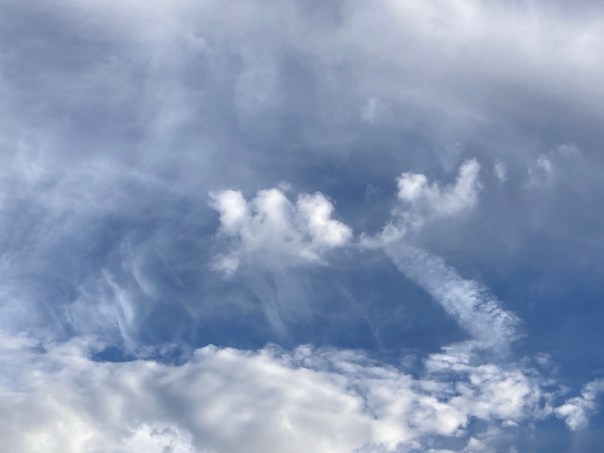
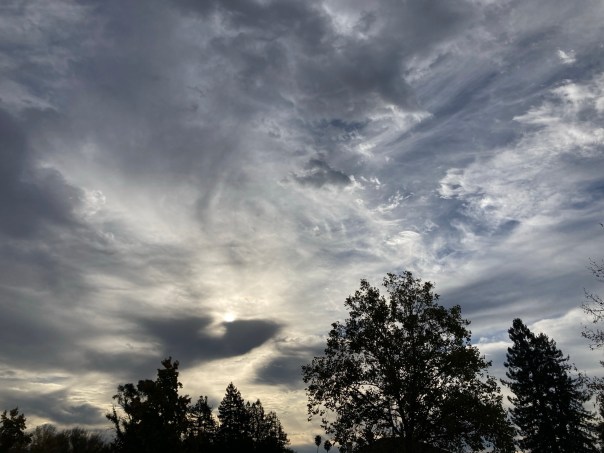
I recognized the remains of a jet stream (or chem trail?) as one element of that picture above, but there was so much else going on up there! I began to think about what Emerson said, that “The sky is the daily bread for the eyes.” I mused on how sometimes we are given all sorts of fancy bread, but at other times the sky is plain blue, or white, or gray….

After a short ride on the bus, I got off and started walking the rest of the way home, along a boulevard where I had plenty more of those big spaces to wonder at. I was struck by the realization that I was the only human on earth to whom each particular picture was given, because I was the only one at that GPS location, at that moment in the constantly changing arrangement of images.

If one lives in the big city, with skyscrapers hogging the sky, usually a little bit at least will peek through; I like to get my bearings occasionally by looking at whatever patches are available for viewing. Being in prison, though… now that would be hard. I guess they do often let at least some of the prisoners outside sometimes, but they might not feel safe and relaxed enough to feast on their daily bread in that setting.

Twice now I’ve started reading The Marvelous Clouds, and shared some quotes here. I reread some of Albert’s comments that I included in one post about the book ; he passed on some excerpts from an article about it, which is about media. One thing the author said was that “Clouds illustrate media ontology. [They] exist by disappearing.” 

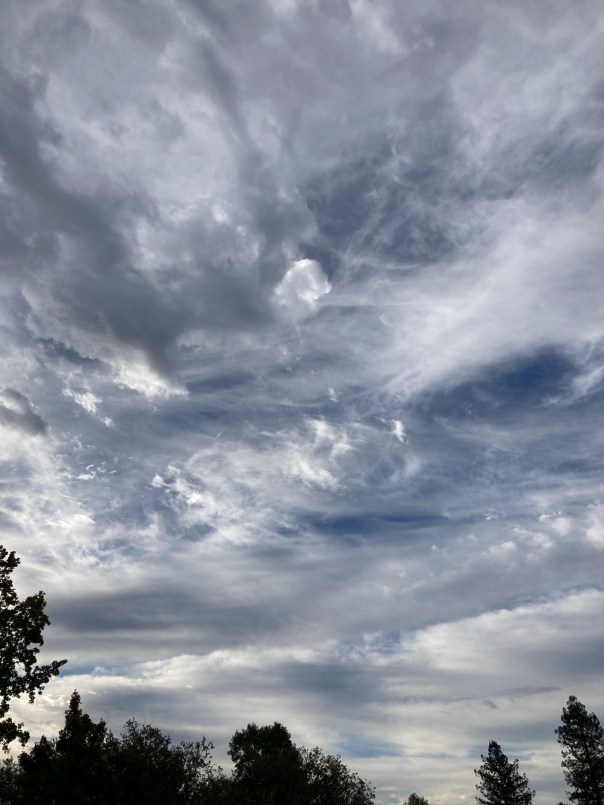
I gave that book away a while back. It’s very thought-provoking, to be sure, but I think if I had continued reading it I would have just been page by page arguing with the author over various things. I don’t like that he uses clouds for anything. I’d rather receive the gift of clouds as bread for my eyes. This arrangement of clouds below looked like it was pretending to be mountains in the distance:

The author of that book, John Durham Peters, also said that clouds are the original white noise. If you want to follow that thought, read the article linked in that more recent post of mine. But I think it’s more profitable for the soul to go out and look at the sky, whether there are clouds in it or not. When there are no clouds, or they have merged into a less enthralling picture, watching them might be like staring out at the ocean. It’s always moving, but it can be boring at the same time. Sometimes we need that plain bread. Feasting all the time is not good.

While my thoughts were on the clouds, my legs carried me into neighborhoods closer to mine, but I took a less familiar route and saw this beautiful plant that I found out is called a Common Lionspaw. I got distracted from the sky and started thinking about where I could fit one of those in my garden.

My cloud show seemed to go to intermission for a few minutes, with the actors going off stage — but quickly it started up again, as the sun began to break through.

Then, I was home again. It was time to start the rest of my day, and figure out what to eat… but my eyes had already had a big breakfast.